

294
A. V. Ravi et al.
from Curcuma longa (Packiavathy et al. 2013), phenyl acetic acid from Streptomyces humidus (Musthafa et al. 2012), sponge extracts (Annapoorani et al. 2012a),
phenolic and flavonoids such as rosmarinic acid, morin, naringin, chlorogenic acid
and mangiferin from edible fruits (Annapoorani et al. 2012b). Srinivasan et al. (2016)
demonstrated the promising anti-QS and antibiofilm activities of Piper betel leaves
extract and its active secondary metabolite phytol against S. marcescens infections.
In another report, Sivaranjani et al. (2016) identified the potential of morin as a
promising antibiofilm agent against biofilm associated infections caused by Listeria
monocytogenes.
The findings on QSIs against aquatic bacterial pathogens includes, the QSI activity
of cell free culture supernatants of marine Bacillus spp. reported by Nithya and
Pandian (2010) against QS dependent biofilm formation, exopolysaccharides production and bacterial attachment of Vibrio spp., such as V. harveyi, V. parahaemolyticus,
V. vulnificus and V. alginolyticus. Similarly, the anti-QS potential of natural compound
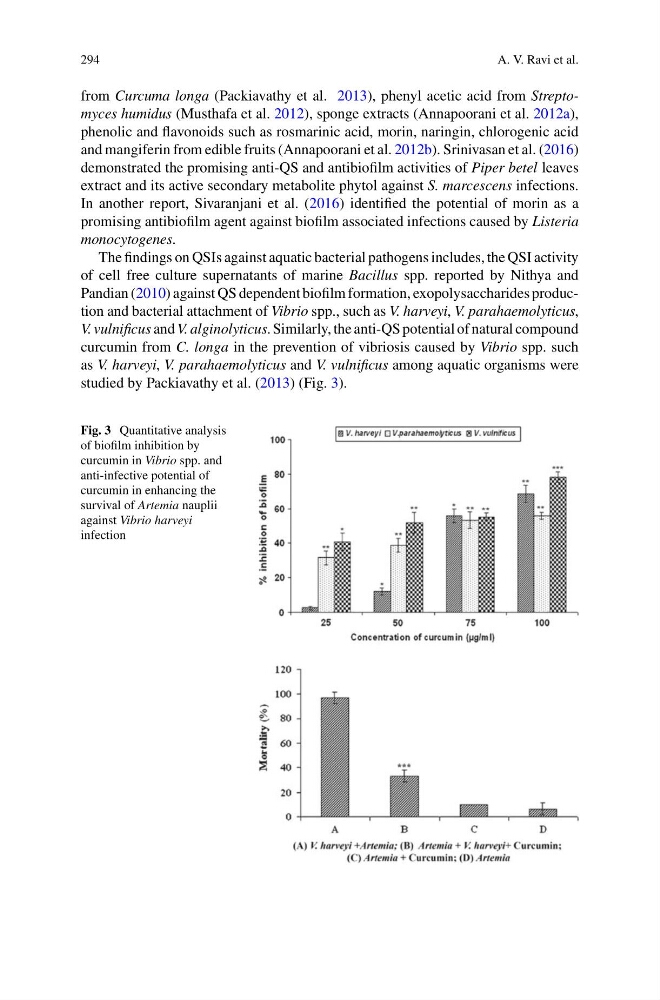
curcumin from C. longa in the prevention of vibriosis caused by Vibrio spp. such
as V. harveyi, V. parahaemolyticus and V. vulnificus among aquatic organisms were
studied by Packiavathy et al. (2013) (Fig. 3).
Fig. 3 Quantitative analysis
of biofilm inhibition by
curcumin in Vibrio spp. and
anti-infective potential of
curcumin in enhancing the
survival of Artemia nauplii
against Vibrio harveyi
infection
A. V. Ravi et al.
from Curcuma longa (Packiavathy et al. 2013), phenyl acetic acid from Streptomyces humidus (Musthafa et al. 2012), sponge extracts (Annapoorani et al. 2012a),
phenolic and flavonoids such as rosmarinic acid, morin, naringin, chlorogenic acid
and mangiferin from edible fruits (Annapoorani et al. 2012b). Srinivasan et al. (2016)
demonstrated the promising anti-QS and antibiofilm activities of Piper betel leaves
extract and its active secondary metabolite phytol against S. marcescens infections.
In another report, Sivaranjani et al. (2016) identified the potential of morin as a
promising antibiofilm agent against biofilm associated infections caused by Listeria
monocytogenes.
The findings on QSIs against aquatic bacterial pathogens includes, the QSI activity
of cell free culture supernatants of marine Bacillus spp. reported by Nithya and
Pandian (2010) against QS dependent biofilm formation, exopolysaccharides production and bacterial attachment of Vibrio spp., such as V. harveyi, V. parahaemolyticus,
V. vulnificus and V. alginolyticus. Similarly, the anti-QS potential of natural compound
curcumin from C. longa in the prevention of vibriosis caused by Vibrio spp. such
as V. harveyi, V. parahaemolyticus and V. vulnificus among aquatic organisms were
studied by Packiavathy et al. (2013) (Fig. 3).
Fig. 3 Quantitative analysis
of biofilm inhibition by
curcumin in Vibrio spp. and
anti-infective potential of
curcumin in enhancing the
survival of Artemia nauplii
against Vibrio harveyi
infection