

Bioremediation Approaches for Degradation …
115
1.2 Classification of Dyes
Dyes are defined as molecules with electronic systems delocalized with conjugates
double bonds which contain two groups such as chromophore and auxochrome.
Chromophore is a group of atoms; generally it is an electron withdrawing groups
and it controls the dye color. Examples for important chromophore group in dyes are
–C=N–, –N=N–, –C=C–, –C=O, –NO 2 and –NO. Auxochrome is a group of atoms,
generally it is an electron donor substituent group and it modifies the energy of the
electronic system which leads to intensify the color of the chromophore. Examples
for important auxochrome group in dyes are –NR 2 , –NH 2 , –SO 3 H, –NHR, –COOH,
–OH, –SO 3 H, and –OCH 3 (Aksu and Tezer 2005; Alhassani et al. 2007).
Textile dyes were classified as azo, diazo, basic, cationic, anthraquione and metal
complex based, depending on its chemical structure (Palanivelan et al. 2013). Chemical structure which is responsible for the color of the dyes was resistant to fading
on exposure to water, light and many chemicals. Based on the chemical structure
dyes are classified as cationic, anionic and nonionic. All these dyes have indigoid,
antroquinoid and azo aromatic structures. In UV visible area, these groups allow
strong π-π transitions with high extinction co-efficient. Among these three structures, most prevalent dye in the dye industry is azo aromatic. This azo dye has one
or more nitrogen–nitrogen double bonds (–N==N–). Based on the azo group, azo
dyes are called as mono-azo dyes, having two azo groups—di-azo dyes and tri-azo
dyes with greater than three azo linkages are labeled as polyazo dyes. Cost effectiveness and ease of synthesis, these azo dyes are being increasingly utilized in the
textile industries. The main disadvantages of these azo dyes that it cannot be easily
degraded by aerobic, anaerobic or microaerobic reductive bacteria (Shivangi 2012).
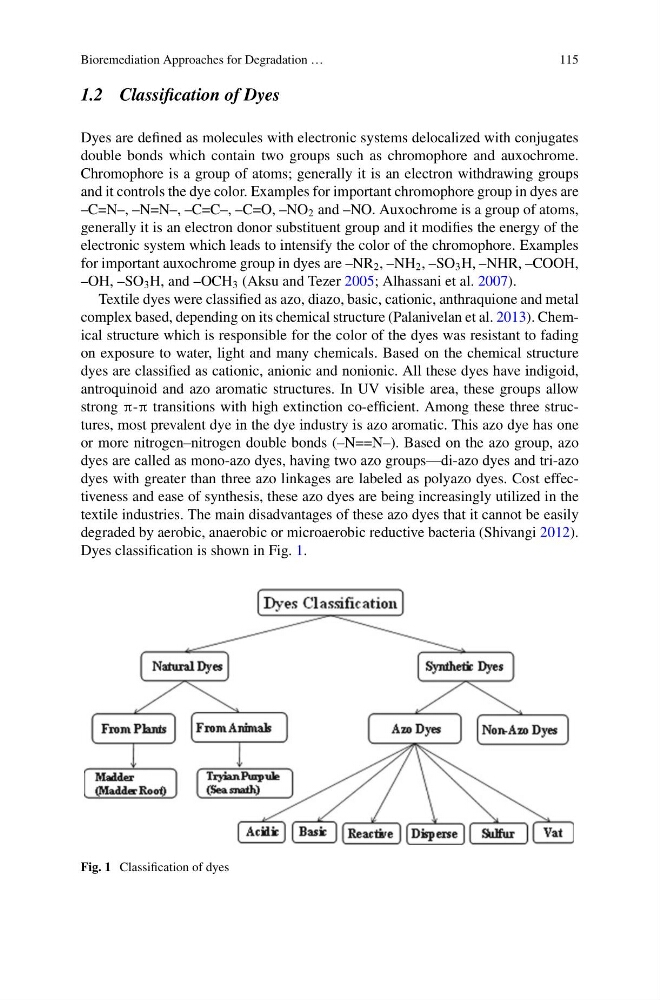
Dyes classification is shown in Fig. 1.
Fig. 1 Classification of dyes
115
1.2 Classification of Dyes
Dyes are defined as molecules with electronic systems delocalized with conjugates
double bonds which contain two groups such as chromophore and auxochrome.
Chromophore is a group of atoms; generally it is an electron withdrawing groups
and it controls the dye color. Examples for important chromophore group in dyes are
–C=N–, –N=N–, –C=C–, –C=O, –NO 2 and –NO. Auxochrome is a group of atoms,
generally it is an electron donor substituent group and it modifies the energy of the
electronic system which leads to intensify the color of the chromophore. Examples
for important auxochrome group in dyes are –NR 2 , –NH 2 , –SO 3 H, –NHR, –COOH,
–OH, –SO 3 H, and –OCH 3 (Aksu and Tezer 2005; Alhassani et al. 2007).
Textile dyes were classified as azo, diazo, basic, cationic, anthraquione and metal
complex based, depending on its chemical structure (Palanivelan et al. 2013). Chemical structure which is responsible for the color of the dyes was resistant to fading
on exposure to water, light and many chemicals. Based on the chemical structure
dyes are classified as cationic, anionic and nonionic. All these dyes have indigoid,
antroquinoid and azo aromatic structures. In UV visible area, these groups allow
strong π-π transitions with high extinction co-efficient. Among these three structures, most prevalent dye in the dye industry is azo aromatic. This azo dye has one
or more nitrogen–nitrogen double bonds (–N==N–). Based on the azo group, azo
dyes are called as mono-azo dyes, having two azo groups—di-azo dyes and tri-azo
dyes with greater than three azo linkages are labeled as polyazo dyes. Cost effectiveness and ease of synthesis, these azo dyes are being increasingly utilized in the
textile industries. The main disadvantages of these azo dyes that it cannot be easily
degraded by aerobic, anaerobic or microaerobic reductive bacteria (Shivangi 2012).
Dyes classification is shown in Fig. 1.
Fig. 1 Classification of dyes