

532
S. da Silva Neiva et al.
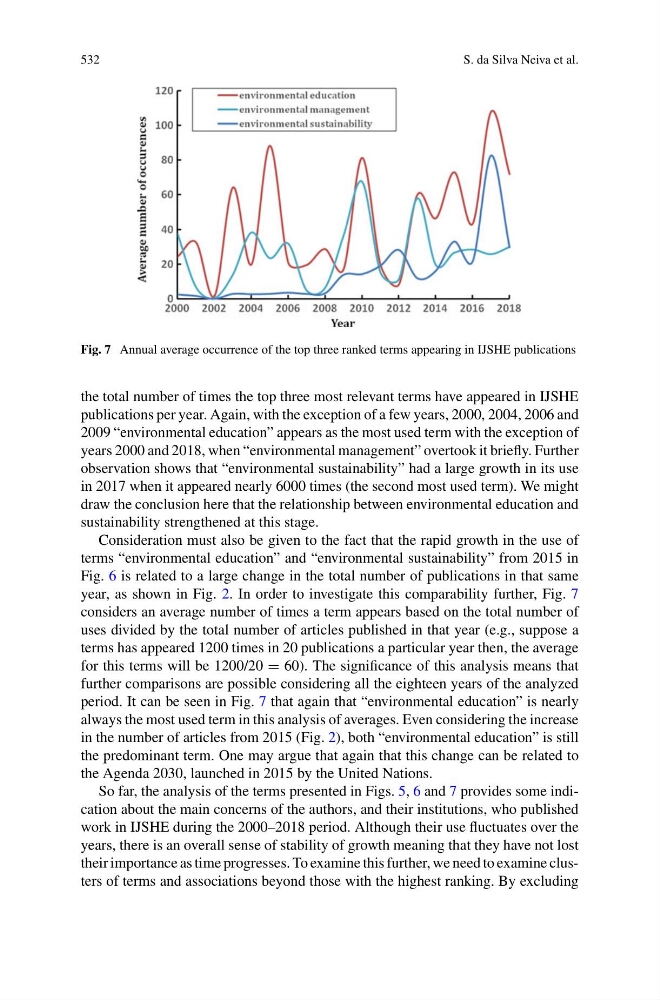
Fig. 7 Annual average occurrence of the top three ranked terms appearing in IJSHE publications
the total number of times the top three most relevant terms have appeared in IJSHE
publications per year. Again, with the exception of a few years, 2000, 2004, 2006 and
2009 “environmental education” appears as the most used term with the exception of
years 2000 and 2018, when “environmental management” overtook it briefly. Further
observation shows that “environmental sustainability” had a large growth in its use
in 2017 when it appeared nearly 6000 times (the second most used term). We might
draw the conclusion here that the relationship between environmental education and
sustainability strengthened at this stage.
Consideration must also be given to the fact that the rapid growth in the use of
terms “environmental education” and “environmental sustainability” from 2015 in
Fig. 6 is related to a large change in the total number of publications in that same
year, as shown in Fig. 2. In order to investigate this comparability further, Fig. 7
considers an average number of times a term appears based on the total number of
uses divided by the total number of articles published in that year (e.g., suppose a
terms has appeared 1200 times in 20 publications a particular year then, the average
for this terms will be 1200/20 = 60). The significance of this analysis means that
further comparisons are possible considering all the eighteen years of the analyzed
period. It can be seen in Fig. 7 that again that “environmental education” is nearly
always the most used term in this analysis of averages. Even considering the increase
in the number of articles from 2015 (Fig. 2), both “environmental education” is still
the predominant term. One may argue that again that this change can be related to
the Agenda 2030, launched in 2015 by the United Nations.
So far, the analysis of the terms presented in Figs. 5, 6 and 7 provides some indication about the main concerns of the authors, and their institutions, who published
work in IJSHE during the 2000–2018 period. Although their use fluctuates over the
years, there is an overall sense of stability of growth meaning that they have not lost
their importance as time progresses. To examine this further, we need to examine clusters of terms and associations beyond those with the highest ranking. By excluding
S. da Silva Neiva et al.
Fig. 7 Annual average occurrence of the top three ranked terms appearing in IJSHE publications
the total number of times the top three most relevant terms have appeared in IJSHE
publications per year. Again, with the exception of a few years, 2000, 2004, 2006 and
2009 “environmental education” appears as the most used term with the exception of
years 2000 and 2018, when “environmental management” overtook it briefly. Further
observation shows that “environmental sustainability” had a large growth in its use
in 2017 when it appeared nearly 6000 times (the second most used term). We might
draw the conclusion here that the relationship between environmental education and
sustainability strengthened at this stage.
Consideration must also be given to the fact that the rapid growth in the use of
terms “environmental education” and “environmental sustainability” from 2015 in
Fig. 6 is related to a large change in the total number of publications in that same
year, as shown in Fig. 2. In order to investigate this comparability further, Fig. 7
considers an average number of times a term appears based on the total number of
uses divided by the total number of articles published in that year (e.g., suppose a
terms has appeared 1200 times in 20 publications a particular year then, the average
for this terms will be 1200/20 = 60). The significance of this analysis means that
further comparisons are possible considering all the eighteen years of the analyzed
period. It can be seen in Fig. 7 that again that “environmental education” is nearly
always the most used term in this analysis of averages. Even considering the increase
in the number of articles from 2015 (Fig. 2), both “environmental education” is still
the predominant term. One may argue that again that this change can be related to
the Agenda 2030, launched in 2015 by the United Nations.
So far, the analysis of the terms presented in Figs. 5, 6 and 7 provides some indication about the main concerns of the authors, and their institutions, who published
work in IJSHE during the 2000–2018 period. Although their use fluctuates over the
years, there is an overall sense of stability of growth meaning that they have not lost
their importance as time progresses. To examine this further, we need to examine clusters of terms and associations beyond those with the highest ranking. By excluding