

Sustainable Development in Higher Education …
531
In relation to the term “environmental issues”, higher education institutions can
be of great help to educate on environmental issues through a variety of practical
activities that stimulate universities HEIs to participate in their programs (Figueredo
and Tsarenko 2013). Jarchow et al. (2018), presented in their study the importance
of “learning outcomes” for sustainability, from the evaluation of curricula of educational courses focused on sustainability and the measurement of student performance
throughout the duration of the course. Additionally, Hill and Wang (2018), consider
the learning outcomes serve to create, evaluate, share and apply knowledge so that
students can be prepared to be accountable leaders.
Christensen et al. (2009), present an analysis on how the HEIs can contribute
to sustainable development, through “environmental management”, from the implementation of new policies and plans and with the development of specific programs
for sustainability. Knowledge for environmental management can be carried out in
a number of ways, such as the creation of research groups, which include students
and researchers at various levels from undergraduate to doctoral and post-doctoral
to professorial. It is this extension from teaching and diffusion through to communities that attracts interdisciplinary relationships. Its adoption from environmental
management practices such as reduction, reuse and recycling, or awareness involves
all members of the HEI community, namely, students, academics and staff (Jabbour
2010). These observations from the data support the work of James and Card (2012),
who cited the main factors that contribute to environmental sustainability as being
green campuses, operational measures, campus administration, organization and
leadership, teaching and research.
Although the word cloud shown in Fig. 5 offers an immediate summary of the
results it only offers narrow view of the data and it would unwise to draw too many
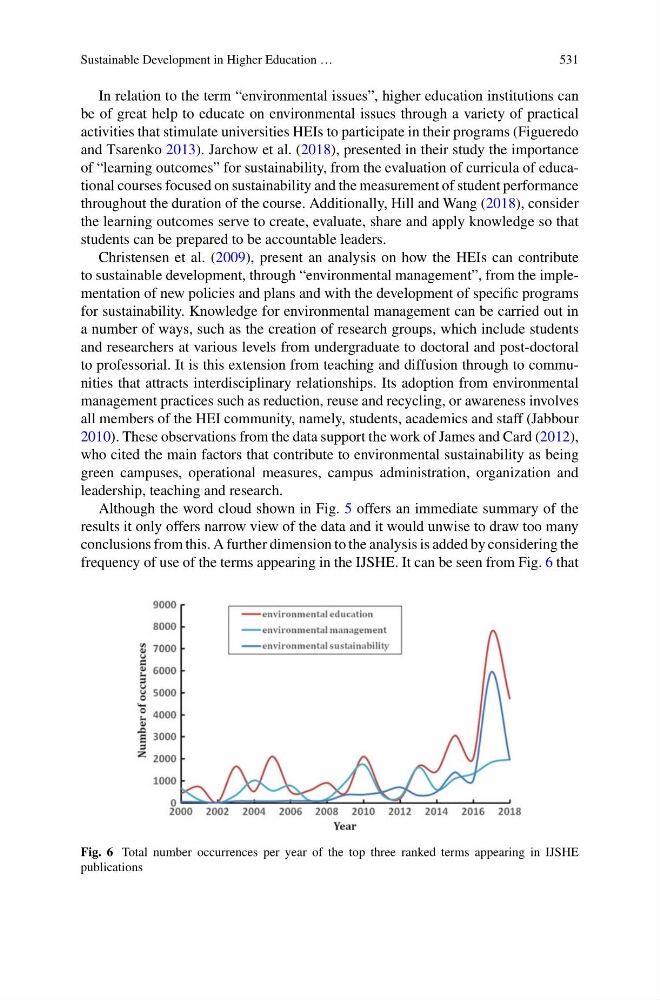
conclusions from this. A further dimension to the analysis is added by considering the
frequency of use of the terms appearing in the IJSHE. It can be seen from Fig. 6 that
Fig. 6 Total number occurrences per year of the top three ranked terms appearing in IJSHE
publications
531
In relation to the term “environmental issues”, higher education institutions can
be of great help to educate on environmental issues through a variety of practical
activities that stimulate universities HEIs to participate in their programs (Figueredo
and Tsarenko 2013). Jarchow et al. (2018), presented in their study the importance
of “learning outcomes” for sustainability, from the evaluation of curricula of educational courses focused on sustainability and the measurement of student performance
throughout the duration of the course. Additionally, Hill and Wang (2018), consider
the learning outcomes serve to create, evaluate, share and apply knowledge so that
students can be prepared to be accountable leaders.
Christensen et al. (2009), present an analysis on how the HEIs can contribute
to sustainable development, through “environmental management”, from the implementation of new policies and plans and with the development of specific programs
for sustainability. Knowledge for environmental management can be carried out in
a number of ways, such as the creation of research groups, which include students
and researchers at various levels from undergraduate to doctoral and post-doctoral
to professorial. It is this extension from teaching and diffusion through to communities that attracts interdisciplinary relationships. Its adoption from environmental
management practices such as reduction, reuse and recycling, or awareness involves
all members of the HEI community, namely, students, academics and staff (Jabbour
2010). These observations from the data support the work of James and Card (2012),
who cited the main factors that contribute to environmental sustainability as being
green campuses, operational measures, campus administration, organization and
leadership, teaching and research.
Although the word cloud shown in Fig. 5 offers an immediate summary of the
results it only offers narrow view of the data and it would unwise to draw too many
conclusions from this. A further dimension to the analysis is added by considering the
frequency of use of the terms appearing in the IJSHE. It can be seen from Fig. 6 that
Fig. 6 Total number occurrences per year of the top three ranked terms appearing in IJSHE
publications