

530
S. da Silva Neiva et al.
nations in these articles and in the academic debate regarding sustainability in HEIs
suggests that there is a great gap that can work as incentive for these regions to be
represented and share their own studies and experience with the academia.
The next phase of analysis process considers the validated frequency of use of
the terms appearing in articles. These results, shown in the Appendix, rank “environmental education”; “environmental management”, “environmental sustainability” as
the top three most used terms with “environmental studies” appearing in the tenth
position. By definition these focus on environmental concerns and from this we
might infer that authors in the IJSHE prioritize these in the programs and curricula
of HEIs. It may also reflect the influence of the 2030 Agenda and SDGs. Although
these high ranking terms are have obvious connections with SD, lower ranked terms
can still highlight important information about the HEI sector with regard to their
strategies for promoting sustainability in activities and programs. For example, other
frequently quoted terms that were validated as being relevant but not necessarily
related directly to the environmental sphere, are “engineering education”, “social
responsibility”, “engineering students”, “learning outcomes”, “teacher education”,
“social sciences” and “services learning”.
The final phase of the process is to present the results of the analysis in a concise
meaningful way that is readily understood by a target audience. A useful method of
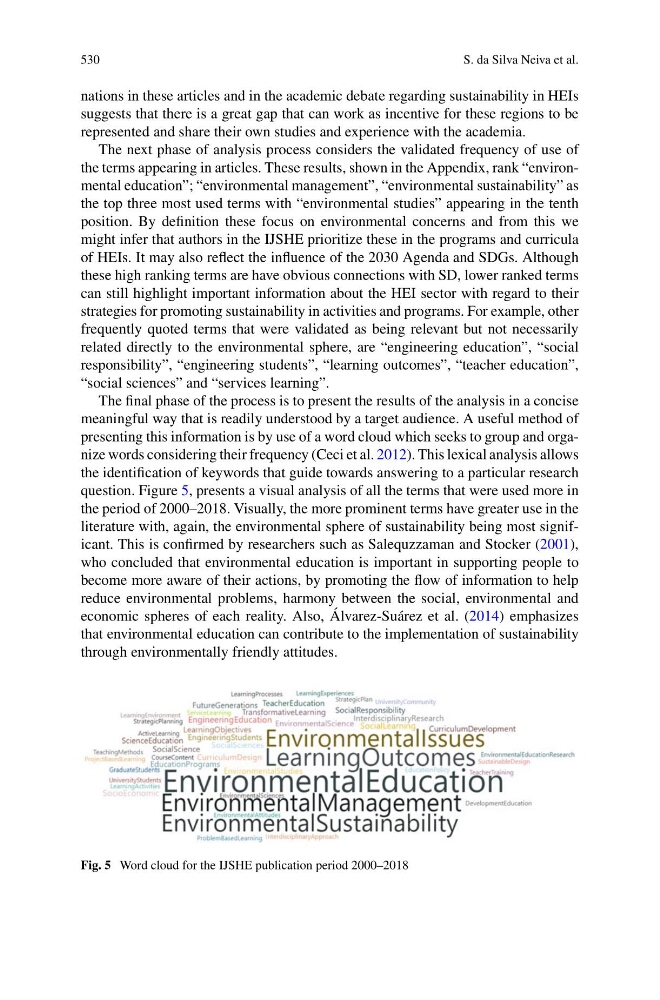
presenting this information is by use of a word cloud which seeks to group and organize words considering their frequency (Ceci et al. 2012). This lexical analysis allows
the identification of keywords that guide towards answering to a particular research
question. Figure 5, presents a visual analysis of all the terms that were used more in
the period of 2000–2018. Visually, the more prominent terms have greater use in the
literature with, again, the environmental sphere of sustainability being most significant. This is confirmed by researchers such as Salequzzaman and Stocker (2001),
who concluded that environmental education is important in supporting people to
become more aware of their actions, by promoting the flow of information to help
reduce environmental problems, harmony between the social, environmental and
economic spheres of each reality. Also, Álvarez-Suárez et al. (2014) emphasizes
that environmental education can contribute to the implementation of sustainability
through environmentally friendly attitudes.
Fig. 5 Word cloud for the IJSHE publication period 2000–2018
S. da Silva Neiva et al.
nations in these articles and in the academic debate regarding sustainability in HEIs
suggests that there is a great gap that can work as incentive for these regions to be
represented and share their own studies and experience with the academia.
The next phase of analysis process considers the validated frequency of use of
the terms appearing in articles. These results, shown in the Appendix, rank “environmental education”; “environmental management”, “environmental sustainability” as
the top three most used terms with “environmental studies” appearing in the tenth
position. By definition these focus on environmental concerns and from this we
might infer that authors in the IJSHE prioritize these in the programs and curricula
of HEIs. It may also reflect the influence of the 2030 Agenda and SDGs. Although
these high ranking terms are have obvious connections with SD, lower ranked terms
can still highlight important information about the HEI sector with regard to their
strategies for promoting sustainability in activities and programs. For example, other
frequently quoted terms that were validated as being relevant but not necessarily
related directly to the environmental sphere, are “engineering education”, “social
responsibility”, “engineering students”, “learning outcomes”, “teacher education”,
“social sciences” and “services learning”.
The final phase of the process is to present the results of the analysis in a concise
meaningful way that is readily understood by a target audience. A useful method of
presenting this information is by use of a word cloud which seeks to group and organize words considering their frequency (Ceci et al. 2012). This lexical analysis allows
the identification of keywords that guide towards answering to a particular research
question. Figure 5, presents a visual analysis of all the terms that were used more in
the period of 2000–2018. Visually, the more prominent terms have greater use in the
literature with, again, the environmental sphere of sustainability being most significant. This is confirmed by researchers such as Salequzzaman and Stocker (2001),
who concluded that environmental education is important in supporting people to
become more aware of their actions, by promoting the flow of information to help
reduce environmental problems, harmony between the social, environmental and
economic spheres of each reality. Also, Álvarez-Suárez et al. (2014) emphasizes
that environmental education can contribute to the implementation of sustainability
through environmentally friendly attitudes.
Fig. 5 Word cloud for the IJSHE publication period 2000–2018