

“The Value of Mixed Teaching Methods in the Context …
361
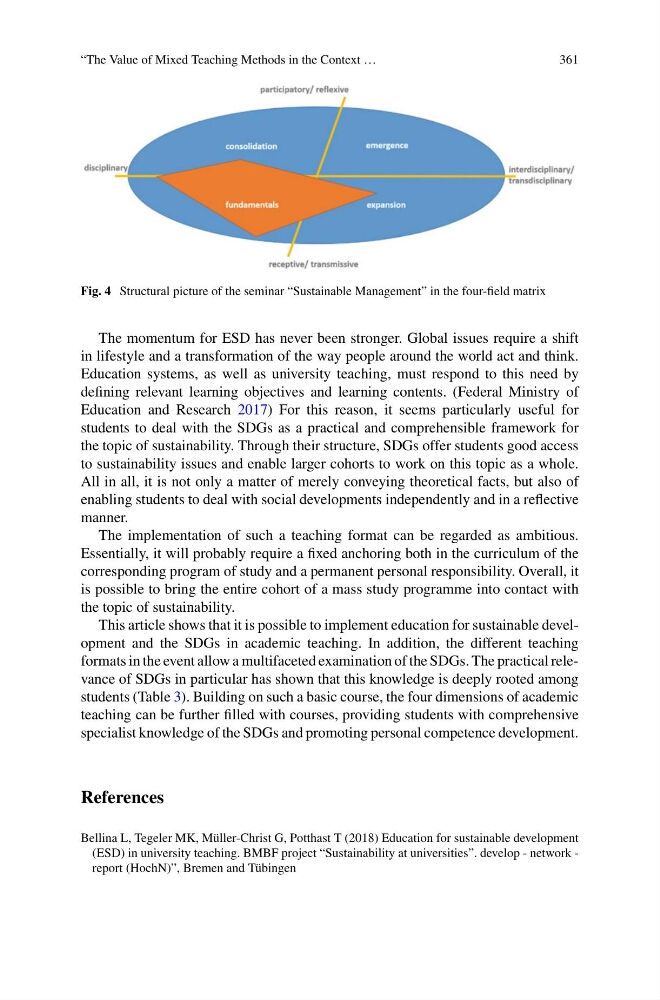
Fig. 4 Structural picture of the seminar “Sustainable Management” in the four-field matrix
The momentum for ESD has never been stronger. Global issues require a shift
in lifestyle and a transformation of the way people around the world act and think.
Education systems, as well as university teaching, must respond to this need by
defining relevant learning objectives and learning contents. (Federal Ministry of
Education and Research 2017) For this reason, it seems particularly useful for
students to deal with the SDGs as a practical and comprehensible framework for
the topic of sustainability. Through their structure, SDGs offer students good access
to sustainability issues and enable larger cohorts to work on this topic as a whole.
All in all, it is not only a matter of merely conveying theoretical facts, but also of
enabling students to deal with social developments independently and in a reflective
manner.
The implementation of such a teaching format can be regarded as ambitious.
Essentially, it will probably require a fixed anchoring both in the curriculum of the
corresponding program of study and a permanent personal responsibility. Overall, it
is possible to bring the entire cohort of a mass study programme into contact with
the topic of sustainability.
This article shows that it is possible to implement education for sustainable development and the SDGs in academic teaching. In addition, the different teaching
formats in the event allow a multifaceted examination of the SDGs. The practical relevance of SDGs in particular has shown that this knowledge is deeply rooted among
students (Table 3). Building on such a basic course, the four dimensions of academic
teaching can be further filled with courses, providing students with comprehensive
specialist knowledge of the SDGs and promoting personal competence development.
References
Bellina L, Tegeler MK, Müller-Christ G, Potthast T (2018) Education for sustainable development
(ESD) in university teaching. BMBF project “Sustainability at universities”. develop - network -
report (HochN)”, Bremen and Tübingen
361
Fig. 4 Structural picture of the seminar “Sustainable Management” in the four-field matrix
The momentum for ESD has never been stronger. Global issues require a shift
in lifestyle and a transformation of the way people around the world act and think.
Education systems, as well as university teaching, must respond to this need by
defining relevant learning objectives and learning contents. (Federal Ministry of
Education and Research 2017) For this reason, it seems particularly useful for
students to deal with the SDGs as a practical and comprehensible framework for
the topic of sustainability. Through their structure, SDGs offer students good access
to sustainability issues and enable larger cohorts to work on this topic as a whole.
All in all, it is not only a matter of merely conveying theoretical facts, but also of
enabling students to deal with social developments independently and in a reflective
manner.
The implementation of such a teaching format can be regarded as ambitious.
Essentially, it will probably require a fixed anchoring both in the curriculum of the
corresponding program of study and a permanent personal responsibility. Overall, it
is possible to bring the entire cohort of a mass study programme into contact with
the topic of sustainability.
This article shows that it is possible to implement education for sustainable development and the SDGs in academic teaching. In addition, the different teaching
formats in the event allow a multifaceted examination of the SDGs. The practical relevance of SDGs in particular has shown that this knowledge is deeply rooted among
students (Table 3). Building on such a basic course, the four dimensions of academic
teaching can be further filled with courses, providing students with comprehensive
specialist knowledge of the SDGs and promoting personal competence development.
References
Bellina L, Tegeler MK, Müller-Christ G, Potthast T (2018) Education for sustainable development
(ESD) in university teaching. BMBF project “Sustainability at universities”. develop - network -
report (HochN)”, Bremen and Tübingen