

Students’ Perception of Campus Sustainability …
299
6.4 Model Performance and Sustainability Perception
for the Case Study
As a result of the principal component analysis, the 31 remaining items of the final
model (Table 5) are related to five of the eight dimensions of the higher education
sustainability model designed by Lozano et al. (2015), described in Table 1.
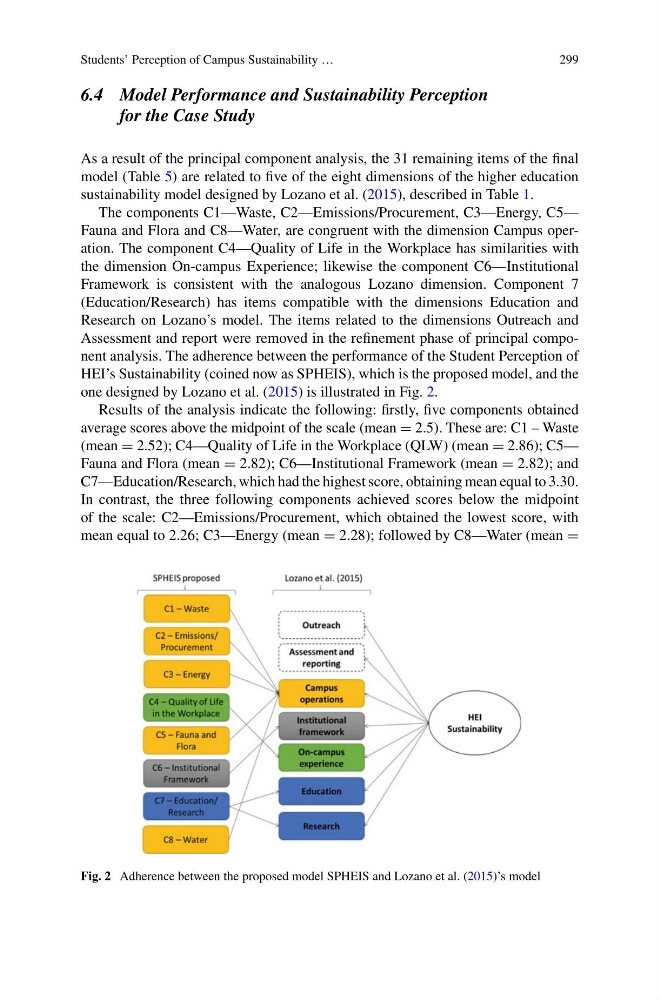
The components C1—Waste, C2—Emissions/Procurement, C3—Energy, C5—
Fauna and Flora and C8—Water, are congruent with the dimension Campus operation. The component C4—Quality of Life in the Workplace has similarities with
the dimension On-campus Experience; likewise the component C6—Institutional
Framework is consistent with the analogous Lozano dimension. Component 7
(Education/Research) has items compatible with the dimensions Education and
Research on Lozano’s model. The items related to the dimensions Outreach and
Assessment and report were removed in the refinement phase of principal component analysis. The adherence between the performance of the Student Perception of
HEI’s Sustainability (coined now as SPHEIS), which is the proposed model, and the
one designed by Lozano et al. (2015) is illustrated in Fig. 2.
Results of the analysis indicate the following: firstly, five components obtained
average scores above the midpoint of the scale (mean = 2.5). These are: C1 – Waste
(mean = 2.52); C4—Quality of Life in the Workplace (QLW) (mean = 2.86); C5—
Fauna and Flora (mean = 2.82); C6—Institutional Framework (mean = 2.82); and
C7—Education/Research, which had the highest score, obtaining mean equal to 3.30.
In contrast, the three following components achieved scores below the midpoint
of the scale: C2—Emissions/Procurement, which obtained the lowest score, with
mean equal to 2.26; C3—Energy (mean = 2.28); followed by C8—Water (mean =
Fig. 2 Adherence between the proposed model SPHEIS and Lozano et al. (2015)’s model
299
6.4 Model Performance and Sustainability Perception
for the Case Study
As a result of the principal component analysis, the 31 remaining items of the final
model (Table 5) are related to five of the eight dimensions of the higher education
sustainability model designed by Lozano et al. (2015), described in Table 1.
The components C1—Waste, C2—Emissions/Procurement, C3—Energy, C5—
Fauna and Flora and C8—Water, are congruent with the dimension Campus operation. The component C4—Quality of Life in the Workplace has similarities with
the dimension On-campus Experience; likewise the component C6—Institutional
Framework is consistent with the analogous Lozano dimension. Component 7
(Education/Research) has items compatible with the dimensions Education and
Research on Lozano’s model. The items related to the dimensions Outreach and
Assessment and report were removed in the refinement phase of principal component analysis. The adherence between the performance of the Student Perception of
HEI’s Sustainability (coined now as SPHEIS), which is the proposed model, and the
one designed by Lozano et al. (2015) is illustrated in Fig. 2.
Results of the analysis indicate the following: firstly, five components obtained
average scores above the midpoint of the scale (mean = 2.5). These are: C1 – Waste
(mean = 2.52); C4—Quality of Life in the Workplace (QLW) (mean = 2.86); C5—
Fauna and Flora (mean = 2.82); C6—Institutional Framework (mean = 2.82); and
C7—Education/Research, which had the highest score, obtaining mean equal to 3.30.
In contrast, the three following components achieved scores below the midpoint
of the scale: C2—Emissions/Procurement, which obtained the lowest score, with
mean equal to 2.26; C3—Energy (mean = 2.28); followed by C8—Water (mean =
Fig. 2 Adherence between the proposed model SPHEIS and Lozano et al. (2015)’s model