

300
C. R. P. Vasconcelos et al.
2.52
2.26
2.28
2.86
3.03
2.82
3.3
2.27
2.67
2
2.2
2.4
2.6
2.8
3
3.2
3.4
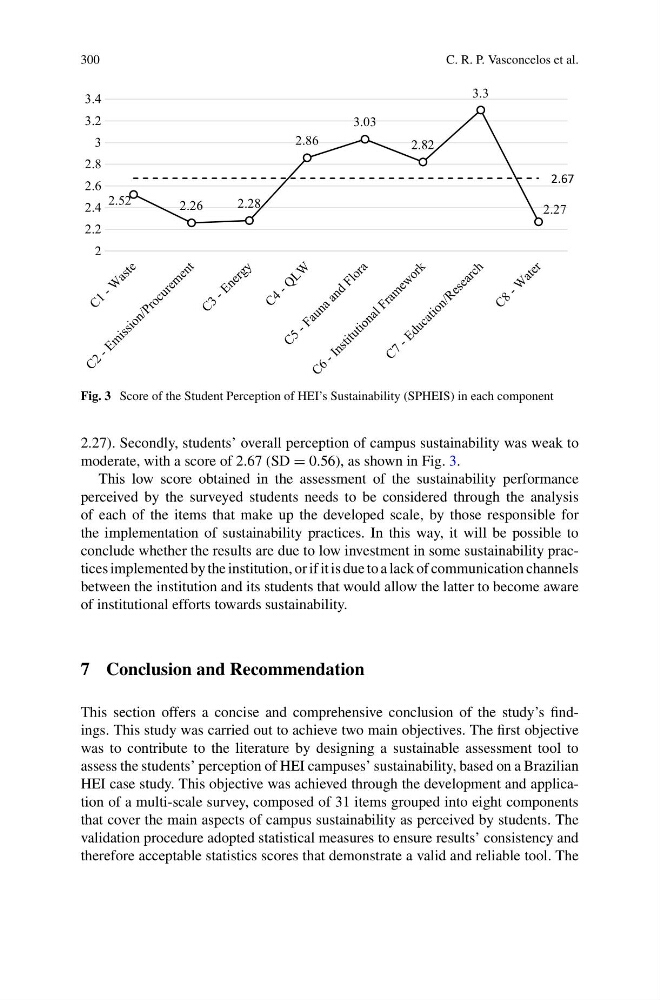
Fig. 3 Score of the Student Perception of HEI’s Sustainability (SPHEIS) in each component
2.27). Secondly, students’ overall perception of campus sustainability was weak to
moderate, with a score of 2.67 (SD = 0.56), as shown in Fig. 3.
This low score obtained in the assessment of the sustainability performance
perceived by the surveyed students needs to be considered through the analysis
of each of the items that make up the developed scale, by those responsible for
the implementation of sustainability practices. In this way, it will be possible to
conclude whether the results are due to low investment in some sustainability practices implemented by the institution, or if it is due to a lack of communication channels
between the institution and its students that would allow the latter to become aware
of institutional efforts towards sustainability.
7 Conclusion and Recommendation
This section offers a concise and comprehensive conclusion of the study’s findings. This study was carried out to achieve two main objectives. The first objective
was to contribute to the literature by designing a sustainable assessment tool to
assess the students’ perception of HEI campuses’ sustainability, based on a Brazilian
HEI case study. This objective was achieved through the development and application of a multi-scale survey, composed of 31 items grouped into eight components
that cover the main aspects of campus sustainability as perceived by students. The
validation procedure adopted statistical measures to ensure results’ consistency and
therefore acceptable statistics scores that demonstrate a valid and reliable tool. The
C. R. P. Vasconcelos et al.
2.52
2.26
2.28
2.86
3.03
2.82
3.3
2.27
2.67
2
2.2
2.4
2.6
2.8
3
3.2
3.4
Fig. 3 Score of the Student Perception of HEI’s Sustainability (SPHEIS) in each component
2.27). Secondly, students’ overall perception of campus sustainability was weak to
moderate, with a score of 2.67 (SD = 0.56), as shown in Fig. 3.
This low score obtained in the assessment of the sustainability performance
perceived by the surveyed students needs to be considered through the analysis
of each of the items that make up the developed scale, by those responsible for
the implementation of sustainability practices. In this way, it will be possible to
conclude whether the results are due to low investment in some sustainability practices implemented by the institution, or if it is due to a lack of communication channels
between the institution and its students that would allow the latter to become aware
of institutional efforts towards sustainability.
7 Conclusion and Recommendation
This section offers a concise and comprehensive conclusion of the study’s findings. This study was carried out to achieve two main objectives. The first objective
was to contribute to the literature by designing a sustainable assessment tool to
assess the students’ perception of HEI campuses’ sustainability, based on a Brazilian
HEI case study. This objective was achieved through the development and application of a multi-scale survey, composed of 31 items grouped into eight components
that cover the main aspects of campus sustainability as perceived by students. The
validation procedure adopted statistical measures to ensure results’ consistency and
therefore acceptable statistics scores that demonstrate a valid and reliable tool. The