

369
cessed with certain statistical tools, can provide identification data. Therefore, after
the chemical characterization of the samples, the obtained information on the contents of the elements is normalized by logarithmic transformation, and component
analysis and cluster analysis are applied. In both cases there is a clear identification
of the two groups depending on the geographical area (Figs. 12.4 and 12.5). Thus,
the model proved to be a successful and useful tool in the process of determining/
confirming the geographical origin of the samples.
12.6 General Conclusions and Perspectives
Determination of the geographical origin of food and beverages has been a growing
issue over the past decade for all countries around the world, mostly because of the
concern of consumers about the authenticity of the food that they eat. An increasing
number of research articles in the past 5 years have investigated the elemental composition and the isotope ratios as indicators to determine the origin of food and
beverages. The proposed investigation will be the first attempt of application of a
validated method including multi-element and multi-isotope chemical characterization and the statistical tools in order to use for determination of the geographical
origin of food and beverages. Comparative analysis can help in improving the largescale application. Isotope ratio mass spectrometry is a promising tool for origin
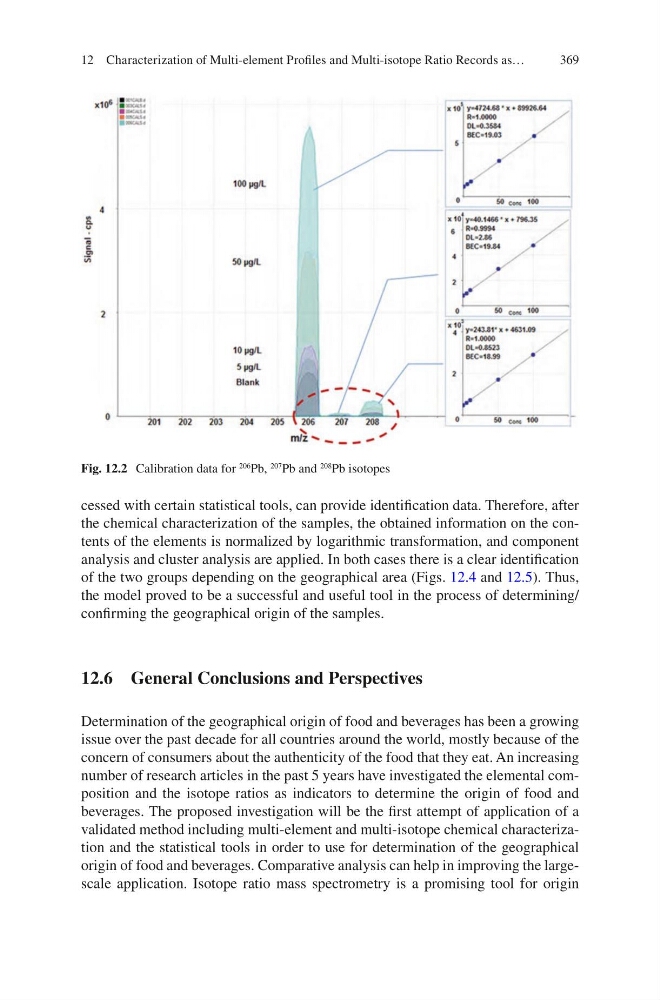
Fig. 12.2 Calibration data for
206
Pb,
207 Pb and
208
Pb isotopes
12 Characterization of Multi-element Profiles and Multi-isotope Ratio Records as…
cessed with certain statistical tools, can provide identification data. Therefore, after
the chemical characterization of the samples, the obtained information on the contents of the elements is normalized by logarithmic transformation, and component
analysis and cluster analysis are applied. In both cases there is a clear identification
of the two groups depending on the geographical area (Figs. 12.4 and 12.5). Thus,
the model proved to be a successful and useful tool in the process of determining/
confirming the geographical origin of the samples.
12.6 General Conclusions and Perspectives
Determination of the geographical origin of food and beverages has been a growing
issue over the past decade for all countries around the world, mostly because of the
concern of consumers about the authenticity of the food that they eat. An increasing
number of research articles in the past 5 years have investigated the elemental composition and the isotope ratios as indicators to determine the origin of food and
beverages. The proposed investigation will be the first attempt of application of a
validated method including multi-element and multi-isotope chemical characterization and the statistical tools in order to use for determination of the geographical
origin of food and beverages. Comparative analysis can help in improving the largescale application. Isotope ratio mass spectrometry is a promising tool for origin
Fig. 12.2 Calibration data for
206
Pb,
207 Pb and
208
Pb isotopes
12 Characterization of Multi-element Profiles and Multi-isotope Ratio Records as…