

225
residence of analytes into the injection port. The technique is known as “pulsed
pressure injection” and it was first introduced by Wylie et al. (1991), who investigated the impact of the pulsed pressure on sample discrimination and allowable
injection volumes in the analysis performed on a gas chromatograph coupled to
atomic emission detector (AED) and GC equipped with flame ionization detector
(FID). The authors also investigated the effect of pulsed pressure on the decomposition of two labile pesticides endrin and 4,4′–DDT and the carbamate pesticide, carbaryl, using GC coupled to atomic emission (AED), electron capture (ECD), and
flame ionization detection. The result showed a substantial reduction of analyte
decomposition for aldrin, 4,4′-DDT, and modest improvements for carbaryl. After
that many researchers investigated the behavior of various compounds when pulsed
pressure injection is used. Godula et al. (1999) in their study come to the conclusion
that for achieving good responses for all analytes especially the low volatiles, the
pressure- time should not exceed 1 min and the intensity of 60 psi. The authors also
noticed that the injection of sample volumes greater than 1 μl causes peak distortion
unless a retention gap is used. Wylie et al. (1991, 1992) observed that increased
pressure during the injection significantly reduce the decomposition of aldrin, DDT,
and aldicarb. Next, the authors investigate six organophosphorus pesticides and
conclude that the pulsed pressure injection dramatically improves the recovery of
notoriously difficult pesticide acephate (Wylie and Uchiyama 1996). The behavior
of nine thermally labile nonvolatile (benalaxyl, buprofezin, chlorpyrifos, malathion,
methomyl, metribuzin, pirimiphos methyl, pyrimethanil, and triadimenol) and two
thermally stable, nonvolatile pesticides (penconazole and pirimicarb) when
increased pressure of 10 psi, 20 psi, 30 psi, 40 psi, and 50 psi and vent time of 0.5
and 1.5 min are used during the time of injection is investigated in this study.
The obtained results as peak response and response factors were compared with
the peak response and the response factor when the classical hot splitless injection
is used and expressed as a percentage of improvement. The physical and chemical
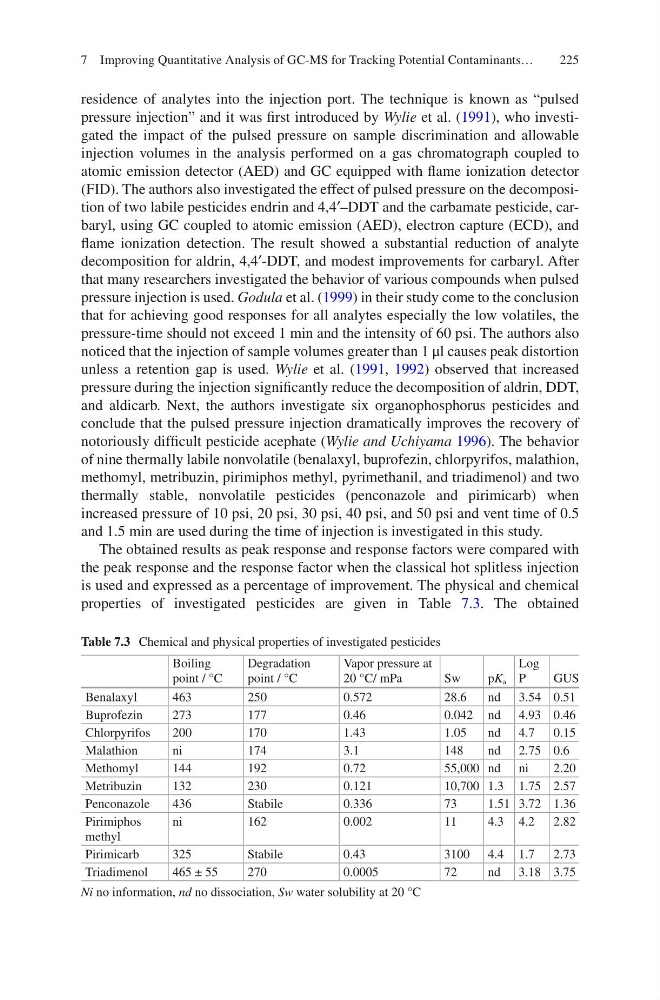
properties of investigated pesticides are given in Table 7.3. The obtained
Table 7.3 Chemical and physical properties of investigated pesticides
Boiling
point / °C
Degradation
point / °C
Vapor pressure at
20 °C/ mPa
Sw
pK a
Log
P
GUS
Benalaxyl
463
250
0.572
28.6
nd 3.54 0.51
Buprofezin
273
177
0.46
0.042 nd 4.93 0.46
Chlorpyrifos
200
170
1.43
1.05
nd 4.7 0.15
Malathion
ni
174
3.1
148
nd 2.75 0.6
Methomyl
144
192
0.72
55,000 nd ni
2.20
Metribuzin
132
230
0.121
10,700 1.3 1.75 2.57
Penconazole
436
Stabile
0.336
73
1.51 3.72 1.36
Pirimiphos
methyl
ni
162
0.002
11
4.3 4.2 2.82
Pirimicarb
325
Stabile
0.43
3100 4.4 1.7 2.73
Triadimenol
465 ± 55
270
0.0005
72
nd 3.18 3.75
Ni no information, nd no dissociation, Sw water solubility at 20 °C
7 Improving Quantitative Analysis of GC-MS for Tracking Potential Contaminants…
residence of analytes into the injection port. The technique is known as “pulsed
pressure injection” and it was first introduced by Wylie et al. (1991), who investigated the impact of the pulsed pressure on sample discrimination and allowable
injection volumes in the analysis performed on a gas chromatograph coupled to
atomic emission detector (AED) and GC equipped with flame ionization detector
(FID). The authors also investigated the effect of pulsed pressure on the decomposition of two labile pesticides endrin and 4,4′–DDT and the carbamate pesticide, carbaryl, using GC coupled to atomic emission (AED), electron capture (ECD), and
flame ionization detection. The result showed a substantial reduction of analyte
decomposition for aldrin, 4,4′-DDT, and modest improvements for carbaryl. After
that many researchers investigated the behavior of various compounds when pulsed
pressure injection is used. Godula et al. (1999) in their study come to the conclusion
that for achieving good responses for all analytes especially the low volatiles, the
pressure- time should not exceed 1 min and the intensity of 60 psi. The authors also
noticed that the injection of sample volumes greater than 1 μl causes peak distortion
unless a retention gap is used. Wylie et al. (1991, 1992) observed that increased
pressure during the injection significantly reduce the decomposition of aldrin, DDT,
and aldicarb. Next, the authors investigate six organophosphorus pesticides and
conclude that the pulsed pressure injection dramatically improves the recovery of
notoriously difficult pesticide acephate (Wylie and Uchiyama 1996). The behavior
of nine thermally labile nonvolatile (benalaxyl, buprofezin, chlorpyrifos, malathion,
methomyl, metribuzin, pirimiphos methyl, pyrimethanil, and triadimenol) and two
thermally stable, nonvolatile pesticides (penconazole and pirimicarb) when
increased pressure of 10 psi, 20 psi, 30 psi, 40 psi, and 50 psi and vent time of 0.5
and 1.5 min are used during the time of injection is investigated in this study.
The obtained results as peak response and response factors were compared with
the peak response and the response factor when the classical hot splitless injection
is used and expressed as a percentage of improvement. The physical and chemical
properties of investigated pesticides are given in Table 7.3. The obtained
Table 7.3 Chemical and physical properties of investigated pesticides
Boiling
point / °C
Degradation
point / °C
Vapor pressure at
20 °C/ mPa
Sw
pK a
Log
P
GUS
Benalaxyl
463
250
0.572
28.6
nd 3.54 0.51
Buprofezin
273
177
0.46
0.042 nd 4.93 0.46
Chlorpyrifos
200
170
1.43
1.05
nd 4.7 0.15
Malathion
ni
174
3.1
148
nd 2.75 0.6
Methomyl
144
192
0.72
55,000 nd ni
2.20
Metribuzin
132
230
0.121
10,700 1.3 1.75 2.57
Penconazole
436
Stabile
0.336
73
1.51 3.72 1.36
Pirimiphos
methyl
ni
162
0.002
11
4.3 4.2 2.82
Pirimicarb
325
Stabile
0.43
3100 4.4 1.7 2.73
Triadimenol
465 ± 55
270
0.0005
72
nd 3.18 3.75
Ni no information, nd no dissociation, Sw water solubility at 20 °C
7 Improving Quantitative Analysis of GC-MS for Tracking Potential Contaminants…