

224
90323L) with deactivated borosilicate wool and single restriction, 3 mm ID and
750 μl maximum volume capacity, was used in all experiments. For the separation
of analytes, DB-5 ms Supelco column (30 m × 0.25 mm × 0.25 μm) was used with
helium as a carrier gas and a total flow of 1 ml/min. The mass spectrometer was
operated in electron ionization mode with ionizing energy of 70 eV, MS quadrupole
temperature 150 °C, and solvent delay of 4.3 min. The analysis was performed in
the selected ion monitoring mode (SIM) based on one target and two qualifier ions.
The method was validated evaluating the linearity, recoveries, LOD, LOQ, and
precision.
7.2.3.4 Data Processing and Statistical Analysis
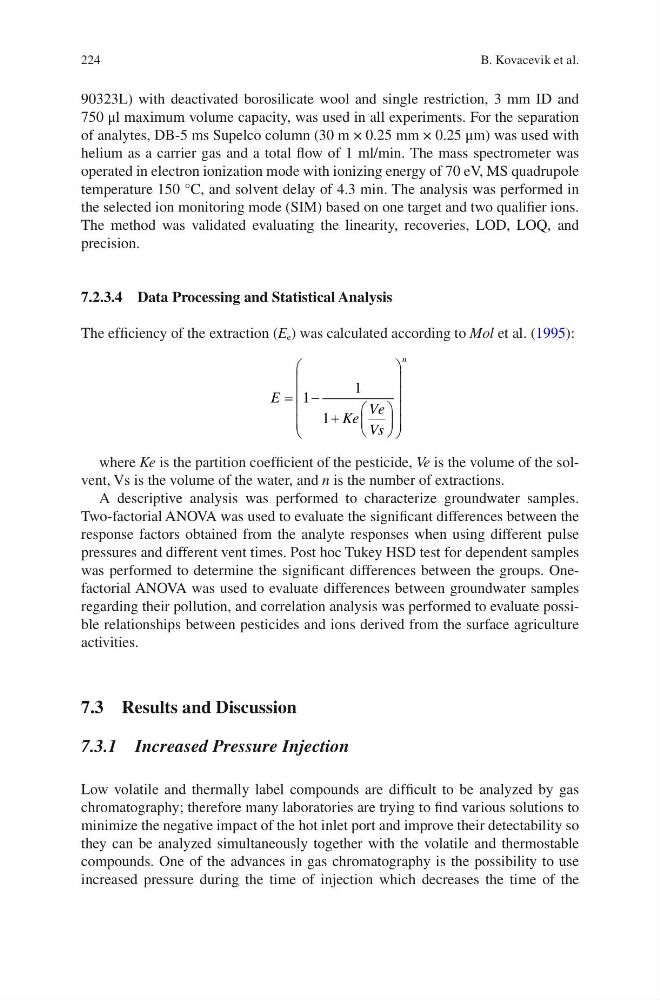
The efficiency of the extraction (E e ) was calculated according to Mol et al. (1995):
E
Ke
Ve
Vs
n
= −
+
1
1
1
where Ke is the partition coefficient of the pesticide, Ve is the volume of the solvent, Vs is the volume of the water, and n is the number of extractions.
A descriptive analysis was performed to characterize groundwater samples.
Two-factorial ANOVA was used to evaluate the significant differences between the
response factors obtained from the analyte responses when using different pulse
pressures and different vent times. Post hoc Tukey HSD test for dependent samples
was performed to determine the significant differences between the groups. Onefactorial ANOVA was used to evaluate differences between groundwater samples
regarding their pollution, and correlation analysis was performed to evaluate possible relationships between pesticides and ions derived from the surface agriculture
activities.
7.3 Results and Discussion
7.3.1 Increased Pressure Injection
Low volatile and thermally label compounds are difficult to be analyzed by gas
chromatography; therefore many laboratories are trying to find various solutions to
minimize the negative impact of the hot inlet port and improve their detectability so
they can be analyzed simultaneously together with the volatile and thermostable
compounds. One of the advances in gas chromatography is the possibility to use
increased pressure during the time of injection which decreases the time of the
B. Kovacevik et al.
90323L) with deactivated borosilicate wool and single restriction, 3 mm ID and
750 μl maximum volume capacity, was used in all experiments. For the separation
of analytes, DB-5 ms Supelco column (30 m × 0.25 mm × 0.25 μm) was used with
helium as a carrier gas and a total flow of 1 ml/min. The mass spectrometer was
operated in electron ionization mode with ionizing energy of 70 eV, MS quadrupole
temperature 150 °C, and solvent delay of 4.3 min. The analysis was performed in
the selected ion monitoring mode (SIM) based on one target and two qualifier ions.
The method was validated evaluating the linearity, recoveries, LOD, LOQ, and
precision.
7.2.3.4 Data Processing and Statistical Analysis
The efficiency of the extraction (E e ) was calculated according to Mol et al. (1995):
E
Ke
Ve
Vs
n
= −
+
1
1
1
where Ke is the partition coefficient of the pesticide, Ve is the volume of the solvent, Vs is the volume of the water, and n is the number of extractions.
A descriptive analysis was performed to characterize groundwater samples.
Two-factorial ANOVA was used to evaluate the significant differences between the
response factors obtained from the analyte responses when using different pulse
pressures and different vent times. Post hoc Tukey HSD test for dependent samples
was performed to determine the significant differences between the groups. Onefactorial ANOVA was used to evaluate differences between groundwater samples
regarding their pollution, and correlation analysis was performed to evaluate possible relationships between pesticides and ions derived from the surface agriculture
activities.
7.3 Results and Discussion
7.3.1 Increased Pressure Injection
Low volatile and thermally label compounds are difficult to be analyzed by gas
chromatography; therefore many laboratories are trying to find various solutions to
minimize the negative impact of the hot inlet port and improve their detectability so
they can be analyzed simultaneously together with the volatile and thermostable
compounds. One of the advances in gas chromatography is the possibility to use
increased pressure during the time of injection which decreases the time of the
B. Kovacevik et al.