

Carbon Footprint of Karnataka: Accounting of Sources and Sinks
81
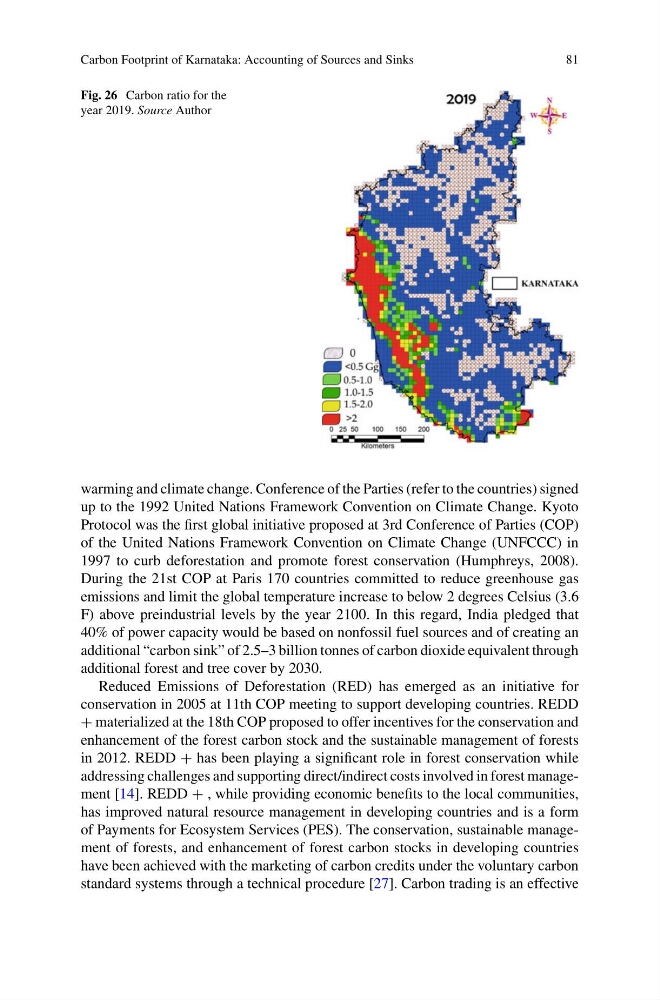
Fig. 26 Carbon ratio for the
year 2019. Source Author
warming and climate change. Conference of the Parties (refer to the countries) signed
up to the 1992 United Nations Framework Convention on Climate Change. Kyoto
Protocol was the first global initiative proposed at 3rd Conference of Parties (COP)
of the United Nations Framework Convention on Climate Change (UNFCCC) in
1997 to curb deforestation and promote forest conservation (Humphreys, 2008).
During the 21st COP at Paris 170 countries committed to reduce greenhouse gas
emissions and limit the global temperature increase to below 2 degrees Celsius (3.6
F) above preindustrial levels by the year 2100. In this regard, India pledged that
40% of power capacity would be based on nonfossil fuel sources and of creating an
additional “carbon sink” of 2.5–3 billion tonnes of carbon dioxide equivalent through
additional forest and tree cover by 2030.
Reduced Emissions of Deforestation (RED) has emerged as an initiative for
conservation in 2005 at 11th COP meeting to support developing countries. REDD
+ materialized at the 18th COP proposed to offer incentives for the conservation and
enhancement of the forest carbon stock and the sustainable management of forests
in 2012. REDD + has been playing a significant role in forest conservation while
addressing challenges and supporting direct/indirect costs involved in forest management [14]. REDD + , while providing economic benefits to the local communities,
has improved natural resource management in developing countries and is a form
of Payments for Ecosystem Services (PES). The conservation, sustainable management of forests, and enhancement of forest carbon stocks in developing countries
have been achieved with the marketing of carbon credits under the voluntary carbon
standard systems through a technical procedure [27]. Carbon trading is an effective
81
Fig. 26 Carbon ratio for the
year 2019. Source Author
warming and climate change. Conference of the Parties (refer to the countries) signed
up to the 1992 United Nations Framework Convention on Climate Change. Kyoto
Protocol was the first global initiative proposed at 3rd Conference of Parties (COP)
of the United Nations Framework Convention on Climate Change (UNFCCC) in
1997 to curb deforestation and promote forest conservation (Humphreys, 2008).
During the 21st COP at Paris 170 countries committed to reduce greenhouse gas
emissions and limit the global temperature increase to below 2 degrees Celsius (3.6
F) above preindustrial levels by the year 2100. In this regard, India pledged that
40% of power capacity would be based on nonfossil fuel sources and of creating an
additional “carbon sink” of 2.5–3 billion tonnes of carbon dioxide equivalent through
additional forest and tree cover by 2030.
Reduced Emissions of Deforestation (RED) has emerged as an initiative for
conservation in 2005 at 11th COP meeting to support developing countries. REDD
+ materialized at the 18th COP proposed to offer incentives for the conservation and
enhancement of the forest carbon stock and the sustainable management of forests
in 2012. REDD + has been playing a significant role in forest conservation while
addressing challenges and supporting direct/indirect costs involved in forest management [14]. REDD + , while providing economic benefits to the local communities,
has improved natural resource management in developing countries and is a form
of Payments for Ecosystem Services (PES). The conservation, sustainable management of forests, and enhancement of forest carbon stocks in developing countries
have been achieved with the marketing of carbon credits under the voluntary carbon
standard systems through a technical procedure [27]. Carbon trading is an effective