

An Overview on Costs of Shifting to Sustainable ...
113
Table 6 Summary of costs system operations and management technology
Examples of
measures
Case
Study
Characteristics
Costs
analysis
Estimated Costs ($)
References
ITS -
Adaptive
Signal
Control
Technology
systems
United
States
Models InSync,
SCATS and
ACS-Lite
Low
US$8,000–US$35,000
per intersection
ITS (2012)
Detroit in
Michigan
Applied in
intersections
through Faster
and Safer Travel
through Traffic
Routing and
Advanced
US$28,800 per mile
year
ITS (2010)
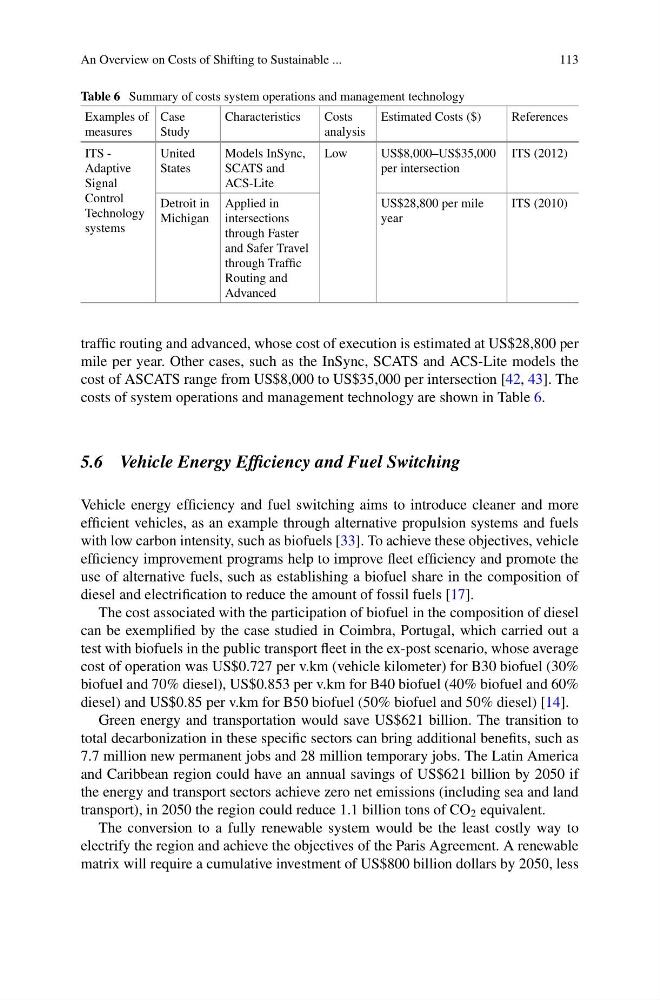
traffic routing and advanced, whose cost of execution is estimated at US$28,800 per
mile per year. Other cases, such as the InSync, SCATS and ACS-Lite models the
cost of ASCATS range from US$8,000 to US$35,000 per intersection [42, 43]. The
costs of system operations and management technology are shown in Table 6.
5.6 Vehicle Energy Efficiency and Fuel Switching
Vehicle energy efficiency and fuel switching aims to introduce cleaner and more
efficient vehicles, as an example through alternative propulsion systems and fuels
with low carbon intensity, such as biofuels [33]. To achieve these objectives, vehicle
efficiency improvement programs help to improve fleet efficiency and promote the
use of alternative fuels, such as establishing a biofuel share in the composition of
diesel and electrification to reduce the amount of fossil fuels [17].
The cost associated with the participation of biofuel in the composition of diesel
can be exemplified by the case studied in Coimbra, Portugal, which carried out a
test with biofuels in the public transport fleet in the ex-post scenario, whose average
cost of operation was US$0.727 per v.km (vehicle kilometer) for B30 biofuel (30%
biofuel and 70% diesel), US$0.853 per v.km for B40 biofuel (40% biofuel and 60%
diesel) and US$0.85 per v.km for B50 biofuel (50% biofuel and 50% diesel) [14].
Green energy and transportation would save US$621 billion. The transition to
total decarbonization in these specific sectors can bring additional benefits, such as
7.7 million new permanent jobs and 28 million temporary jobs. The Latin America
and Caribbean region could have an annual savings of US$621 billion by 2050 if
the energy and transport sectors achieve zero net emissions (including sea and land
transport), in 2050 the region could reduce 1.1 billion tons of CO 2 equivalent.
The conversion to a fully renewable system would be the least costly way to
electrify the region and achieve the objectives of the Paris Agreement. A renewable
matrix will require a cumulative investment of US$800 billion dollars by 2050, less
113
Table 6 Summary of costs system operations and management technology
Examples of
measures
Case
Study
Characteristics
Costs
analysis
Estimated Costs ($)
References
ITS -
Adaptive
Signal
Control
Technology
systems
United
States
Models InSync,
SCATS and
ACS-Lite
Low
US$8,000–US$35,000
per intersection
ITS (2012)
Detroit in
Michigan
Applied in
intersections
through Faster
and Safer Travel
through Traffic
Routing and
Advanced
US$28,800 per mile
year
ITS (2010)
traffic routing and advanced, whose cost of execution is estimated at US$28,800 per
mile per year. Other cases, such as the InSync, SCATS and ACS-Lite models the
cost of ASCATS range from US$8,000 to US$35,000 per intersection [42, 43]. The
costs of system operations and management technology are shown in Table 6.
5.6 Vehicle Energy Efficiency and Fuel Switching
Vehicle energy efficiency and fuel switching aims to introduce cleaner and more
efficient vehicles, as an example through alternative propulsion systems and fuels
with low carbon intensity, such as biofuels [33]. To achieve these objectives, vehicle
efficiency improvement programs help to improve fleet efficiency and promote the
use of alternative fuels, such as establishing a biofuel share in the composition of
diesel and electrification to reduce the amount of fossil fuels [17].
The cost associated with the participation of biofuel in the composition of diesel
can be exemplified by the case studied in Coimbra, Portugal, which carried out a
test with biofuels in the public transport fleet in the ex-post scenario, whose average
cost of operation was US$0.727 per v.km (vehicle kilometer) for B30 biofuel (30%
biofuel and 70% diesel), US$0.853 per v.km for B40 biofuel (40% biofuel and 60%
diesel) and US$0.85 per v.km for B50 biofuel (50% biofuel and 50% diesel) [14].
Green energy and transportation would save US$621 billion. The transition to
total decarbonization in these specific sectors can bring additional benefits, such as
7.7 million new permanent jobs and 28 million temporary jobs. The Latin America
and Caribbean region could have an annual savings of US$621 billion by 2050 if
the energy and transport sectors achieve zero net emissions (including sea and land
transport), in 2050 the region could reduce 1.1 billion tons of CO 2 equivalent.
The conversion to a fully renewable system would be the least costly way to
electrify the region and achieve the objectives of the Paris Agreement. A renewable
matrix will require a cumulative investment of US$800 billion dollars by 2050, less