

110
A. S. Santos et al.
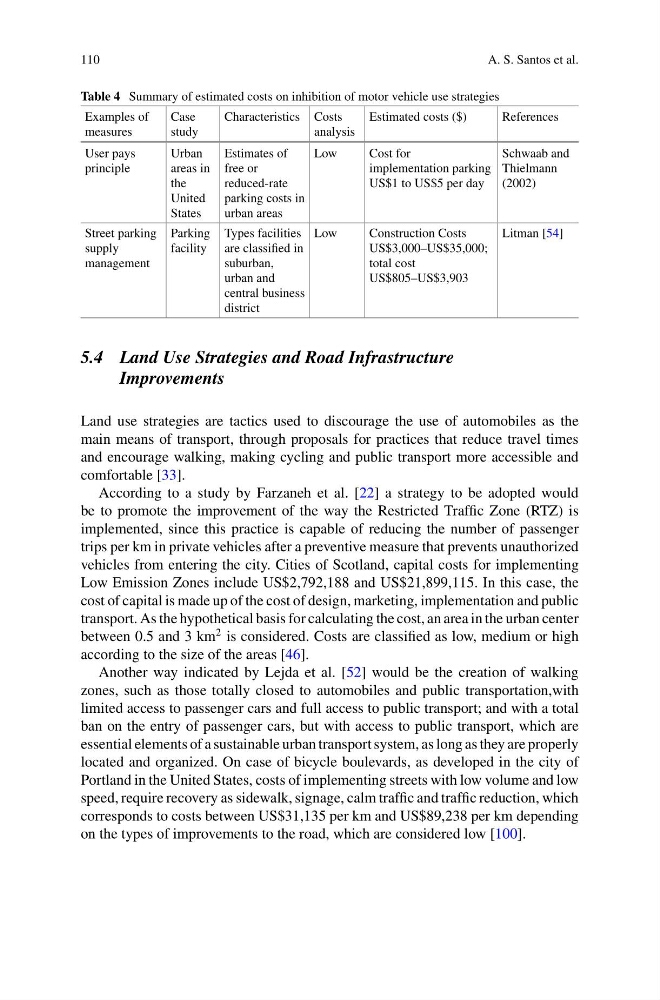
Table 4 Summary of estimated costs on inhibition of motor vehicle use strategies
Examples of
measures
Case
study
Characteristics Costs
analysis
Estimated costs ($)
References
User pays
principle
Urban
areas in
the
United
States
Estimates of
free or
reduced-rate
parking costs in
urban areas
Low
Cost for
implementation parking
US$1 to US$5 per day
Schwaab and
Thielmann
(2002)
Street parking
supply
management
Parking
facility
Types facilities
are classified in
suburban,
urban and
central business
district
Low
Construction Costs
US$3,000–US$35,000;
total cost
US$805–US$3,903
Litman [54]
5.4 Land Use Strategies and Road Infrastructure
Improvements
Land use strategies are tactics used to discourage the use of automobiles as the
main means of transport, through proposals for practices that reduce travel times
and encourage walking, making cycling and public transport more accessible and
comfortable [33].
According to a study by Farzaneh et al. [22] a strategy to be adopted would
be to promote the improvement of the way the Restricted Traffic Zone (RTZ) is
implemented, since this practice is capable of reducing the number of passenger
trips per km in private vehicles after a preventive measure that prevents unauthorized
vehicles from entering the city. Cities of Scotland, capital costs for implementing
Low Emission Zones include US$2,792,188 and US$21,899,115. In this case, the
cost of capital is made up of the cost of design, marketing, implementation and public
transport. As the hypothetical basis for calculating the cost, an area in the urban center
between 0.5 and 3 km
2 is considered. Costs are classified as low, medium or high
according to the size of the areas [46].
Another way indicated by Lejda et al. [52] would be the creation of walking
zones, such as those totally closed to automobiles and public transportation,with
limited access to passenger cars and full access to public transport; and with a total
ban on the entry of passenger cars, but with access to public transport, which are
essential elements of a sustainable urban transport system, as long as they are properly
located and organized. On case of bicycle boulevards, as developed in the city of
Portland in the United States, costs of implementing streets with low volume and low
speed, require recovery as sidewalk, signage, calm traffic and traffic reduction, which
corresponds to costs between US$31,135 per km and US$89,238 per km depending
on the types of improvements to the road, which are considered low [100].
A. S. Santos et al.
Table 4 Summary of estimated costs on inhibition of motor vehicle use strategies
Examples of
measures
Case
study
Characteristics Costs
analysis
Estimated costs ($)
References
User pays
principle
Urban
areas in
the
United
States
Estimates of
free or
reduced-rate
parking costs in
urban areas
Low
Cost for
implementation parking
US$1 to US$5 per day
Schwaab and
Thielmann
(2002)
Street parking
supply
management
Parking
facility
Types facilities
are classified in
suburban,
urban and
central business
district
Low
Construction Costs
US$3,000–US$35,000;
total cost
US$805–US$3,903
Litman [54]
5.4 Land Use Strategies and Road Infrastructure
Improvements
Land use strategies are tactics used to discourage the use of automobiles as the
main means of transport, through proposals for practices that reduce travel times
and encourage walking, making cycling and public transport more accessible and
comfortable [33].
According to a study by Farzaneh et al. [22] a strategy to be adopted would
be to promote the improvement of the way the Restricted Traffic Zone (RTZ) is
implemented, since this practice is capable of reducing the number of passenger
trips per km in private vehicles after a preventive measure that prevents unauthorized
vehicles from entering the city. Cities of Scotland, capital costs for implementing
Low Emission Zones include US$2,792,188 and US$21,899,115. In this case, the
cost of capital is made up of the cost of design, marketing, implementation and public
transport. As the hypothetical basis for calculating the cost, an area in the urban center
between 0.5 and 3 km
2 is considered. Costs are classified as low, medium or high
according to the size of the areas [46].
Another way indicated by Lejda et al. [52] would be the creation of walking
zones, such as those totally closed to automobiles and public transportation,with
limited access to passenger cars and full access to public transport; and with a total
ban on the entry of passenger cars, but with access to public transport, which are
essential elements of a sustainable urban transport system, as long as they are properly
located and organized. On case of bicycle boulevards, as developed in the city of
Portland in the United States, costs of implementing streets with low volume and low
speed, require recovery as sidewalk, signage, calm traffic and traffic reduction, which
corresponds to costs between US$31,135 per km and US$89,238 per km depending
on the types of improvements to the road, which are considered low [100].