

An Overview on Costs of Shifting to Sustainable ...
97
this process, resulting in an ecological environment and a transport system on the
brink of collapse [99].
The transport sector will be playing a particularly important role on track to
achieving the Paris agreement, given the fact close to a quarter of energy related global
GHG emissions come from transport [12]. In most cases, safe, clean, sustainable and
equitable transport systems help countries especially in cities and urban centers to
thrive [4].
Therefore, given the importance of the road transportation in terms of energy
consumption and CO 2 emissions as mentioned before, a rational and subnational
traffic structure based on the concepts of sustainable development should be established, considering high efficiency, low-energy, low pollution and high-capacity to
solve, or at least minimize, the problems arising mainly from motorized transport
[99].
In addition, it must include a broad implementation of sustainable transport policies, including economic and regulatory instruments, physical and flexible measures
(infrastructure improvements in road transportation, including land use and public
transportation), and technological innovations, without compromising the mobility
of goods and people [72].
In the 2030 Agenda for Sustainable Development, sustainable transport is mainstreamed across several SDGs and targets, mainly to: Objective 7 (affordable and
clean energy); Objective 9 (industry, innovation and infrastructure); Objective 11
(sustainable cities and communities); Objective 12 (responsible consumption and
production); and Objective 13 (climate action) [90, 88].
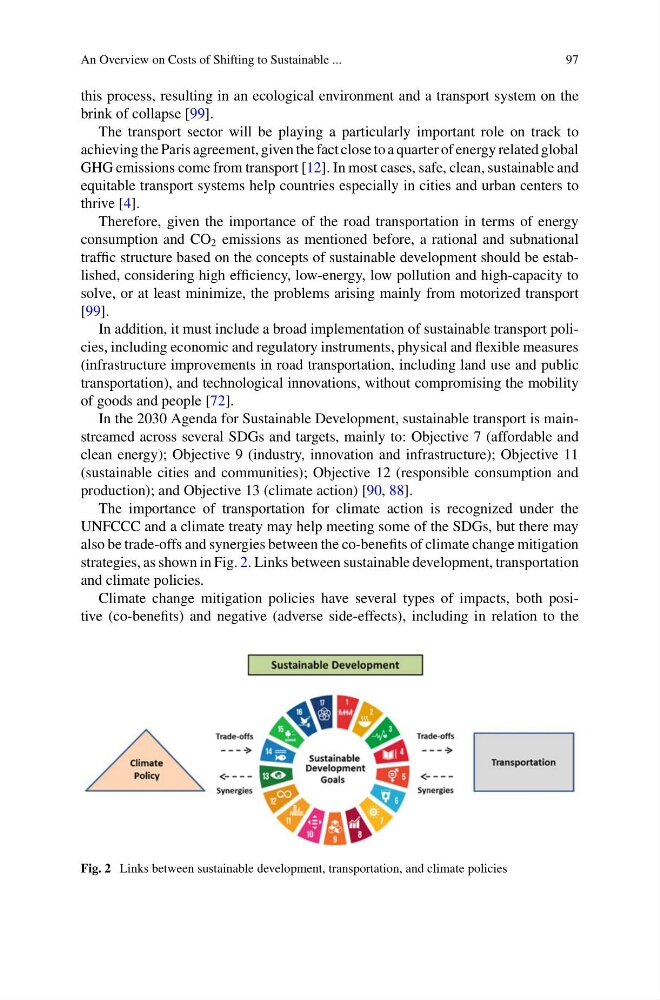
The importance of transportation for climate action is recognized under the
UNFCCC and a climate treaty may help meeting some of the SDGs, but there may
also be trade-offs and synergies between the co-benefits of climate change mitigation
strategies, as shown in Fig. 2. Links between sustainable development, transportation
and climate policies.
Climate change mitigation policies have several types of impacts, both positive (co-benefits) and negative (adverse side-effects), including in relation to the
Fig. 2 Links between sustainable development, transportation, and climate policies
97
this process, resulting in an ecological environment and a transport system on the
brink of collapse [99].
The transport sector will be playing a particularly important role on track to
achieving the Paris agreement, given the fact close to a quarter of energy related global
GHG emissions come from transport [12]. In most cases, safe, clean, sustainable and
equitable transport systems help countries especially in cities and urban centers to
thrive [4].
Therefore, given the importance of the road transportation in terms of energy
consumption and CO 2 emissions as mentioned before, a rational and subnational
traffic structure based on the concepts of sustainable development should be established, considering high efficiency, low-energy, low pollution and high-capacity to
solve, or at least minimize, the problems arising mainly from motorized transport
[99].
In addition, it must include a broad implementation of sustainable transport policies, including economic and regulatory instruments, physical and flexible measures
(infrastructure improvements in road transportation, including land use and public
transportation), and technological innovations, without compromising the mobility
of goods and people [72].
In the 2030 Agenda for Sustainable Development, sustainable transport is mainstreamed across several SDGs and targets, mainly to: Objective 7 (affordable and
clean energy); Objective 9 (industry, innovation and infrastructure); Objective 11
(sustainable cities and communities); Objective 12 (responsible consumption and
production); and Objective 13 (climate action) [90, 88].
The importance of transportation for climate action is recognized under the
UNFCCC and a climate treaty may help meeting some of the SDGs, but there may
also be trade-offs and synergies between the co-benefits of climate change mitigation
strategies, as shown in Fig. 2. Links between sustainable development, transportation
and climate policies.
Climate change mitigation policies have several types of impacts, both positive (co-benefits) and negative (adverse side-effects), including in relation to the
Fig. 2 Links between sustainable development, transportation, and climate policies