

96
A. S. Santos et al.
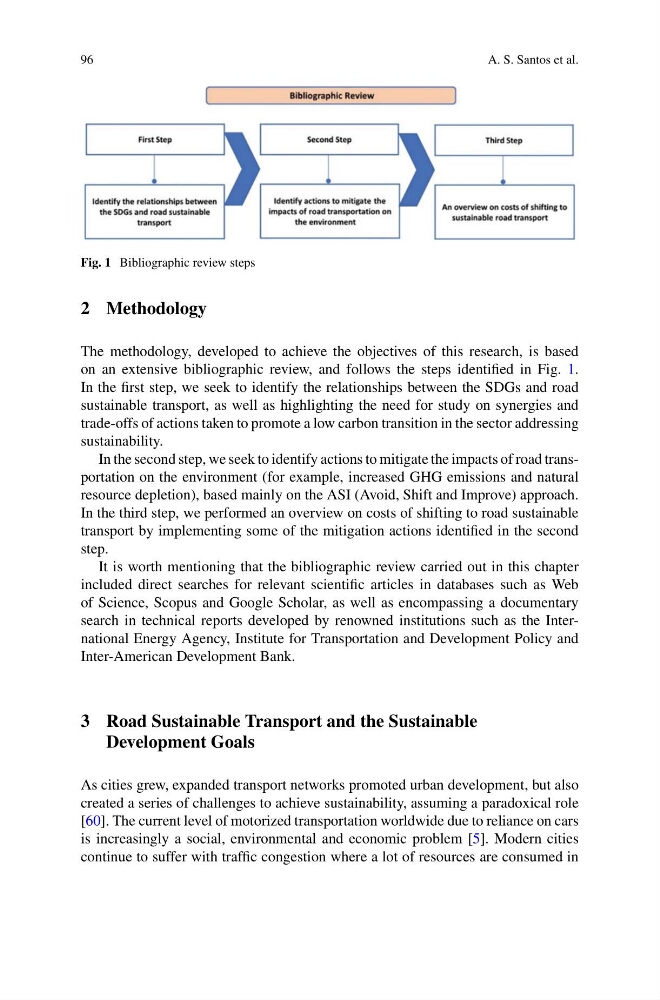
Fig. 1 Bibliographic review steps
2 Methodology
The methodology, developed to achieve the objectives of this research, is based
on an extensive bibliographic review, and follows the steps identified in Fig. 1.
In the first step, we seek to identify the relationships between the SDGs and road
sustainable transport, as well as highlighting the need for study on synergies and
trade-offs of actions taken to promote a low carbon transition in the sector addressing
sustainability.
In the second step, we seek to identify actions to mitigate the impacts of road transportation on the environment (for example, increased GHG emissions and natural
resource depletion), based mainly on the ASI (Avoid, Shift and Improve) approach.
In the third step, we performed an overview on costs of shifting to road sustainable
transport by implementing some of the mitigation actions identified in the second
step.
It is worth mentioning that the bibliographic review carried out in this chapter
included direct searches for relevant scientific articles in databases such as Web
of Science, Scopus and Google Scholar, as well as encompassing a documentary
search in technical reports developed by renowned institutions such as the International Energy Agency, Institute for Transportation and Development Policy and
Inter-American Development Bank.
3 Road Sustainable Transport and the Sustainable
Development Goals
As cities grew, expanded transport networks promoted urban development, but also
created a series of challenges to achieve sustainability, assuming a paradoxical role
[60]. The current level of motorized transportation worldwide due to reliance on cars
is increasingly a social, environmental and economic problem [5]. Modern cities
continue to suffer with traffic congestion where a lot of resources are consumed in
A. S. Santos et al.
Fig. 1 Bibliographic review steps
2 Methodology
The methodology, developed to achieve the objectives of this research, is based
on an extensive bibliographic review, and follows the steps identified in Fig. 1.
In the first step, we seek to identify the relationships between the SDGs and road
sustainable transport, as well as highlighting the need for study on synergies and
trade-offs of actions taken to promote a low carbon transition in the sector addressing
sustainability.
In the second step, we seek to identify actions to mitigate the impacts of road transportation on the environment (for example, increased GHG emissions and natural
resource depletion), based mainly on the ASI (Avoid, Shift and Improve) approach.
In the third step, we performed an overview on costs of shifting to road sustainable
transport by implementing some of the mitigation actions identified in the second
step.
It is worth mentioning that the bibliographic review carried out in this chapter
included direct searches for relevant scientific articles in databases such as Web
of Science, Scopus and Google Scholar, as well as encompassing a documentary
search in technical reports developed by renowned institutions such as the International Energy Agency, Institute for Transportation and Development Policy and
Inter-American Development Bank.
3 Road Sustainable Transport and the Sustainable
Development Goals
As cities grew, expanded transport networks promoted urban development, but also
created a series of challenges to achieve sustainability, assuming a paradoxical role
[60]. The current level of motorized transportation worldwide due to reliance on cars
is increasingly a social, environmental and economic problem [5]. Modern cities
continue to suffer with traffic congestion where a lot of resources are consumed in