

98
A. S. Santos et al.
SDGs. Thus, a successful integration of climate mitigation policies also requires
a comprehensive understanding of the adverse side-effects, causing greater synergy
between the SDGs, especially regarding Goal 10 (reduce inequality within and among
countries) [58, 59].
For example, policies that encourage energy efficiency in the transport sector, that
is, transition to a low carbon future, have several co-benefits such as improving air
quality and reducing natural resource depletion. However, it can lead to unemployment in the fossil fuel industry or other sectors of the economy that can be negatively
affected by carbon prices [15].
Even so, many opportunities on creating green jobs specially related to renewable
energy and energy efficiency sectors are increasing [79]. Therefore, strategic thinking
and government support can be used to minimize the long-term adverse consequences
of the transition to a low carbon economy for repurposing obsolete sites and retraining
newly unnecessary workers, for example [59].
In addition, incentives for stockholder and a coherent transition and diversification
strategy based on the skills of the existing workforce are fundamental to facilitate
the process of economic restructuring and mitigate the effects of transformation of
existing industrial, institutional, social and technological structures [15].
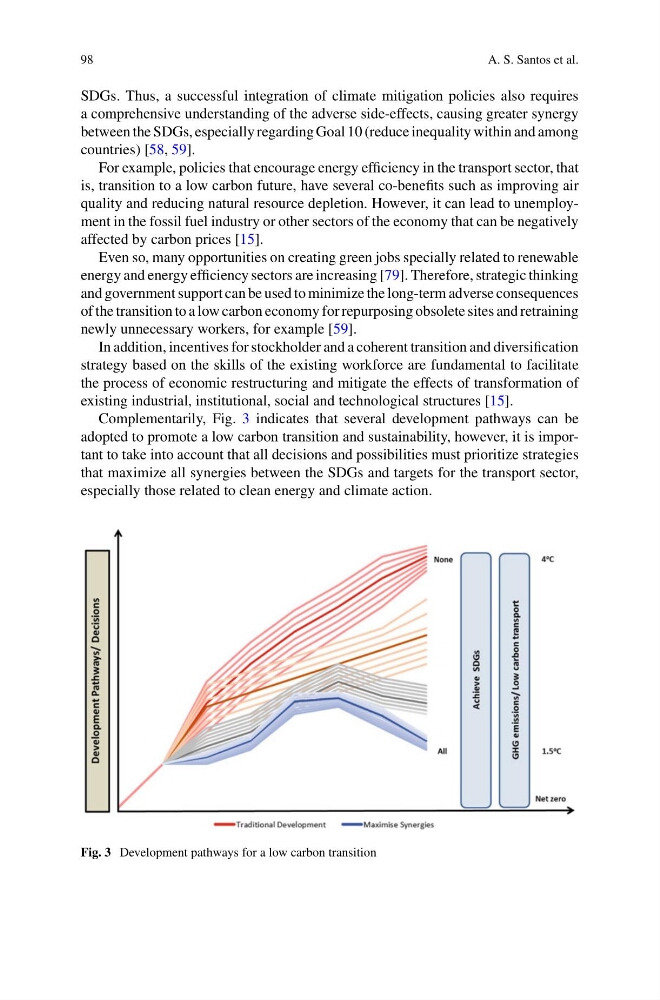
Complementarily, Fig. 3 indicates that several development pathways can be
adopted to promote a low carbon transition and sustainability, however, it is important to take into account that all decisions and possibilities must prioritize strategies
that maximize all synergies between the SDGs and targets for the transport sector,
especially those related to clean energy and climate action.
Fig. 3 Development pathways for a low carbon transition
A. S. Santos et al.
SDGs. Thus, a successful integration of climate mitigation policies also requires
a comprehensive understanding of the adverse side-effects, causing greater synergy
between the SDGs, especially regarding Goal 10 (reduce inequality within and among
countries) [58, 59].
For example, policies that encourage energy efficiency in the transport sector, that
is, transition to a low carbon future, have several co-benefits such as improving air
quality and reducing natural resource depletion. However, it can lead to unemployment in the fossil fuel industry or other sectors of the economy that can be negatively
affected by carbon prices [15].
Even so, many opportunities on creating green jobs specially related to renewable
energy and energy efficiency sectors are increasing [79]. Therefore, strategic thinking
and government support can be used to minimize the long-term adverse consequences
of the transition to a low carbon economy for repurposing obsolete sites and retraining
newly unnecessary workers, for example [59].
In addition, incentives for stockholder and a coherent transition and diversification
strategy based on the skills of the existing workforce are fundamental to facilitate
the process of economic restructuring and mitigate the effects of transformation of
existing industrial, institutional, social and technological structures [15].
Complementarily, Fig. 3 indicates that several development pathways can be
adopted to promote a low carbon transition and sustainability, however, it is important to take into account that all decisions and possibilities must prioritize strategies
that maximize all synergies between the SDGs and targets for the transport sector,
especially those related to clean energy and climate action.
Fig. 3 Development pathways for a low carbon transition