

54
V. Nawandar et al.
EF RM =
W j ∗
1 + ω j
∗ E CO2 j
∗
(1 − L oc )
L f
∗ γ CO2
(4)
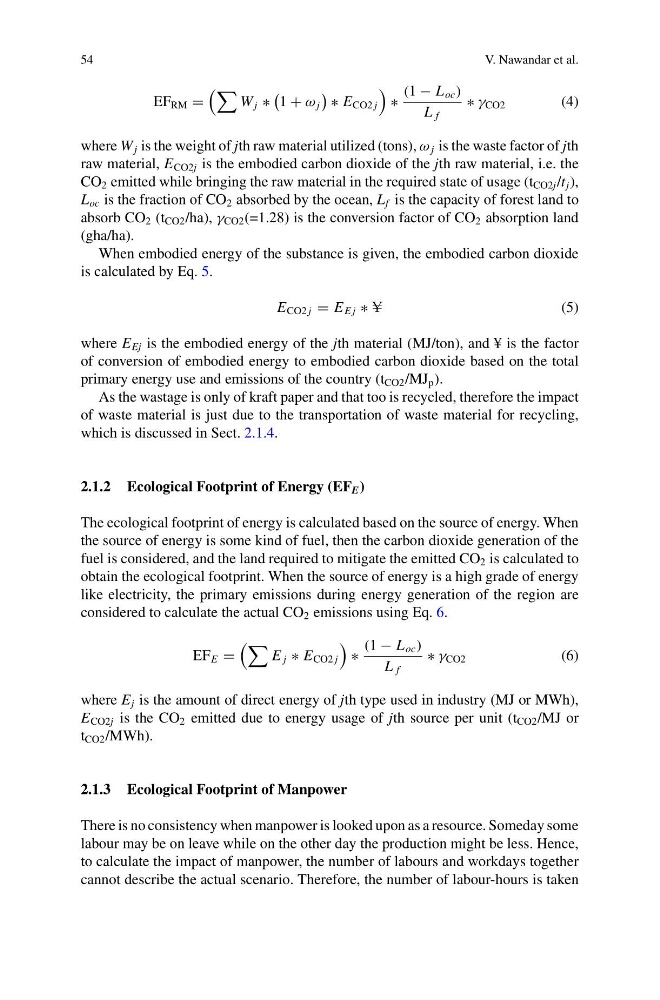
where W j is the weight of jth raw material utilized (tons), ω j is the waste factor of jth
raw material, E CO2j is the embodied carbon dioxide of the jth raw material, i.e. the
CO 2 emitted while bringing the raw material in the required state of usage (t CO2j /t j ),
L oc is the fraction of CO 2 absorbed by the ocean, L f is the capacity of forest land to
absorb CO 2 (t CO2 /ha), γ CO2 (=1.28) is the conversion factor of CO 2 absorption land
(gha/ha).
When embodied energy of the substance is given, the embodied carbon dioxide
is calculated by Eq. 5.
E CO2 j = E E j ∗
(5)
where E Ej is the embodied energy of the jth material (MJ/ton), and ¥ is the factor
of conversion of embodied energy to embodied carbon dioxide based on the total
primary energy use and emissions of the country (t CO2 /MJ p ).
As the wastage is only of kraft paper and that too is recycled, therefore the impact
of waste material is just due to the transportation of waste material for recycling,
which is discussed in Sect. 2.1.4.
2.1.2 Ecological Footprint of Energy (EF E )
The ecological footprint of energy is calculated based on the source of energy. When
the source of energy is some kind of fuel, then the carbon dioxide generation of the
fuel is considered, and the land required to mitigate the emitted CO 2 is calculated to
obtain the ecological footprint. When the source of energy is a high grade of energy
like electricity, the primary emissions during energy generation of the region are
considered to calculate the actual CO 2 emissions using Eq. 6.
EF E =
E j ∗ E CO2 j
∗
(1 − L oc )
L f
∗ γ CO2
(6)
where E j is the amount of direct energy of jth type used in industry (MJ or MWh),
E CO2j is the CO 2 emitted due to energy usage of jth source per unit (t CO2 /MJ or
t CO2 /MWh).
2.1.3 Ecological Footprint of Manpower
There is no consistency when manpower is looked upon as a resource. Someday some
labour may be on leave while on the other day the production might be less. Hence,
to calculate the impact of manpower, the number of labours and workdays together
cannot describe the actual scenario. Therefore, the number of labour-hours is taken
V. Nawandar et al.
EF RM =
W j ∗
1 + ω j
∗ E CO2 j
∗
(1 − L oc )
L f
∗ γ CO2
(4)
where W j is the weight of jth raw material utilized (tons), ω j is the waste factor of jth
raw material, E CO2j is the embodied carbon dioxide of the jth raw material, i.e. the
CO 2 emitted while bringing the raw material in the required state of usage (t CO2j /t j ),
L oc is the fraction of CO 2 absorbed by the ocean, L f is the capacity of forest land to
absorb CO 2 (t CO2 /ha), γ CO2 (=1.28) is the conversion factor of CO 2 absorption land
(gha/ha).
When embodied energy of the substance is given, the embodied carbon dioxide
is calculated by Eq. 5.
E CO2 j = E E j ∗
(5)
where E Ej is the embodied energy of the jth material (MJ/ton), and ¥ is the factor
of conversion of embodied energy to embodied carbon dioxide based on the total
primary energy use and emissions of the country (t CO2 /MJ p ).
As the wastage is only of kraft paper and that too is recycled, therefore the impact
of waste material is just due to the transportation of waste material for recycling,
which is discussed in Sect. 2.1.4.
2.1.2 Ecological Footprint of Energy (EF E )
The ecological footprint of energy is calculated based on the source of energy. When
the source of energy is some kind of fuel, then the carbon dioxide generation of the
fuel is considered, and the land required to mitigate the emitted CO 2 is calculated to
obtain the ecological footprint. When the source of energy is a high grade of energy
like electricity, the primary emissions during energy generation of the region are
considered to calculate the actual CO 2 emissions using Eq. 6.
EF E =
E j ∗ E CO2 j
∗
(1 − L oc )
L f
∗ γ CO2
(6)
where E j is the amount of direct energy of jth type used in industry (MJ or MWh),
E CO2j is the CO 2 emitted due to energy usage of jth source per unit (t CO2 /MJ or
t CO2 /MWh).
2.1.3 Ecological Footprint of Manpower
There is no consistency when manpower is looked upon as a resource. Someday some
labour may be on leave while on the other day the production might be less. Hence,
to calculate the impact of manpower, the number of labours and workdays together
cannot describe the actual scenario. Therefore, the number of labour-hours is taken