

Ecological Footprint Assessment …
53
2 Methodology
2.1 Environmental Assessment
The environmental impacts of industries mainly focus on carbon emissions. In this
study, Ecological Footprint (EF) is used to assess the environmental impact of an
industry which not only imbibes the carbon emissions but also resembles the actual
impact of the industry on the planet. Ecological footprint measures the bio-productive
land required to meet the needs of resources and energy. The basic formula of
ecological footprint is shown in Eq. 2 [8]
EF =
Consumption Yield
∗
Conversion factor
(2)
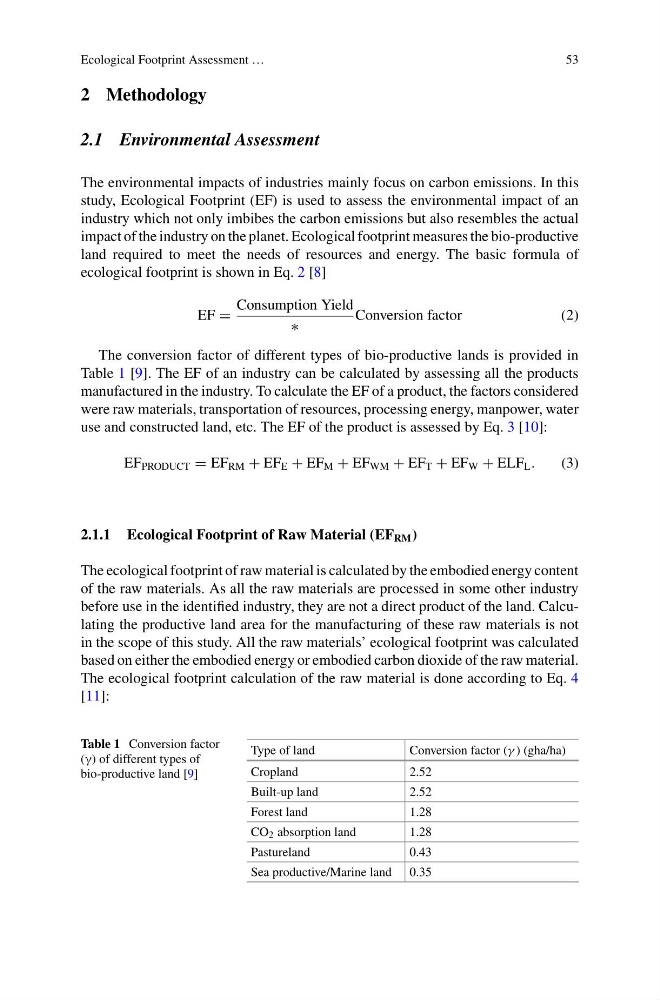
The conversion factor of different types of bio-productive lands is provided in
Table 1 [9]. The EF of an industry can be calculated by assessing all the products
manufactured in the industry. To calculate the EF of a product, the factors considered
were raw materials, transportation of resources, processing energy, manpower, water
use and constructed land, etc. The EF of the product is assessed by Eq. 3 [10]:
EF PRODUCT = EF RM + EF E + EF M + EF WM + EF T + EF W + ELF L .
(3)
2.1.1 Ecological Footprint of Raw Material (EF RM )
The ecological footprint of raw material is calculated by the embodied energy content
of the raw materials. As all the raw materials are processed in some other industry
before use in the identified industry, they are not a direct product of the land. Calculating the productive land area for the manufacturing of these raw materials is not
in the scope of this study. All the raw materials’ ecological footprint was calculated
based on either the embodied energy or embodied carbon dioxide of the raw material.
The ecological footprint calculation of the raw material is done according to Eq. 4
[11]:
Table 1 Conversion factor
(γ) of different types of
bio-productive land [9]
Type of land
Conversion factor (γ ) (gha/ha)
Cropland
2.52
Built-up land
2.52
Forest land
1.28
CO 2 absorption land
1.28
Pastureland
0.43
Sea productive/Marine land 0.35
53
2 Methodology
2.1 Environmental Assessment
The environmental impacts of industries mainly focus on carbon emissions. In this
study, Ecological Footprint (EF) is used to assess the environmental impact of an
industry which not only imbibes the carbon emissions but also resembles the actual
impact of the industry on the planet. Ecological footprint measures the bio-productive
land required to meet the needs of resources and energy. The basic formula of
ecological footprint is shown in Eq. 2 [8]
EF =
Consumption Yield
∗
Conversion factor
(2)
The conversion factor of different types of bio-productive lands is provided in
Table 1 [9]. The EF of an industry can be calculated by assessing all the products
manufactured in the industry. To calculate the EF of a product, the factors considered
were raw materials, transportation of resources, processing energy, manpower, water
use and constructed land, etc. The EF of the product is assessed by Eq. 3 [10]:
EF PRODUCT = EF RM + EF E + EF M + EF WM + EF T + EF W + ELF L .
(3)
2.1.1 Ecological Footprint of Raw Material (EF RM )
The ecological footprint of raw material is calculated by the embodied energy content
of the raw materials. As all the raw materials are processed in some other industry
before use in the identified industry, they are not a direct product of the land. Calculating the productive land area for the manufacturing of these raw materials is not
in the scope of this study. All the raw materials’ ecological footprint was calculated
based on either the embodied energy or embodied carbon dioxide of the raw material.
The ecological footprint calculation of the raw material is done according to Eq. 4
[11]:
Table 1 Conversion factor
(γ) of different types of
bio-productive land [9]
Type of land
Conversion factor (γ ) (gha/ha)
Cropland
2.52
Built-up land
2.52
Forest land
1.28
CO 2 absorption land
1.28
Pastureland
0.43
Sea productive/Marine land 0.35