

Ecological Footprint Assessment …
47
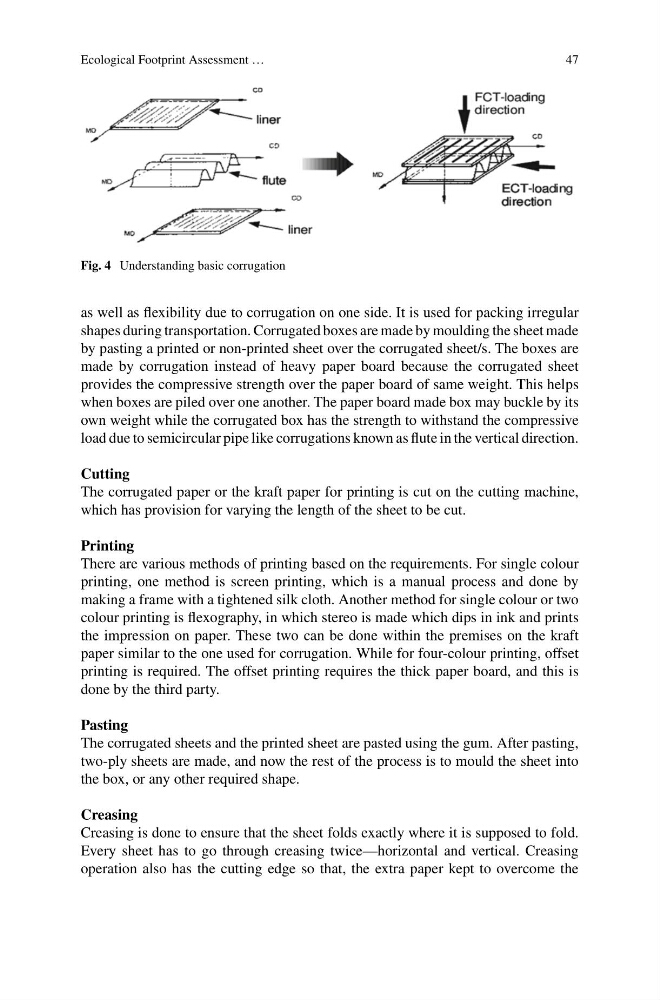
Fig. 4 Understanding basic corrugation
as well as flexibility due to corrugation on one side. It is used for packing irregular
shapes during transportation. Corrugated boxes are made by moulding the sheet made
by pasting a printed or non-printed sheet over the corrugated sheet/s. The boxes are
made by corrugation instead of heavy paper board because the corrugated sheet
provides the compressive strength over the paper board of same weight. This helps
when boxes are piled over one another. The paper board made box may buckle by its
own weight while the corrugated box has the strength to withstand the compressive
load due to semicircular pipe like corrugations known as flute in the vertical direction.
Cutting
The corrugated paper or the kraft paper for printing is cut on the cutting machine,
which has provision for varying the length of the sheet to be cut.
Printing
There are various methods of printing based on the requirements. For single colour
printing, one method is screen printing, which is a manual process and done by
making a frame with a tightened silk cloth. Another method for single colour or two
colour printing is flexography, in which stereo is made which dips in ink and prints
the impression on paper. These two can be done within the premises on the kraft
paper similar to the one used for corrugation. While for four-colour printing, offset
printing is required. The offset printing requires the thick paper board, and this is
done by the third party.
Pasting
The corrugated sheets and the printed sheet are pasted using the gum. After pasting,
two-ply sheets are made, and now the rest of the process is to mould the sheet into
the box, or any other required shape.
Creasing
Creasing is done to ensure that the sheet folds exactly where it is supposed to fold.
Every sheet has to go through creasing twice—horizontal and vertical. Creasing
operation also has the cutting edge so that, the extra paper kept to overcome the
47
Fig. 4 Understanding basic corrugation
as well as flexibility due to corrugation on one side. It is used for packing irregular
shapes during transportation. Corrugated boxes are made by moulding the sheet made
by pasting a printed or non-printed sheet over the corrugated sheet/s. The boxes are
made by corrugation instead of heavy paper board because the corrugated sheet
provides the compressive strength over the paper board of same weight. This helps
when boxes are piled over one another. The paper board made box may buckle by its
own weight while the corrugated box has the strength to withstand the compressive
load due to semicircular pipe like corrugations known as flute in the vertical direction.
Cutting
The corrugated paper or the kraft paper for printing is cut on the cutting machine,
which has provision for varying the length of the sheet to be cut.
Printing
There are various methods of printing based on the requirements. For single colour
printing, one method is screen printing, which is a manual process and done by
making a frame with a tightened silk cloth. Another method for single colour or two
colour printing is flexography, in which stereo is made which dips in ink and prints
the impression on paper. These two can be done within the premises on the kraft
paper similar to the one used for corrugation. While for four-colour printing, offset
printing is required. The offset printing requires the thick paper board, and this is
done by the third party.
Pasting
The corrugated sheets and the printed sheet are pasted using the gum. After pasting,
two-ply sheets are made, and now the rest of the process is to mould the sheet into
the box, or any other required shape.
Creasing
Creasing is done to ensure that the sheet folds exactly where it is supposed to fold.
Every sheet has to go through creasing twice—horizontal and vertical. Creasing
operation also has the cutting edge so that, the extra paper kept to overcome the