

46
V. Nawandar et al.
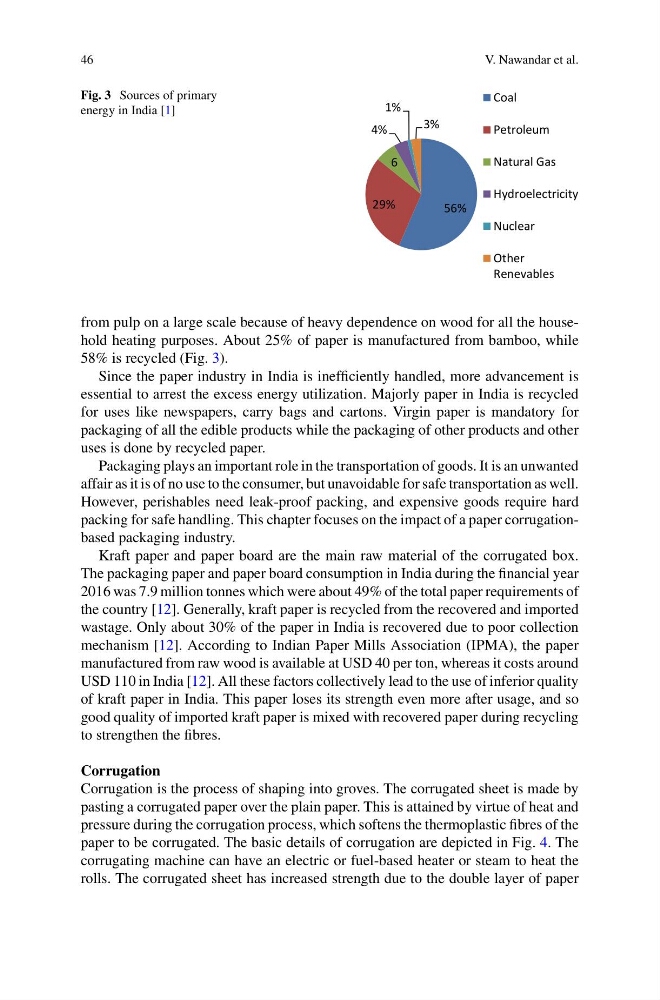
Fig. 3 Sources of primary
energy in India [1]
56%
29%
6
4%
1%
3%
Coal
Petroleum
Natural Gas
Hydroelectricity
Nuclear
Other
Renevables
from pulp on a large scale because of heavy dependence on wood for all the household heating purposes. About 25% of paper is manufactured from bamboo, while
58% is recycled (Fig. 3).
Since the paper industry in India is inefficiently handled, more advancement is
essential to arrest the excess energy utilization. Majorly paper in India is recycled
for uses like newspapers, carry bags and cartons. Virgin paper is mandatory for
packaging of all the edible products while the packaging of other products and other
uses is done by recycled paper.
Packaging plays an important role in the transportation of goods. It is an unwanted
affair as it is of no use to the consumer, but unavoidable for safe transportation as well.
However, perishables need leak-proof packing, and expensive goods require hard
packing for safe handling. This chapter focuses on the impact of a paper corrugationbased packaging industry.
Kraft paper and paper board are the main raw material of the corrugated box.
The packaging paper and paper board consumption in India during the financial year
2016 was 7.9 million tonnes which were about 49% of the total paper requirements of
the country [12]. Generally, kraft paper is recycled from the recovered and imported
wastage. Only about 30% of the paper in India is recovered due to poor collection
mechanism [12]. According to Indian Paper Mills Association (IPMA), the paper
manufactured from raw wood is available at USD 40 per ton, whereas it costs around
USD 110 in India [12]. All these factors collectively lead to the use of inferior quality
of kraft paper in India. This paper loses its strength even more after usage, and so
good quality of imported kraft paper is mixed with recovered paper during recycling
to strengthen the fibres.
Corrugation
Corrugation is the process of shaping into groves. The corrugated sheet is made by
pasting a corrugated paper over the plain paper. This is attained by virtue of heat and
pressure during the corrugation process, which softens the thermoplastic fibres of the
paper to be corrugated. The basic details of corrugation are depicted in Fig. 4. The
corrugating machine can have an electric or fuel-based heater or steam to heat the
rolls. The corrugated sheet has increased strength due to the double layer of paper
V. Nawandar et al.
Fig. 3 Sources of primary
energy in India [1]
56%
29%
6
4%
1%
3%
Coal
Petroleum
Natural Gas
Hydroelectricity
Nuclear
Other
Renevables
from pulp on a large scale because of heavy dependence on wood for all the household heating purposes. About 25% of paper is manufactured from bamboo, while
58% is recycled (Fig. 3).
Since the paper industry in India is inefficiently handled, more advancement is
essential to arrest the excess energy utilization. Majorly paper in India is recycled
for uses like newspapers, carry bags and cartons. Virgin paper is mandatory for
packaging of all the edible products while the packaging of other products and other
uses is done by recycled paper.
Packaging plays an important role in the transportation of goods. It is an unwanted
affair as it is of no use to the consumer, but unavoidable for safe transportation as well.
However, perishables need leak-proof packing, and expensive goods require hard
packing for safe handling. This chapter focuses on the impact of a paper corrugationbased packaging industry.
Kraft paper and paper board are the main raw material of the corrugated box.
The packaging paper and paper board consumption in India during the financial year
2016 was 7.9 million tonnes which were about 49% of the total paper requirements of
the country [12]. Generally, kraft paper is recycled from the recovered and imported
wastage. Only about 30% of the paper in India is recovered due to poor collection
mechanism [12]. According to Indian Paper Mills Association (IPMA), the paper
manufactured from raw wood is available at USD 40 per ton, whereas it costs around
USD 110 in India [12]. All these factors collectively lead to the use of inferior quality
of kraft paper in India. This paper loses its strength even more after usage, and so
good quality of imported kraft paper is mixed with recovered paper during recycling
to strengthen the fibres.
Corrugation
Corrugation is the process of shaping into groves. The corrugated sheet is made by
pasting a corrugated paper over the plain paper. This is attained by virtue of heat and
pressure during the corrugation process, which softens the thermoplastic fibres of the
paper to be corrugated. The basic details of corrugation are depicted in Fig. 4. The
corrugating machine can have an electric or fuel-based heater or steam to heat the
rolls. The corrugated sheet has increased strength due to the double layer of paper