

Ecological Footprint Assessment …
45
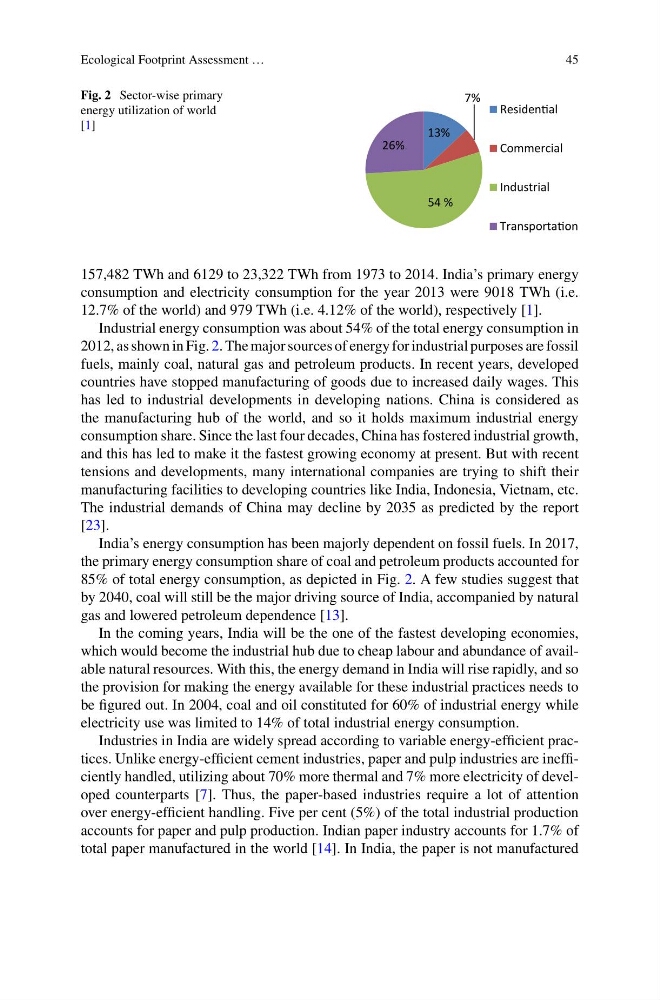
Fig. 2 Sector-wise primary
energy utilization of world
[1]
13%
7%
54 %
26%
ResidenƟal
Commercial
Industrial
TransportaƟon
157,482 TWh and 6129 to 23,322 TWh from 1973 to 2014. India’s primary energy
consumption and electricity consumption for the year 2013 were 9018 TWh (i.e.
12.7% of the world) and 979 TWh (i.e. 4.12% of the world), respectively [1].
Industrial energy consumption was about 54% of the total energy consumption in
2012, as shown in Fig. 2. The major sources of energy for industrial purposes are fossil
fuels, mainly coal, natural gas and petroleum products. In recent years, developed
countries have stopped manufacturing of goods due to increased daily wages. This
has led to industrial developments in developing nations. China is considered as
the manufacturing hub of the world, and so it holds maximum industrial energy
consumption share. Since the last four decades, China has fostered industrial growth,
and this has led to make it the fastest growing economy at present. But with recent
tensions and developments, many international companies are trying to shift their
manufacturing facilities to developing countries like India, Indonesia, Vietnam, etc.
The industrial demands of China may decline by 2035 as predicted by the report
[23].
India’s energy consumption has been majorly dependent on fossil fuels. In 2017,
the primary energy consumption share of coal and petroleum products accounted for
85% of total energy consumption, as depicted in Fig. 2. A few studies suggest that
by 2040, coal will still be the major driving source of India, accompanied by natural
gas and lowered petroleum dependence [13].
In the coming years, India will be the one of the fastest developing economies,
which would become the industrial hub due to cheap labour and abundance of available natural resources. With this, the energy demand in India will rise rapidly, and so
the provision for making the energy available for these industrial practices needs to
be figured out. In 2004, coal and oil constituted for 60% of industrial energy while
electricity use was limited to 14% of total industrial energy consumption.
Industries in India are widely spread according to variable energy-efficient practices. Unlike energy-efficient cement industries, paper and pulp industries are inefficiently handled, utilizing about 70% more thermal and 7% more electricity of developed counterparts [7]. Thus, the paper-based industries require a lot of attention
over energy-efficient handling. Five per cent (5%) of the total industrial production
accounts for paper and pulp production. Indian paper industry accounts for 1.7% of
total paper manufactured in the world [14]. In India, the paper is not manufactured
45
Fig. 2 Sector-wise primary
energy utilization of world
[1]
13%
7%
54 %
26%
ResidenƟal
Commercial
Industrial
TransportaƟon
157,482 TWh and 6129 to 23,322 TWh from 1973 to 2014. India’s primary energy
consumption and electricity consumption for the year 2013 were 9018 TWh (i.e.
12.7% of the world) and 979 TWh (i.e. 4.12% of the world), respectively [1].
Industrial energy consumption was about 54% of the total energy consumption in
2012, as shown in Fig. 2. The major sources of energy for industrial purposes are fossil
fuels, mainly coal, natural gas and petroleum products. In recent years, developed
countries have stopped manufacturing of goods due to increased daily wages. This
has led to industrial developments in developing nations. China is considered as
the manufacturing hub of the world, and so it holds maximum industrial energy
consumption share. Since the last four decades, China has fostered industrial growth,
and this has led to make it the fastest growing economy at present. But with recent
tensions and developments, many international companies are trying to shift their
manufacturing facilities to developing countries like India, Indonesia, Vietnam, etc.
The industrial demands of China may decline by 2035 as predicted by the report
[23].
India’s energy consumption has been majorly dependent on fossil fuels. In 2017,
the primary energy consumption share of coal and petroleum products accounted for
85% of total energy consumption, as depicted in Fig. 2. A few studies suggest that
by 2040, coal will still be the major driving source of India, accompanied by natural
gas and lowered petroleum dependence [13].
In the coming years, India will be the one of the fastest developing economies,
which would become the industrial hub due to cheap labour and abundance of available natural resources. With this, the energy demand in India will rise rapidly, and so
the provision for making the energy available for these industrial practices needs to
be figured out. In 2004, coal and oil constituted for 60% of industrial energy while
electricity use was limited to 14% of total industrial energy consumption.
Industries in India are widely spread according to variable energy-efficient practices. Unlike energy-efficient cement industries, paper and pulp industries are inefficiently handled, utilizing about 70% more thermal and 7% more electricity of developed counterparts [7]. Thus, the paper-based industries require a lot of attention
over energy-efficient handling. Five per cent (5%) of the total industrial production
accounts for paper and pulp production. Indian paper industry accounts for 1.7% of
total paper manufactured in the world [14]. In India, the paper is not manufactured