

Ecological Footprint of the Life Cycle of Buildings
31
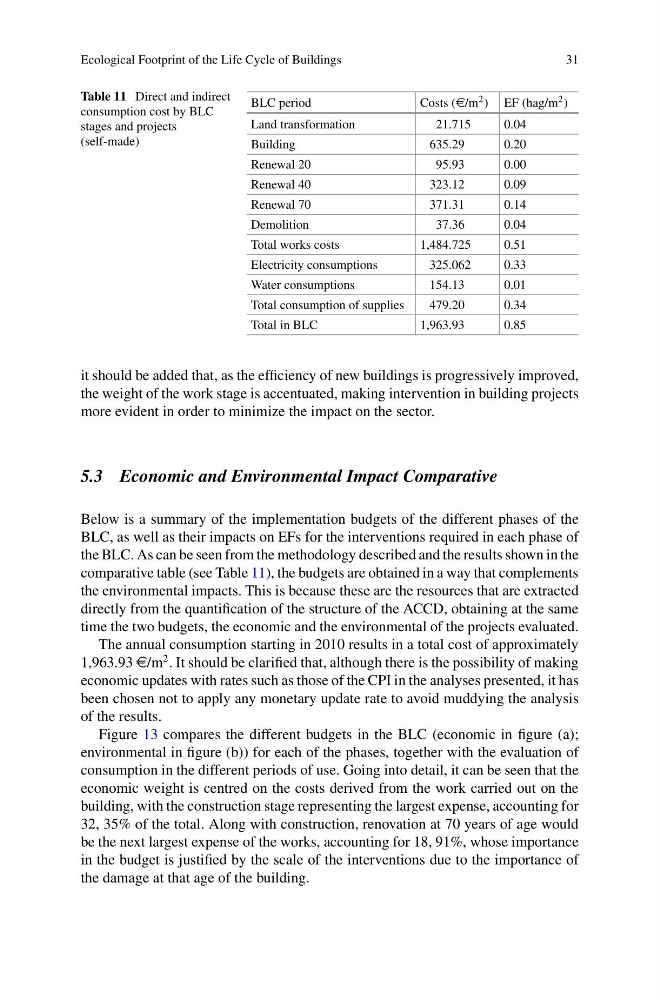
Table 11 Direct and indirect
consumption cost by BLC
stages and projects
(self-made)
BLC period
Costs (e/m 2 ) EF (hag/m 2 )
Land transformation
21.715
0.04
Building
635.29
0.20
Renewal 20
95.93
0.00
Renewal 40
323.12
0.09
Renewal 70
371.31
0.14
Demolition
37.36
0.04
Total works costs
1,484.725
0.51
Electricity consumptions
325.062
0.33
Water consumptions
154.13
0.01
Total consumption of supplies
479.20
0.34
Total in BLC
1,963.93
0.85
it should be added that, as the efficiency of new buildings is progressively improved,
the weight of the work stage is accentuated, making intervention in building projects
more evident in order to minimize the impact on the sector.
5.3 Economic and Environmental Impact Comparative
Below is a summary of the implementation budgets of the different phases of the
BLC, as well as their impacts on EFs for the interventions required in each phase of
the BLC. As can be seen from the methodology described and the results shown in the
comparative table (see Table 11), the budgets are obtained in a way that complements
the environmental impacts. This is because these are the resources that are extracted
directly from the quantification of the structure of the ACCD, obtaining at the same
time the two budgets, the economic and the environmental of the projects evaluated.
The annual consumption starting in 2010 results in a total cost of approximately
1,963.93 e/m
2 . It should be clarified that, although there is the possibility of making
economic updates with rates such as those of the CPI in the analyses presented, it has
been chosen not to apply any monetary update rate to avoid muddying the analysis
of the results.
Figure 13 compares the different budgets in the BLC (economic in figure (a);
environmental in figure (b)) for each of the phases, together with the evaluation of
consumption in the different periods of use. Going into detail, it can be seen that the
economic weight is centred on the costs derived from the work carried out on the
building, with the construction stage representing the largest expense, accounting for
32, 35% of the total. Along with construction, renovation at 70 years of age would
be the next largest expense of the works, accounting for 18, 91%, whose importance
in the budget is justified by the scale of the interventions due to the importance of
the damage at that age of the building.
31
Table 11 Direct and indirect
consumption cost by BLC
stages and projects
(self-made)
BLC period
Costs (e/m 2 ) EF (hag/m 2 )
Land transformation
21.715
0.04
Building
635.29
0.20
Renewal 20
95.93
0.00
Renewal 40
323.12
0.09
Renewal 70
371.31
0.14
Demolition
37.36
0.04
Total works costs
1,484.725
0.51
Electricity consumptions
325.062
0.33
Water consumptions
154.13
0.01
Total consumption of supplies
479.20
0.34
Total in BLC
1,963.93
0.85
it should be added that, as the efficiency of new buildings is progressively improved,
the weight of the work stage is accentuated, making intervention in building projects
more evident in order to minimize the impact on the sector.
5.3 Economic and Environmental Impact Comparative
Below is a summary of the implementation budgets of the different phases of the
BLC, as well as their impacts on EFs for the interventions required in each phase of
the BLC. As can be seen from the methodology described and the results shown in the
comparative table (see Table 11), the budgets are obtained in a way that complements
the environmental impacts. This is because these are the resources that are extracted
directly from the quantification of the structure of the ACCD, obtaining at the same
time the two budgets, the economic and the environmental of the projects evaluated.
The annual consumption starting in 2010 results in a total cost of approximately
1,963.93 e/m
2 . It should be clarified that, although there is the possibility of making
economic updates with rates such as those of the CPI in the analyses presented, it has
been chosen not to apply any monetary update rate to avoid muddying the analysis
of the results.
Figure 13 compares the different budgets in the BLC (economic in figure (a);
environmental in figure (b)) for each of the phases, together with the evaluation of
consumption in the different periods of use. Going into detail, it can be seen that the
economic weight is centred on the costs derived from the work carried out on the
building, with the construction stage representing the largest expense, accounting for
32, 35% of the total. Along with construction, renovation at 70 years of age would
be the next largest expense of the works, accounting for 18, 91%, whose importance
in the budget is justified by the scale of the interventions due to the importance of
the damage at that age of the building.