

Ecological Footprint of the Life Cycle of Buildings
21
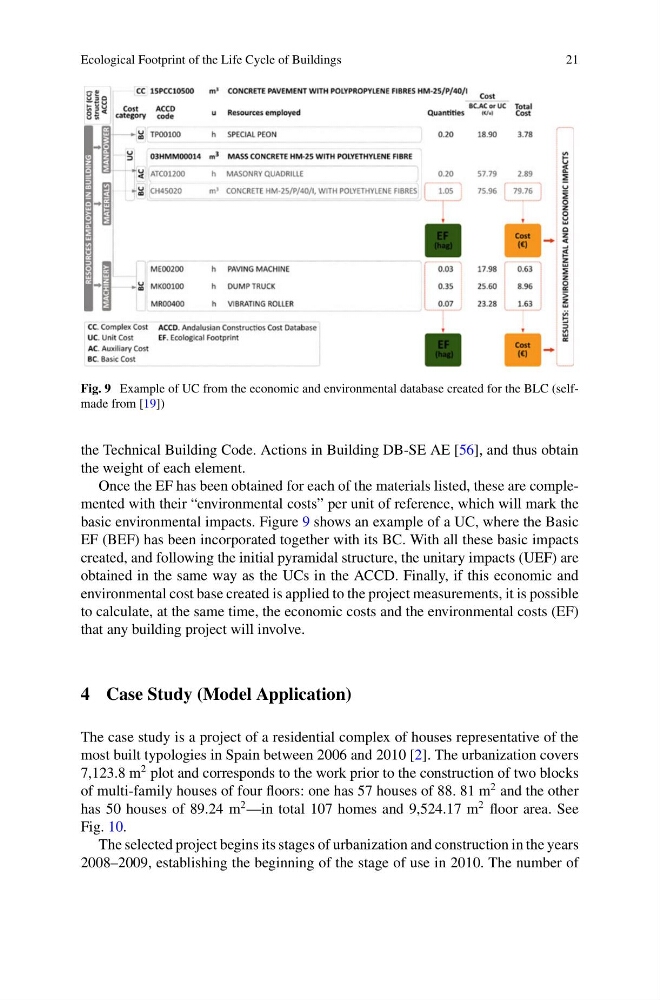
Fig. 9 Example of UC from the economic and environmental database created for the BLC (selfmade from [19])
the Technical Building Code. Actions in Building DB-SE AE [56], and thus obtain
the weight of each element.
Once the EF has been obtained for each of the materials listed, these are complemented with their “environmental costs” per unit of reference, which will mark the
basic environmental impacts. Figure 9 shows an example of a UC, where the Basic
EF (BEF) has been incorporated together with its BC. With all these basic impacts
created, and following the initial pyramidal structure, the unitary impacts (UEF) are
obtained in the same way as the UCs in the ACCD. Finally, if this economic and
environmental cost base created is applied to the project measurements, it is possible
to calculate, at the same time, the economic costs and the environmental costs (EF)
that any building project will involve.
4 Case Study (Model Application)
The case study is a project of a residential complex of houses representative of the
most built typologies in Spain between 2006 and 2010 [2]. The urbanization covers
7,123.8 m
2 plot and corresponds to the work prior to the construction of two blocks
of multi-family houses of four floors: one has 57 houses of 88. 81 m
2 and the other
has 50 houses of 89.24 m
2 —in total 107 homes and 9,524.17 m
2 floor area. See
Fig. 10.
The selected project begins its stages of urbanization and construction in the years
2008–2009, establishing the beginning of the stage of use in 2010. The number of
21
Fig. 9 Example of UC from the economic and environmental database created for the BLC (selfmade from [19])
the Technical Building Code. Actions in Building DB-SE AE [56], and thus obtain
the weight of each element.
Once the EF has been obtained for each of the materials listed, these are complemented with their “environmental costs” per unit of reference, which will mark the
basic environmental impacts. Figure 9 shows an example of a UC, where the Basic
EF (BEF) has been incorporated together with its BC. With all these basic impacts
created, and following the initial pyramidal structure, the unitary impacts (UEF) are
obtained in the same way as the UCs in the ACCD. Finally, if this economic and
environmental cost base created is applied to the project measurements, it is possible
to calculate, at the same time, the economic costs and the environmental costs (EF)
that any building project will involve.
4 Case Study (Model Application)
The case study is a project of a residential complex of houses representative of the
most built typologies in Spain between 2006 and 2010 [2]. The urbanization covers
7,123.8 m
2 plot and corresponds to the work prior to the construction of two blocks
of multi-family houses of four floors: one has 57 houses of 88. 81 m
2 and the other
has 50 houses of 89.24 m
2 —in total 107 homes and 9,524.17 m
2 floor area. See
Fig. 10.
The selected project begins its stages of urbanization and construction in the years
2008–2009, establishing the beginning of the stage of use in 2010. The number of