

20
C. Rivero-Camacho et al.
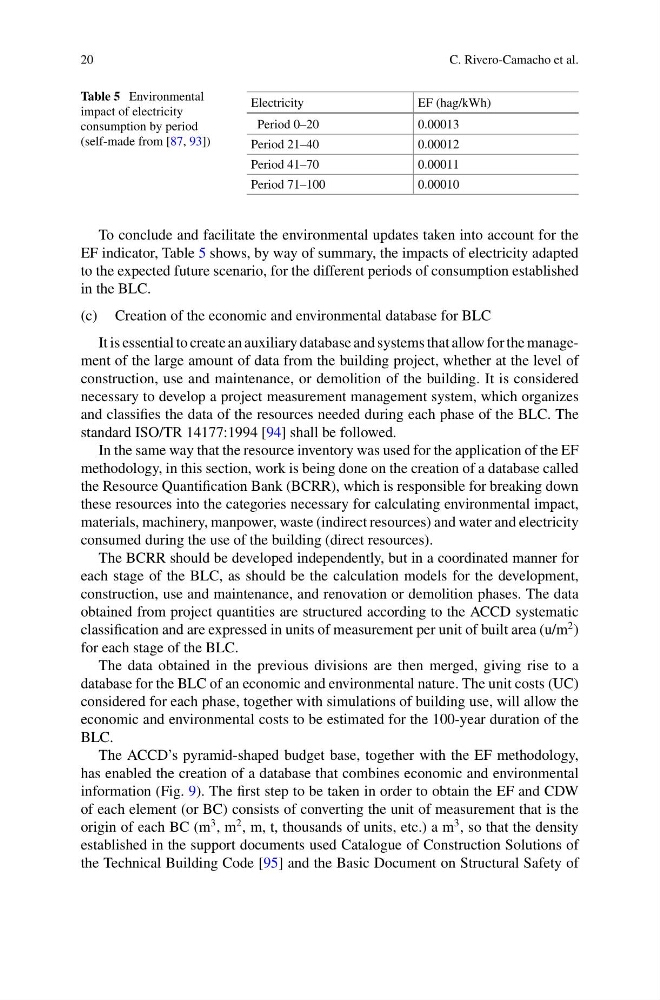
Table 5 Environmental
impact of electricity
consumption by period
(self-made from [87, 93])
Electricity
EF (hag/kWh)
Period 0–20
0.00013
Period 21–40
0.00012
Period 41–70
0.00011
Period 71–100
0.00010
To conclude and facilitate the environmental updates taken into account for the
EF indicator, Table 5 shows, by way of summary, the impacts of electricity adapted
to the expected future scenario, for the different periods of consumption established
in the BLC.
(c) Creation of the economic and environmental database for BLC
It is essential to create an auxiliary database and systems that allow for the management of the large amount of data from the building project, whether at the level of
construction, use and maintenance, or demolition of the building. It is considered
necessary to develop a project measurement management system, which organizes
and classifies the data of the resources needed during each phase of the BLC. The
standard ISO/TR 14177:1994 [94] shall be followed.
In the same way that the resource inventory was used for the application of the EF
methodology, in this section, work is being done on the creation of a database called
the Resource Quantification Bank (BCRR), which is responsible for breaking down
these resources into the categories necessary for calculating environmental impact,
materials, machinery, manpower, waste (indirect resources) and water and electricity
consumed during the use of the building (direct resources).
The BCRR should be developed independently, but in a coordinated manner for
each stage of the BLC, as should be the calculation models for the development,
construction, use and maintenance, and renovation or demolition phases. The data
obtained from project quantities are structured according to the ACCD systematic
classification and are expressed in units of measurement per unit of built area (u/m
2 )
for each stage of the BLC.
The data obtained in the previous divisions are then merged, giving rise to a
database for the BLC of an economic and environmental nature. The unit costs (UC)
considered for each phase, together with simulations of building use, will allow the
economic and environmental costs to be estimated for the 100-year duration of the
BLC.
The ACCD’s pyramid-shaped budget base, together with the EF methodology,
has enabled the creation of a database that combines economic and environmental
information (Fig. 9). The first step to be taken in order to obtain the EF and CDW
of each element (or BC) consists of converting the unit of measurement that is the
origin of each BC (m
3 , m
2 , m, t, thousands of units, etc.) a m
3 , so that the density
established in the support documents used Catalogue of Construction Solutions of
the Technical Building Code [95] and the Basic Document on Structural Safety of
C. Rivero-Camacho et al.
Table 5 Environmental
impact of electricity
consumption by period
(self-made from [87, 93])
Electricity
EF (hag/kWh)
Period 0–20
0.00013
Period 21–40
0.00012
Period 41–70
0.00011
Period 71–100
0.00010
To conclude and facilitate the environmental updates taken into account for the
EF indicator, Table 5 shows, by way of summary, the impacts of electricity adapted
to the expected future scenario, for the different periods of consumption established
in the BLC.
(c) Creation of the economic and environmental database for BLC
It is essential to create an auxiliary database and systems that allow for the management of the large amount of data from the building project, whether at the level of
construction, use and maintenance, or demolition of the building. It is considered
necessary to develop a project measurement management system, which organizes
and classifies the data of the resources needed during each phase of the BLC. The
standard ISO/TR 14177:1994 [94] shall be followed.
In the same way that the resource inventory was used for the application of the EF
methodology, in this section, work is being done on the creation of a database called
the Resource Quantification Bank (BCRR), which is responsible for breaking down
these resources into the categories necessary for calculating environmental impact,
materials, machinery, manpower, waste (indirect resources) and water and electricity
consumed during the use of the building (direct resources).
The BCRR should be developed independently, but in a coordinated manner for
each stage of the BLC, as should be the calculation models for the development,
construction, use and maintenance, and renovation or demolition phases. The data
obtained from project quantities are structured according to the ACCD systematic
classification and are expressed in units of measurement per unit of built area (u/m
2 )
for each stage of the BLC.
The data obtained in the previous divisions are then merged, giving rise to a
database for the BLC of an economic and environmental nature. The unit costs (UC)
considered for each phase, together with simulations of building use, will allow the
economic and environmental costs to be estimated for the 100-year duration of the
BLC.
The ACCD’s pyramid-shaped budget base, together with the EF methodology,
has enabled the creation of a database that combines economic and environmental
information (Fig. 9). The first step to be taken in order to obtain the EF and CDW
of each element (or BC) consists of converting the unit of measurement that is the
origin of each BC (m
3 , m
2 , m, t, thousands of units, etc.) a m
3 , so that the density
established in the support documents used Catalogue of Construction Solutions of
the Technical Building Code [95] and the Basic Document on Structural Safety of