

Ecological Footprint of the Life Cycle of Buildings
19
7.2 Electricity consumption
With regard to electrical consumption, the first thing that is needed is an estimate
of the consumption that the building will require according to its construction characteristics. To this end, the case studies have been subjected to a simplified consumption
analysis through the CE3x_housing energy certification programme (CE3X v2.3).
The initial configurations of the buildings have been modelled using the thermal
transmittances of their construction solutions according to the construction projects
and the subsequent improvement measures defined based on the new transmittances
improved in the successive renovation projects, obtaining consumption and emission
data.
Something important to take into account given the duration of the BLC are
the possible changes in the environmental impact of the energy consumed. The
continuous search to minimize the environmental impacts caused by the current
lifestyle leads to the progressive improvement of the manufacturing processes of
resources, as well as the search for sources of energy generation that reduce GHG
emissions as much as possible, that is, energy matrices, tends to increase the presence
of renewable sources. For this reason, the model includes the evolution of the energy
mix over time. With the combination of data collected from predictions of the energy
mix [87] and data obtained from LCA databases [93], a possible future scenario was
generated, where the different trends (polynomials) of the energy sources in the
Spanish mix were analysed.
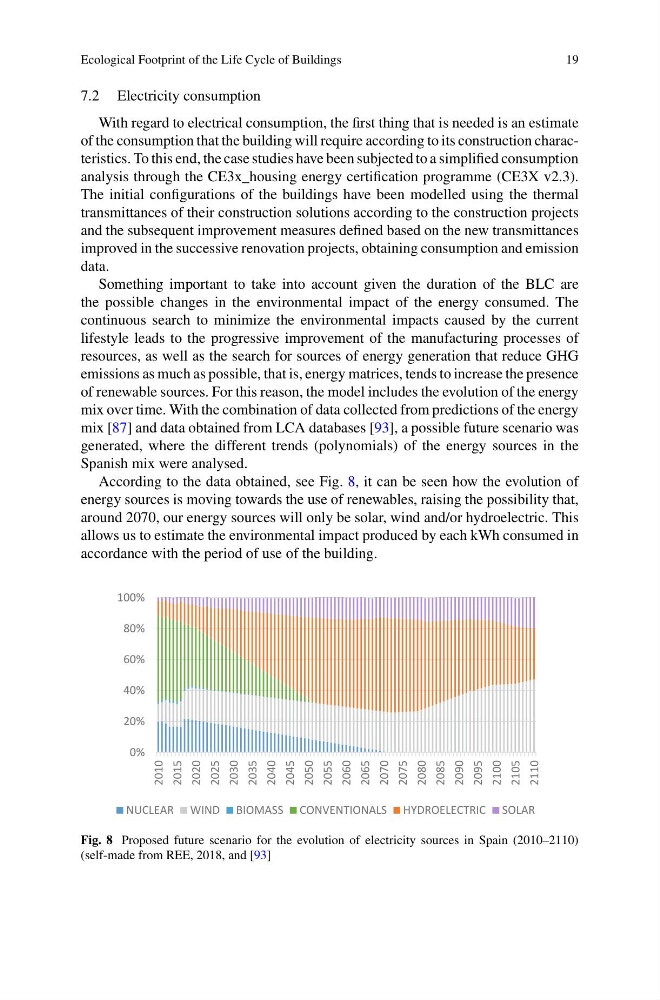
According to the data obtained, see Fig. 8, it can be seen how the evolution of
energy sources is moving towards the use of renewables, raising the possibility that,
around 2070, our energy sources will only be solar, wind and/or hydroelectric. This
allows us to estimate the environmental impact produced by each kWh consumed in
accordance with the period of use of the building.
0%
20%
40%
60%
80%
100%
2010
2015
2020
2025
2030
2035
2040
2045
2050
2055
2060
2065
2070
2075
2080
2085
2090
2095
2100
2105
2110
NUCLEAR WIND BIOMASS CONVENTIONALS HYDROELECTRIC SOLAR
Fig. 8 Proposed future scenario for the evolution of electricity sources in Spain (2010–2110)
(self-made from REE, 2018, and [93]
19
7.2 Electricity consumption
With regard to electrical consumption, the first thing that is needed is an estimate
of the consumption that the building will require according to its construction characteristics. To this end, the case studies have been subjected to a simplified consumption
analysis through the CE3x_housing energy certification programme (CE3X v2.3).
The initial configurations of the buildings have been modelled using the thermal
transmittances of their construction solutions according to the construction projects
and the subsequent improvement measures defined based on the new transmittances
improved in the successive renovation projects, obtaining consumption and emission
data.
Something important to take into account given the duration of the BLC are
the possible changes in the environmental impact of the energy consumed. The
continuous search to minimize the environmental impacts caused by the current
lifestyle leads to the progressive improvement of the manufacturing processes of
resources, as well as the search for sources of energy generation that reduce GHG
emissions as much as possible, that is, energy matrices, tends to increase the presence
of renewable sources. For this reason, the model includes the evolution of the energy
mix over time. With the combination of data collected from predictions of the energy
mix [87] and data obtained from LCA databases [93], a possible future scenario was
generated, where the different trends (polynomials) of the energy sources in the
Spanish mix were analysed.
According to the data obtained, see Fig. 8, it can be seen how the evolution of
energy sources is moving towards the use of renewables, raising the possibility that,
around 2070, our energy sources will only be solar, wind and/or hydroelectric. This
allows us to estimate the environmental impact produced by each kWh consumed in
accordance with the period of use of the building.
0%
20%
40%
60%
80%
100%
2010
2015
2020
2025
2030
2035
2040
2045
2050
2055
2060
2065
2070
2075
2080
2085
2090
2095
2100
2105
2110
NUCLEAR WIND BIOMASS CONVENTIONALS HYDROELECTRIC SOLAR
Fig. 8 Proposed future scenario for the evolution of electricity sources in Spain (2010–2110)
(self-made from REE, 2018, and [93]