

2 Affinity-Based Methods for the Analysis of Emerging …
41
2.2 Affinity Methods Using Antibodies
2.2.1 General Principles of Antibody-Based Affinity
Separations
Immunoaffinity chromatography (IAC) refers to an affinity chromatographic technique that employs antibodies as binding agents for the selective extraction or detection of target analytes (Hage and Phillips 2006; Nelson and Hage 2006; Zhang et al.
2018). Antibodies are glycoproteins that are generated by the body in response to
a foreign agent, or antigen, such as a virus or bacterial cell. A typical antibody, as
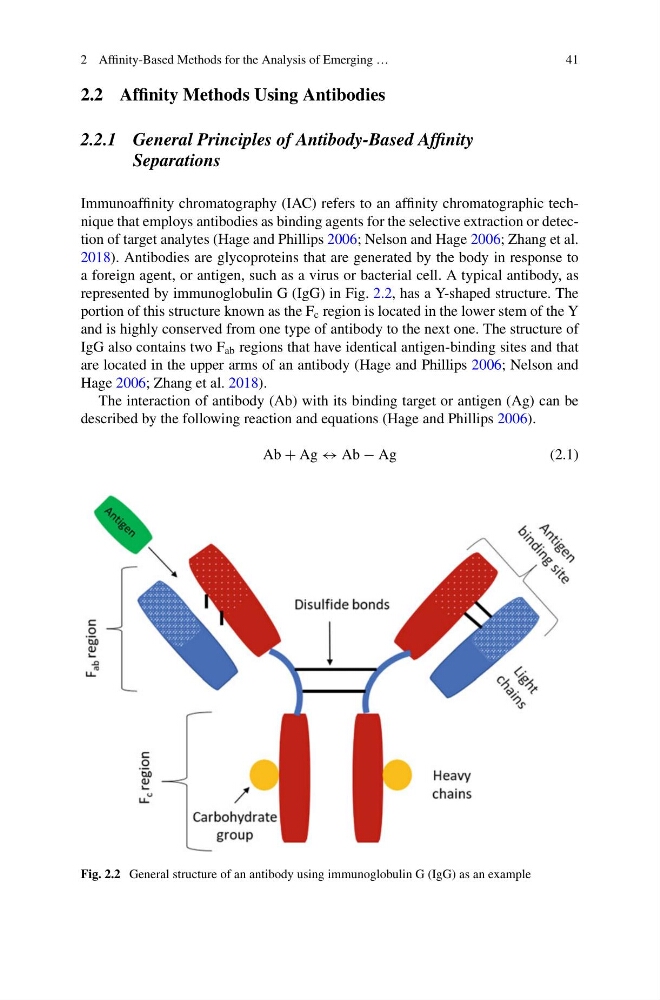
represented by immunoglobulin G (IgG) in Fig. 2.2, has a Y-shaped structure. The
portion of this structure known as the F c region is located in the lower stem of the Y
and is highly conserved from one type of antibody to the next one. The structure of
IgG also contains two F ab regions that have identical antigen-binding sites and that
are located in the upper arms of an antibody (Hage and Phillips 2006; Nelson and
Hage 2006; Zhang et al. 2018).
The interaction of antibody (Ab) with its binding target or antigen (Ag) can be
described by the following reaction and equations (Hage and Phillips 2006).
Ab + Ag ↔ Ab − Ag
(2.1)
Fig. 2.2 General structure of an antibody using immunoglobulin G (IgG) as an example
41
2.2 Affinity Methods Using Antibodies
2.2.1 General Principles of Antibody-Based Affinity
Separations
Immunoaffinity chromatography (IAC) refers to an affinity chromatographic technique that employs antibodies as binding agents for the selective extraction or detection of target analytes (Hage and Phillips 2006; Nelson and Hage 2006; Zhang et al.
2018). Antibodies are glycoproteins that are generated by the body in response to
a foreign agent, or antigen, such as a virus or bacterial cell. A typical antibody, as
represented by immunoglobulin G (IgG) in Fig. 2.2, has a Y-shaped structure. The
portion of this structure known as the F c region is located in the lower stem of the Y
and is highly conserved from one type of antibody to the next one. The structure of
IgG also contains two F ab regions that have identical antigen-binding sites and that
are located in the upper arms of an antibody (Hage and Phillips 2006; Nelson and
Hage 2006; Zhang et al. 2018).
The interaction of antibody (Ab) with its binding target or antigen (Ag) can be
described by the following reaction and equations (Hage and Phillips 2006).
Ab + Ag ↔ Ab − Ag
(2.1)
Fig. 2.2 General structure of an antibody using immunoglobulin G (IgG) as an example