

42
S. Iftekhar et al.
K a =
k a
k d
(2.2)
K a =
[Ab − Ag]
[Ab][Ag]
(2.3)
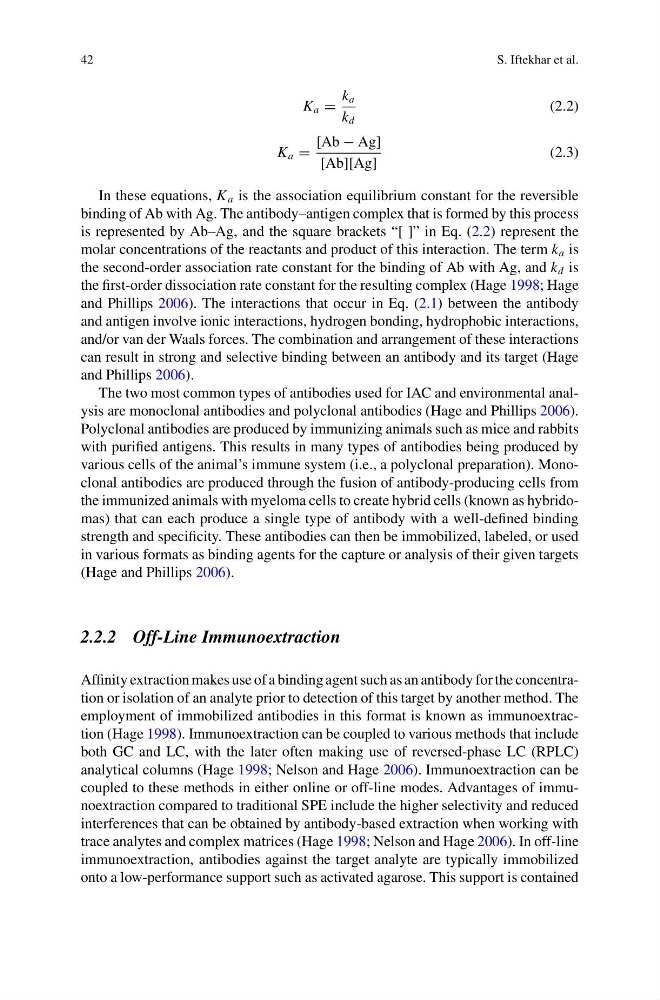
In these equations, K a is the association equilibrium constant for the reversible
binding of Ab with Ag. The antibody–antigen complex that is formed by this process
is represented by Ab–Ag, and the square brackets “[ ]” in Eq. (2.2) represent the
molar concentrations of the reactants and product of this interaction. The term k a is
the second-order association rate constant for the binding of Ab with Ag, and k d is
the first-order dissociation rate constant for the resulting complex (Hage 1998; Hage
and Phillips 2006). The interactions that occur in Eq. (2.1) between the antibody
and antigen involve ionic interactions, hydrogen bonding, hydrophobic interactions,
and/or van der Waals forces. The combination and arrangement of these interactions
can result in strong and selective binding between an antibody and its target (Hage
and Phillips 2006).
The two most common types of antibodies used for IAC and environmental analysis are monoclonal antibodies and polyclonal antibodies (Hage and Phillips 2006).
Polyclonal antibodies are produced by immunizing animals such as mice and rabbits
with purified antigens. This results in many types of antibodies being produced by
various cells of the animal’s immune system (i.e., a polyclonal preparation). Monoclonal antibodies are produced through the fusion of antibody-producing cells from
the immunized animals with myeloma cells to create hybrid cells (known as hybridomas) that can each produce a single type of antibody with a well-defined binding
strength and specificity. These antibodies can then be immobilized, labeled, or used
in various formats as binding agents for the capture or analysis of their given targets
(Hage and Phillips 2006).
2.2.2 Off-Line Immunoextraction
Affinity extraction makes use of a binding agent such as an antibody for the concentration or isolation of an analyte prior to detection of this target by another method. The
employment of immobilized antibodies in this format is known as immunoextraction (Hage 1998). Immunoextraction can be coupled to various methods that include
both GC and LC, with the later often making use of reversed-phase LC (RPLC)
analytical columns (Hage 1998; Nelson and Hage 2006). Immunoextraction can be
coupled to these methods in either online or off-line modes. Advantages of immunoextraction compared to traditional SPE include the higher selectivity and reduced
interferences that can be obtained by antibody-based extraction when working with
trace analytes and complex matrices (Hage 1998; Nelson and Hage 2006). In off-line
immunoextraction, antibodies against the target analyte are typically immobilized
onto a low-performance support such as activated agarose. This support is contained
S. Iftekhar et al.
K a =
k a
k d
(2.2)
K a =
[Ab − Ag]
[Ab][Ag]
(2.3)
In these equations, K a is the association equilibrium constant for the reversible
binding of Ab with Ag. The antibody–antigen complex that is formed by this process
is represented by Ab–Ag, and the square brackets “[ ]” in Eq. (2.2) represent the
molar concentrations of the reactants and product of this interaction. The term k a is
the second-order association rate constant for the binding of Ab with Ag, and k d is
the first-order dissociation rate constant for the resulting complex (Hage 1998; Hage
and Phillips 2006). The interactions that occur in Eq. (2.1) between the antibody
and antigen involve ionic interactions, hydrogen bonding, hydrophobic interactions,
and/or van der Waals forces. The combination and arrangement of these interactions
can result in strong and selective binding between an antibody and its target (Hage
and Phillips 2006).
The two most common types of antibodies used for IAC and environmental analysis are monoclonal antibodies and polyclonal antibodies (Hage and Phillips 2006).
Polyclonal antibodies are produced by immunizing animals such as mice and rabbits
with purified antigens. This results in many types of antibodies being produced by
various cells of the animal’s immune system (i.e., a polyclonal preparation). Monoclonal antibodies are produced through the fusion of antibody-producing cells from
the immunized animals with myeloma cells to create hybrid cells (known as hybridomas) that can each produce a single type of antibody with a well-defined binding
strength and specificity. These antibodies can then be immobilized, labeled, or used
in various formats as binding agents for the capture or analysis of their given targets
(Hage and Phillips 2006).
2.2.2 Off-Line Immunoextraction
Affinity extraction makes use of a binding agent such as an antibody for the concentration or isolation of an analyte prior to detection of this target by another method. The
employment of immobilized antibodies in this format is known as immunoextraction (Hage 1998). Immunoextraction can be coupled to various methods that include
both GC and LC, with the later often making use of reversed-phase LC (RPLC)
analytical columns (Hage 1998; Nelson and Hage 2006). Immunoextraction can be
coupled to these methods in either online or off-line modes. Advantages of immunoextraction compared to traditional SPE include the higher selectivity and reduced
interferences that can be obtained by antibody-based extraction when working with
trace analytes and complex matrices (Hage 1998; Nelson and Hage 2006). In off-line
immunoextraction, antibodies against the target analyte are typically immobilized
onto a low-performance support such as activated agarose. This support is contained