

422
K. Dhangar and M. Kumar
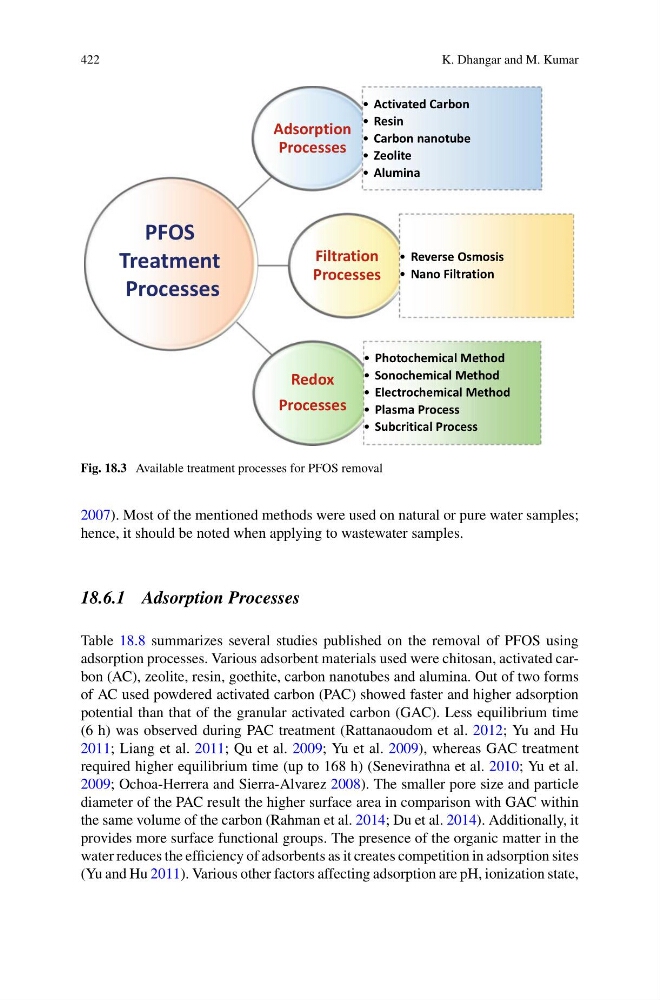
Adsorption
Processes
• Activated Carbon
• Resin
• Carbon nanotube
• Zeolite
• Alumina
Filtration
Processes
• Reverse Osmosis
• Nano Filtration
Redox
Processes
• Photochemical Method
• Sonochemical Method
• Electrochemical Method
• Plasma Process
• Subcritical Process
PFOS
Treatment
Processes
Fig. 18.3 Available treatment processes for PFOS removal
2007). Most of the mentioned methods were used on natural or pure water samples;
hence, it should be noted when applying to wastewater samples.
18.6.1 Adsorption Processes
Table 18.8 summarizes several studies published on the removal of PFOS using
adsorption processes. Various adsorbent materials used were chitosan, activated carbon (AC), zeolite, resin, goethite, carbon nanotubes and alumina. Out of two forms
of AC used powdered activated carbon (PAC) showed faster and higher adsorption
potential than that of the granular activated carbon (GAC). Less equilibrium time
(6 h) was observed during PAC treatment (Rattanaoudom et al. 2012; Yu and Hu
2011; Liang et al. 2011; Qu et al. 2009; Yu et al. 2009), whereas GAC treatment
required higher equilibrium time (up to 168 h) (Senevirathna et al. 2010; Yu et al.
2009; Ochoa-Herrera and Sierra-Alvarez 2008). The smaller pore size and particle
diameter of the PAC result the higher surface area in comparison with GAC within
the same volume of the carbon (Rahman et al. 2014; Du et al. 2014). Additionally, it
provides more surface functional groups. The presence of the organic matter in the
water reduces the efficiency of adsorbents as it creates competition in adsorption sites
(Yu and Hu 2011). Various other factors affecting adsorption are pH, ionization state,
K. Dhangar and M. Kumar
Adsorption
Processes
• Activated Carbon
• Resin
• Carbon nanotube
• Zeolite
• Alumina
Filtration
Processes
• Reverse Osmosis
• Nano Filtration
Redox
Processes
• Photochemical Method
• Sonochemical Method
• Electrochemical Method
• Plasma Process
• Subcritical Process
PFOS
Treatment
Processes
Fig. 18.3 Available treatment processes for PFOS removal
2007). Most of the mentioned methods were used on natural or pure water samples;
hence, it should be noted when applying to wastewater samples.
18.6.1 Adsorption Processes
Table 18.8 summarizes several studies published on the removal of PFOS using
adsorption processes. Various adsorbent materials used were chitosan, activated carbon (AC), zeolite, resin, goethite, carbon nanotubes and alumina. Out of two forms
of AC used powdered activated carbon (PAC) showed faster and higher adsorption
potential than that of the granular activated carbon (GAC). Less equilibrium time
(6 h) was observed during PAC treatment (Rattanaoudom et al. 2012; Yu and Hu
2011; Liang et al. 2011; Qu et al. 2009; Yu et al. 2009), whereas GAC treatment
required higher equilibrium time (up to 168 h) (Senevirathna et al. 2010; Yu et al.
2009; Ochoa-Herrera and Sierra-Alvarez 2008). The smaller pore size and particle
diameter of the PAC result the higher surface area in comparison with GAC within
the same volume of the carbon (Rahman et al. 2014; Du et al. 2014). Additionally, it
provides more surface functional groups. The presence of the organic matter in the
water reduces the efficiency of adsorbents as it creates competition in adsorption sites
(Yu and Hu 2011). Various other factors affecting adsorption are pH, ionization state,