

18 Perfluorooctanesulfonate (PFOS), Its Occurrence, Fate …
423
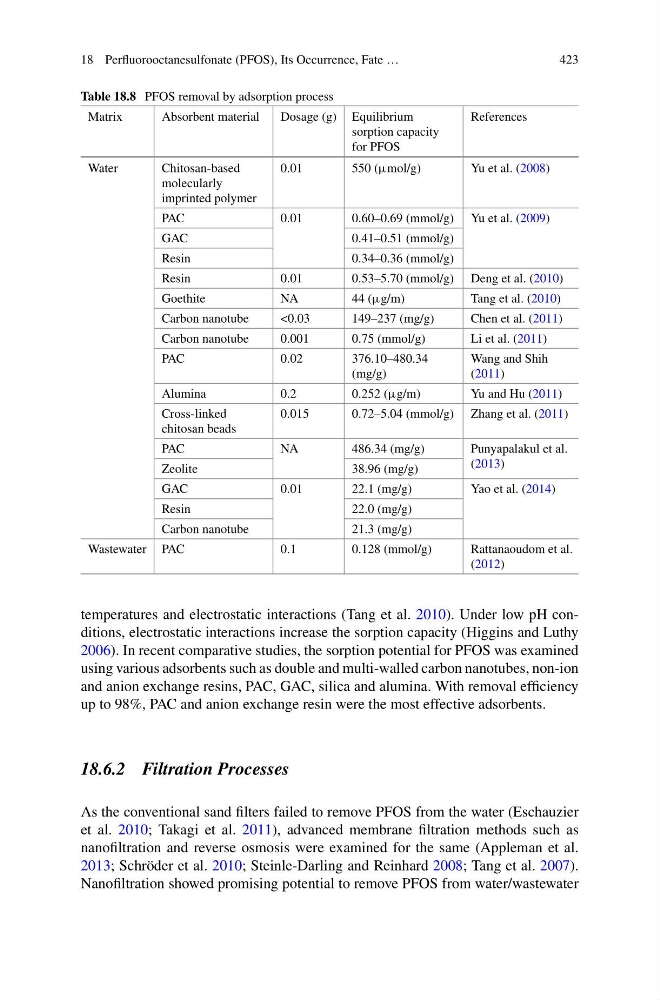
Table 18.8 PFOS removal by adsorption process
Matrix
Absorbent material
Dosage (g) Equilibrium
sorption capacity
for PFOS
References
Water
Chitosan-based
molecularly
imprinted polymer
0.01
550 (µmol/g)
Yu et al. (2008)
PAC
0.01
0.60–0.69 (mmol/g) Yu et al. (2009)
GAC
0.41–0.51 (mmol/g)
Resin
0.34–0.36 (mmol/g)
Resin
0.01
0.53–5.70 (mmol/g) Deng et al. (2010)
Goethite
NA
44 (µg/m)
Tang et al. (2010)
Carbon nanotube
<0.03
149–237 (mg/g)
Chen et al. (2011)
Carbon nanotube
0.001
0.75 (mmol/g)
Li et al. (2011)
PAC
0.02
376.10–480.34
(mg/g)
Wang and Shih
(2011)
Alumina
0.2
0.252 (µg/m)
Yu and Hu (2011)
Cross-linked
chitosan beads
0.015
0.72–5.04 (mmol/g) Zhang et al. (2011)
PAC
NA
486.34 (mg/g)
Punyapalakul et al.
(2013)
Zeolite
38.96 (mg/g)
GAC
0.01
22.1 (mg/g)
Yao et al. (2014)
Resin
22.0 (mg/g)
Carbon nanotube
21.3 (mg/g)
Wastewater PAC
0.1
0.128 (mmol/g)
Rattanaoudom et al.
(2012)
temperatures and electrostatic interactions (Tang et al. 2010). Under low pH conditions, electrostatic interactions increase the sorption capacity (Higgins and Luthy
2006). In recent comparative studies, the sorption potential for PFOS was examined
using various adsorbents such as double and multi-walled carbon nanotubes, non-ion
and anion exchange resins, PAC, GAC, silica and alumina. With removal efficiency
up to 98%, PAC and anion exchange resin were the most effective adsorbents.
18.6.2 Filtration Processes
As the conventional sand filters failed to remove PFOS from the water (Eschauzier
et al. 2010; Takagi et al. 2011), advanced membrane filtration methods such as
nanofiltration and reverse osmosis were examined for the same (Appleman et al.
2013; Schröder et al. 2010; Steinle-Darling and Reinhard 2008; Tang et al. 2007).
Nanofiltration showed promising potential to remove PFOS from water/wastewater
423
Table 18.8 PFOS removal by adsorption process
Matrix
Absorbent material
Dosage (g) Equilibrium
sorption capacity
for PFOS
References
Water
Chitosan-based
molecularly
imprinted polymer
0.01
550 (µmol/g)
Yu et al. (2008)
PAC
0.01
0.60–0.69 (mmol/g) Yu et al. (2009)
GAC
0.41–0.51 (mmol/g)
Resin
0.34–0.36 (mmol/g)
Resin
0.01
0.53–5.70 (mmol/g) Deng et al. (2010)
Goethite
NA
44 (µg/m)
Tang et al. (2010)
Carbon nanotube
<0.03
149–237 (mg/g)
Chen et al. (2011)
Carbon nanotube
0.001
0.75 (mmol/g)
Li et al. (2011)
PAC
0.02
376.10–480.34
(mg/g)
Wang and Shih
(2011)
Alumina
0.2
0.252 (µg/m)
Yu and Hu (2011)
Cross-linked
chitosan beads
0.015
0.72–5.04 (mmol/g) Zhang et al. (2011)
PAC
NA
486.34 (mg/g)
Punyapalakul et al.
(2013)
Zeolite
38.96 (mg/g)
GAC
0.01
22.1 (mg/g)
Yao et al. (2014)
Resin
22.0 (mg/g)
Carbon nanotube
21.3 (mg/g)
Wastewater PAC
0.1
0.128 (mmol/g)
Rattanaoudom et al.
(2012)
temperatures and electrostatic interactions (Tang et al. 2010). Under low pH conditions, electrostatic interactions increase the sorption capacity (Higgins and Luthy
2006). In recent comparative studies, the sorption potential for PFOS was examined
using various adsorbents such as double and multi-walled carbon nanotubes, non-ion
and anion exchange resins, PAC, GAC, silica and alumina. With removal efficiency
up to 98%, PAC and anion exchange resin were the most effective adsorbents.
18.6.2 Filtration Processes
As the conventional sand filters failed to remove PFOS from the water (Eschauzier
et al. 2010; Takagi et al. 2011), advanced membrane filtration methods such as
nanofiltration and reverse osmosis were examined for the same (Appleman et al.
2013; Schröder et al. 2010; Steinle-Darling and Reinhard 2008; Tang et al. 2007).
Nanofiltration showed promising potential to remove PFOS from water/wastewater