

17 Scope of Conventional Versus Advanced Technologies …
391
retained in the so-called retentate. Both the macromolecules and the solution containing the small molecules may be used for further analysis. UF membranes can
be utilized for removal of micron-sized pathogens from drinking water. They can
also be utilized to remove particulates and macromolecules from untreated water,
to produce drinkable water. UF processes are preferred over traditional treatment
methods because (i) no chemicals are required aside from cleaning and (ii) constant
product quality is attained regardless of feed quality.
Those industries which consume huge volumes of water or release highly toxic
effluents make use of ultrafiltration to reclaim water. Such industries are the chemicals, steel, plastics and resins, paper and pulp, and pharmaceutical industries. Food
and beverage, including soft drinks and canned foods, industries also use UF process
of reclaiming the effluent water from their industries.
In many cases, UF is used as prefiltration process, for example, in reverse-osmosis
plants, ultra filtration is done prior to reverse osmosis in order to protect the reverseosmosis process. UF is also frequently used to pretreat surface water, seawater, and
biologically treated municipal water before directing the water to reverse-osmosis
unit. UF is an efficient way of reducing the silt density index of water and remove
such particulates that can taint the reverse-osmosis membranes.
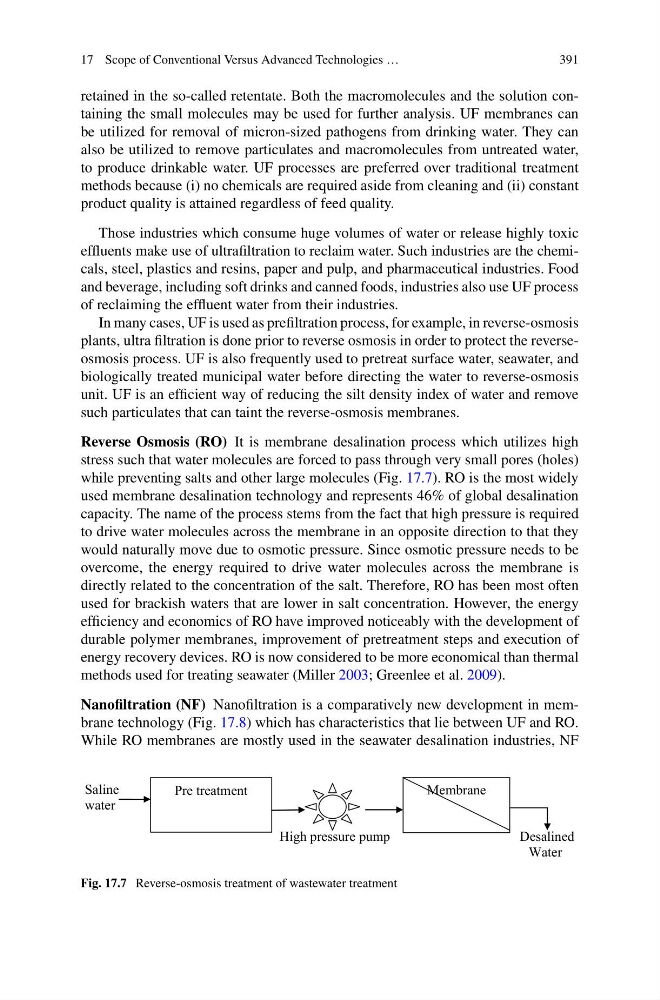
Reverse Osmosis (RO) It is membrane desalination process which utilizes high
stress such that water molecules are forced to pass through very small pores (holes)
while preventing salts and other large molecules (Fig. 17.7). RO is the most widely
used membrane desalination technology and represents 46% of global desalination
capacity. The name of the process stems from the fact that high pressure is required
to drive water molecules across the membrane in an opposite direction to that they
would naturally move due to osmotic pressure. Since osmotic pressure needs to be
overcome, the energy required to drive water molecules across the membrane is
directly related to the concentration of the salt. Therefore, RO has been most often
used for brackish waters that are lower in salt concentration. However, the energy
efficiency and economics of RO have improved noticeably with the development of
durable polymer membranes, improvement of pretreatment steps and execution of
energy recovery devices. RO is now considered to be more economical than thermal
methods used for treating seawater (Miller 2003; Greenlee et al. 2009).
Nanofiltration (NF) Nanofiltration is a comparatively new development in membrane technology (Fig. 17.8) which has characteristics that lie between UF and RO.
While RO membranes are mostly used in the seawater desalination industries, NF
Saline
water
High pressure pump
Desalined
Water
Pre treatment
Membrane
Fig. 17.7 Reverse-osmosis treatment of wastewater treatment
391
retained in the so-called retentate. Both the macromolecules and the solution containing the small molecules may be used for further analysis. UF membranes can
be utilized for removal of micron-sized pathogens from drinking water. They can
also be utilized to remove particulates and macromolecules from untreated water,
to produce drinkable water. UF processes are preferred over traditional treatment
methods because (i) no chemicals are required aside from cleaning and (ii) constant
product quality is attained regardless of feed quality.
Those industries which consume huge volumes of water or release highly toxic
effluents make use of ultrafiltration to reclaim water. Such industries are the chemicals, steel, plastics and resins, paper and pulp, and pharmaceutical industries. Food
and beverage, including soft drinks and canned foods, industries also use UF process
of reclaiming the effluent water from their industries.
In many cases, UF is used as prefiltration process, for example, in reverse-osmosis
plants, ultra filtration is done prior to reverse osmosis in order to protect the reverseosmosis process. UF is also frequently used to pretreat surface water, seawater, and
biologically treated municipal water before directing the water to reverse-osmosis
unit. UF is an efficient way of reducing the silt density index of water and remove
such particulates that can taint the reverse-osmosis membranes.
Reverse Osmosis (RO) It is membrane desalination process which utilizes high
stress such that water molecules are forced to pass through very small pores (holes)
while preventing salts and other large molecules (Fig. 17.7). RO is the most widely
used membrane desalination technology and represents 46% of global desalination
capacity. The name of the process stems from the fact that high pressure is required
to drive water molecules across the membrane in an opposite direction to that they
would naturally move due to osmotic pressure. Since osmotic pressure needs to be
overcome, the energy required to drive water molecules across the membrane is
directly related to the concentration of the salt. Therefore, RO has been most often
used for brackish waters that are lower in salt concentration. However, the energy
efficiency and economics of RO have improved noticeably with the development of
durable polymer membranes, improvement of pretreatment steps and execution of
energy recovery devices. RO is now considered to be more economical than thermal
methods used for treating seawater (Miller 2003; Greenlee et al. 2009).
Nanofiltration (NF) Nanofiltration is a comparatively new development in membrane technology (Fig. 17.8) which has characteristics that lie between UF and RO.
While RO membranes are mostly used in the seawater desalination industries, NF
Saline
water
High pressure pump
Desalined
Water
Pre treatment
Membrane
Fig. 17.7 Reverse-osmosis treatment of wastewater treatment