

390
A. Srivastava
ranges between 0.1 and 10 µm (Baker 2012). The fairly accurate molecular weight of
macromolecules, these membranes can separate, is usually less than 100,000 g/mol.
The filters which are used in the MF process are specifically designed to avert particles such as algae, protozoa or large bacteria, and sediment from passing through
the specially contemplated filters. Extra microscopic, ionic, or atomic materials as
water (H 2 O), sodium (Na
+ ) or chloride (Cl
− ) ions, dissolved or natural organic matter, minute colloids and viruses, etc., can still pass through the filter. The suspended
liquid is made to pass through at a moderately high velocity of about 1–3 m/s and at
low-to-moderate pressures, ranging between 100 and 400 kPa, parallel or tangential
to the semipermeable membrane in a sheet or tubular form. After treatment through
the microfilter exit, process stream has a recovery rate usually in a range of about
90–98% (Kenna and Zander 2000). MF is an extensively process as it is capable of
being used at normal atmospheric pressure. Most abundantly microfiltration membranes are utilized in beverage, water, and bioprocessing industries. However, inspite
of having several advantages, since the use of MF is limited to the removal of contaminants of size <1 µm (i.e., dissolved solids), it is not useful for the removal of
most of the ECs.
17.1.1 Feed Permeate
Ultrafiltration (UF) UF is another variety of membrane filtration in which forces
like pressure or concentration gradients lead to a separation through a semipermeable
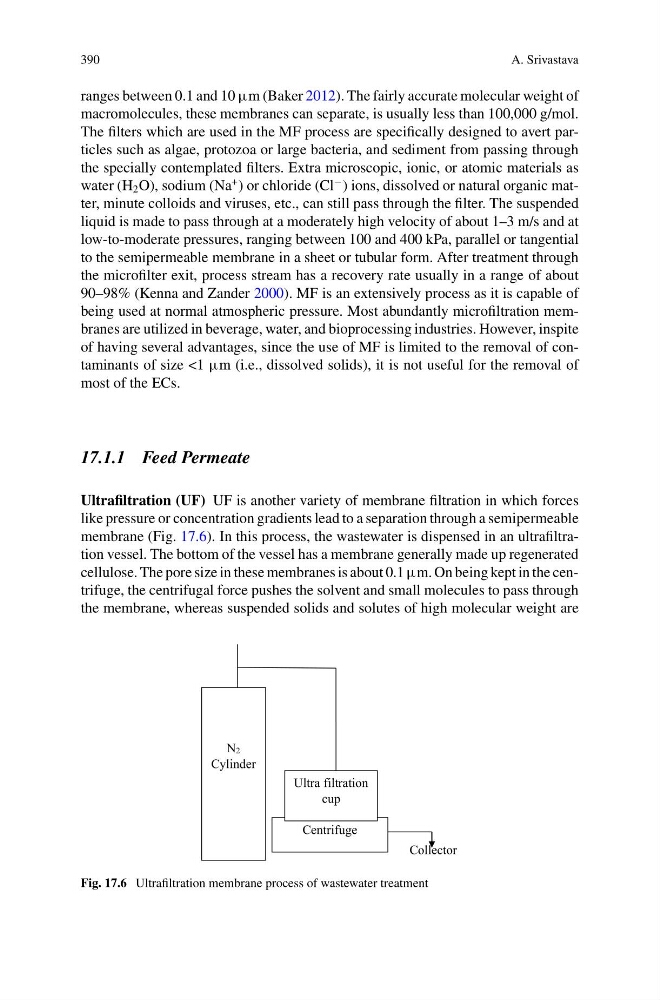
membrane (Fig. 17.6). In this process, the wastewater is dispensed in an ultrafiltration vessel. The bottom of the vessel has a membrane generally made up regenerated
cellulose. The pore size in these membranes is about 0.1 µm. On being kept in the centrifuge, the centrifugal force pushes the solvent and small molecules to pass through
the membrane, whereas suspended solids and solutes of high molecular weight are
Collector
N2
Cylinder
Centrifuge
Ultra filtration
cup
Fig. 17.6 Ultrafiltration membrane process of wastewater treatment
A. Srivastava
ranges between 0.1 and 10 µm (Baker 2012). The fairly accurate molecular weight of
macromolecules, these membranes can separate, is usually less than 100,000 g/mol.
The filters which are used in the MF process are specifically designed to avert particles such as algae, protozoa or large bacteria, and sediment from passing through
the specially contemplated filters. Extra microscopic, ionic, or atomic materials as
water (H 2 O), sodium (Na
+ ) or chloride (Cl
− ) ions, dissolved or natural organic matter, minute colloids and viruses, etc., can still pass through the filter. The suspended
liquid is made to pass through at a moderately high velocity of about 1–3 m/s and at
low-to-moderate pressures, ranging between 100 and 400 kPa, parallel or tangential
to the semipermeable membrane in a sheet or tubular form. After treatment through
the microfilter exit, process stream has a recovery rate usually in a range of about
90–98% (Kenna and Zander 2000). MF is an extensively process as it is capable of
being used at normal atmospheric pressure. Most abundantly microfiltration membranes are utilized in beverage, water, and bioprocessing industries. However, inspite
of having several advantages, since the use of MF is limited to the removal of contaminants of size <1 µm (i.e., dissolved solids), it is not useful for the removal of
most of the ECs.
17.1.1 Feed Permeate
Ultrafiltration (UF) UF is another variety of membrane filtration in which forces
like pressure or concentration gradients lead to a separation through a semipermeable
membrane (Fig. 17.6). In this process, the wastewater is dispensed in an ultrafiltration vessel. The bottom of the vessel has a membrane generally made up regenerated
cellulose. The pore size in these membranes is about 0.1 µm. On being kept in the centrifuge, the centrifugal force pushes the solvent and small molecules to pass through
the membrane, whereas suspended solids and solutes of high molecular weight are
Collector
N2
Cylinder
Centrifuge
Ultra filtration
cup
Fig. 17.6 Ultrafiltration membrane process of wastewater treatment