

17 Scope of Conventional Versus Advanced Technologies …
389
ensured. The chemical structure of quite a lot of compounds which are included in the
ECs are such that they can be easily solubilized in water and then transported through
the water cycle causing threat to aquatic organisms as well as humans (Agüera
et al. 2013). The ECs list of compounds has grown significantly in the current years
leading to an unidentified numbers of parent compounds and transformation products
(Nikolaou 2013).
Advanced technologies for the control and prevention of emerging contamination.
The occurrence of ECs in STP effluents, both industrial and domestic as well as
hospitals, despite the treatment through conventional methods, makes it inevitable to
adopt advanced treatment systems. The conventional wastewater treatment methods
vary greatly in their ability to remove drug or personal care product residues from
wastewaters. Some extra treatment ways need to be used at the effluent discharge
location or prior to the entry point of the drinking water delivery systems. Thus, before
wastewater disposal or reuse, some advanced wastewater treatments are essential to
effectively remove ECs possessing chronic toxicity, endocrine-disrupting effects, and
the capability of inducing the proliferation of highly resistant microbial strains in
water. Membrane processes like microfiltration (MF), ultrafiltration (UF), nanofiltration (NF), and reverse osmosis (RO) are some pressure-driven filtration processes
that are considered as highly effective processes (Adams et al. 2002; Strathmann
2001) for removing huge amounts of organic micropollutants including ECs.
The organic precursor matter as well as other ECs can be effectively removed
by use of membranes. Though there are several mechanisms through which ECs
removal by membranes is feasible, size exclusion is an effective way that can be
used to decontaminate water from these contaminants.
Microfiltration (MF) MF is the process in which impure or contaminated fluid is
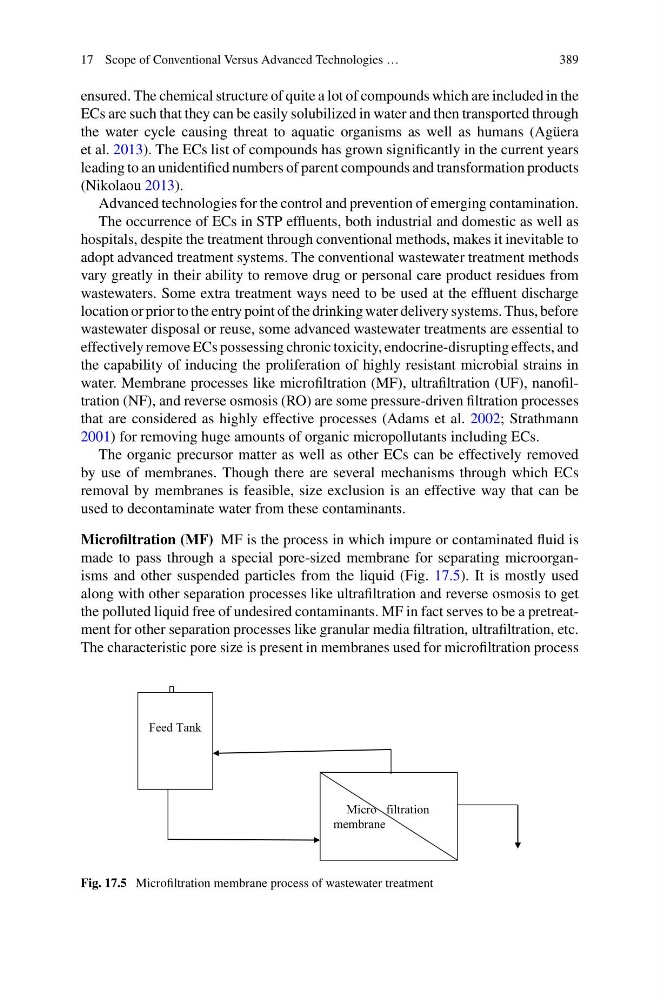
made to pass through a special pore-sized membrane for separating microorganisms and other suspended particles from the liquid (Fig. 17.5). It is mostly used
along with other separation processes like ultrafiltration and reverse osmosis to get
the polluted liquid free of undesired contaminants. MF in fact serves to be a pretreatment for other separation processes like granular media filtration, ultrafiltration, etc.
The characteristic pore size is present in membranes used for microfiltration process
Feed Tank
Micro filtration
membrane
Fig. 17.5 Microfiltration membrane process of wastewater treatment
389
ensured. The chemical structure of quite a lot of compounds which are included in the
ECs are such that they can be easily solubilized in water and then transported through
the water cycle causing threat to aquatic organisms as well as humans (Agüera
et al. 2013). The ECs list of compounds has grown significantly in the current years
leading to an unidentified numbers of parent compounds and transformation products
(Nikolaou 2013).
Advanced technologies for the control and prevention of emerging contamination.
The occurrence of ECs in STP effluents, both industrial and domestic as well as
hospitals, despite the treatment through conventional methods, makes it inevitable to
adopt advanced treatment systems. The conventional wastewater treatment methods
vary greatly in their ability to remove drug or personal care product residues from
wastewaters. Some extra treatment ways need to be used at the effluent discharge
location or prior to the entry point of the drinking water delivery systems. Thus, before
wastewater disposal or reuse, some advanced wastewater treatments are essential to
effectively remove ECs possessing chronic toxicity, endocrine-disrupting effects, and
the capability of inducing the proliferation of highly resistant microbial strains in
water. Membrane processes like microfiltration (MF), ultrafiltration (UF), nanofiltration (NF), and reverse osmosis (RO) are some pressure-driven filtration processes
that are considered as highly effective processes (Adams et al. 2002; Strathmann
2001) for removing huge amounts of organic micropollutants including ECs.
The organic precursor matter as well as other ECs can be effectively removed
by use of membranes. Though there are several mechanisms through which ECs
removal by membranes is feasible, size exclusion is an effective way that can be
used to decontaminate water from these contaminants.
Microfiltration (MF) MF is the process in which impure or contaminated fluid is
made to pass through a special pore-sized membrane for separating microorganisms and other suspended particles from the liquid (Fig. 17.5). It is mostly used
along with other separation processes like ultrafiltration and reverse osmosis to get
the polluted liquid free of undesired contaminants. MF in fact serves to be a pretreatment for other separation processes like granular media filtration, ultrafiltration, etc.
The characteristic pore size is present in membranes used for microfiltration process
Feed Tank
Micro filtration
membrane
Fig. 17.5 Microfiltration membrane process of wastewater treatment