

392
A. Srivastava
Raw
water
Recirculating
Permeate
Pump
Fermentor
Tank
Membrane
Unit
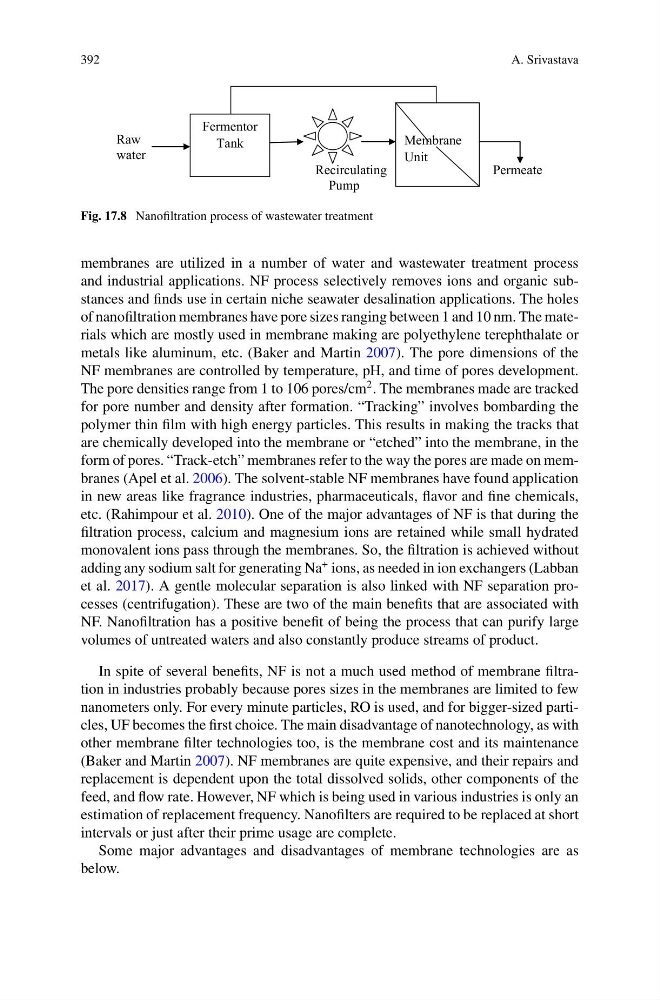
Fig. 17.8 Nanofiltration process of wastewater treatment
membranes are utilized in a number of water and wastewater treatment process
and industrial applications. NF process selectively removes ions and organic substances and finds use in certain niche seawater desalination applications. The holes
of nanofiltration membranes have pore sizes ranging between 1 and 10 nm. The materials which are mostly used in membrane making are polyethylene terephthalate or
metals like aluminum, etc. (Baker and Martin 2007). The pore dimensions of the
NF membranes are controlled by temperature, pH, and time of pores development.
The pore densities range from 1 to 106 pores/cm
2 . The membranes made are tracked
for pore number and density after formation. “Tracking” involves bombarding the
polymer thin film with high energy particles. This results in making the tracks that
are chemically developed into the membrane or “etched” into the membrane, in the
form of pores. “Track-etch” membranes refer to the way the pores are made on membranes (Apel et al. 2006). The solvent-stable NF membranes have found application
in new areas like fragrance industries, pharmaceuticals, flavor and fine chemicals,
etc. (Rahimpour et al. 2010). One of the major advantages of NF is that during the
filtration process, calcium and magnesium ions are retained while small hydrated
monovalent ions pass through the membranes. So, the filtration is achieved without
adding any sodium salt for generating Na
+ ions, as needed in ion exchangers (Labban
et al. 2017). A gentle molecular separation is also linked with NF separation processes (centrifugation). These are two of the main benefits that are associated with
NF. Nanofiltration has a positive benefit of being the process that can purify large
volumes of untreated waters and also constantly produce streams of product.
In spite of several benefits, NF is not a much used method of membrane filtration in industries probably because pores sizes in the membranes are limited to few
nanometers only. For every minute particles, RO is used, and for bigger-sized particles, UF becomes the first choice. The main disadvantage of nanotechnology, as with
other membrane filter technologies too, is the membrane cost and its maintenance
(Baker and Martin 2007). NF membranes are quite expensive, and their repairs and
replacement is dependent upon the total dissolved solids, other components of the
feed, and flow rate. However, NF which is being used in various industries is only an
estimation of replacement frequency. Nanofilters are required to be replaced at short
intervals or just after their prime usage are complete.
Some major advantages and disadvantages of membrane technologies are as
below.
A. Srivastava
Raw
water
Recirculating
Permeate
Pump
Fermentor
Tank
Membrane
Unit
Fig. 17.8 Nanofiltration process of wastewater treatment
membranes are utilized in a number of water and wastewater treatment process
and industrial applications. NF process selectively removes ions and organic substances and finds use in certain niche seawater desalination applications. The holes
of nanofiltration membranes have pore sizes ranging between 1 and 10 nm. The materials which are mostly used in membrane making are polyethylene terephthalate or
metals like aluminum, etc. (Baker and Martin 2007). The pore dimensions of the
NF membranes are controlled by temperature, pH, and time of pores development.
The pore densities range from 1 to 106 pores/cm
2 . The membranes made are tracked
for pore number and density after formation. “Tracking” involves bombarding the
polymer thin film with high energy particles. This results in making the tracks that
are chemically developed into the membrane or “etched” into the membrane, in the
form of pores. “Track-etch” membranes refer to the way the pores are made on membranes (Apel et al. 2006). The solvent-stable NF membranes have found application
in new areas like fragrance industries, pharmaceuticals, flavor and fine chemicals,
etc. (Rahimpour et al. 2010). One of the major advantages of NF is that during the
filtration process, calcium and magnesium ions are retained while small hydrated
monovalent ions pass through the membranes. So, the filtration is achieved without
adding any sodium salt for generating Na
+ ions, as needed in ion exchangers (Labban
et al. 2017). A gentle molecular separation is also linked with NF separation processes (centrifugation). These are two of the main benefits that are associated with
NF. Nanofiltration has a positive benefit of being the process that can purify large
volumes of untreated waters and also constantly produce streams of product.
In spite of several benefits, NF is not a much used method of membrane filtration in industries probably because pores sizes in the membranes are limited to few
nanometers only. For every minute particles, RO is used, and for bigger-sized particles, UF becomes the first choice. The main disadvantage of nanotechnology, as with
other membrane filter technologies too, is the membrane cost and its maintenance
(Baker and Martin 2007). NF membranes are quite expensive, and their repairs and
replacement is dependent upon the total dissolved solids, other components of the
feed, and flow rate. However, NF which is being used in various industries is only an
estimation of replacement frequency. Nanofilters are required to be replaced at short
intervals or just after their prime usage are complete.
Some major advantages and disadvantages of membrane technologies are as
below.