

17 Scope of Conventional Versus Advanced Technologies …
387
engineering aspects relating to reactor operation with only little emphasis on fundamentals of microbiology. Granules making up aerobic granular activated sludge are
understood to be aggregates of microbial origin, which do not coagulate under
reduced hydrodynamic shear and which subsequently settle significantly faster than
activated sludge. Aerobic activated sludge granules are opaque, impermeable, and
globular biofilms which enhance purification efficiency and sludge settling process in
wastewater treatment. Thus, the treatment allows excellent settleability, high biomass
retention, simultaneous nutrient removal, and tolerance to toxicity.
Research has shown that GST performs better than activated sludge treatment
(AST) in removing contaminants from the wastewater (Thwaites et al. 2018). GST
has been demonstrated to degrade a variety of toxic and recalcitrant organic compounds such as azo dyes, phenols, metal-chelating agents, organophosphorus compounds, nitroaromatic compounds, anilines, and pharmaceuticals in laboratory-scale
bioreactors (Sarvajith et al. 2017; Nancharaiah et al. 2006; Nancharaiah et al. 2015;
Ramos et al. 2015; Zhao et al. 2015). However, studies on full-scale GST plants
reported long start-up periods of up to 10 months for achieving reasonable granulation (80% of biomass in the form of granules). It is to be noted that these full-scale
plants are used for treating wastewater consisting of significant proportion (30–70%)
of industrial effluents.
Granular sludge treatment is done by the use of both aerobic as well as anaerobic
granular sludge.
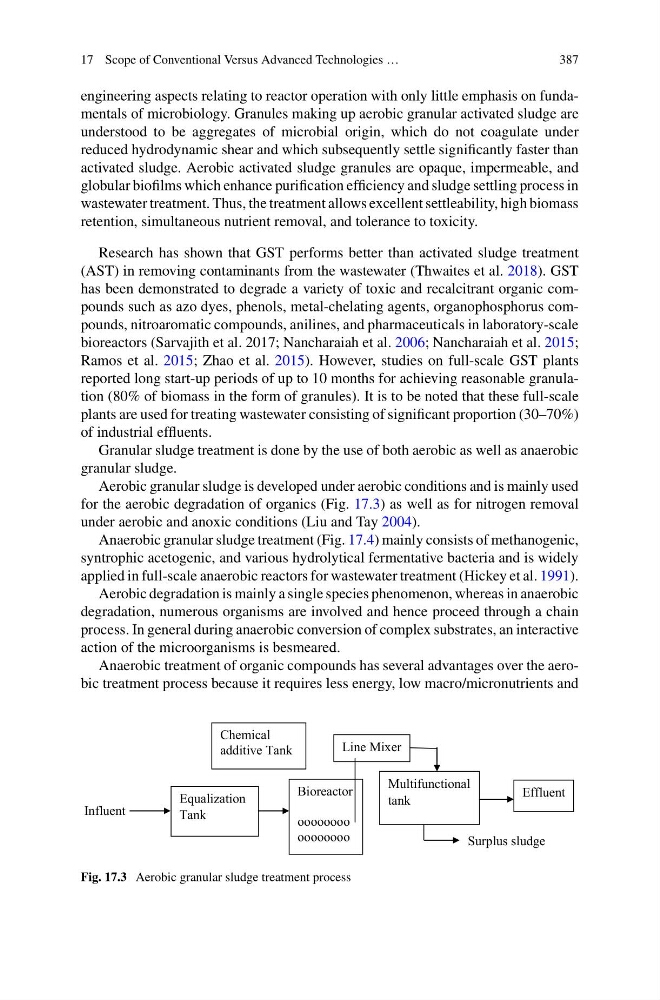
Aerobic granular sludge is developed under aerobic conditions and is mainly used
for the aerobic degradation of organics (Fig. 17.3) as well as for nitrogen removal
under aerobic and anoxic conditions (Liu and Tay 2004).
Anaerobic granular sludge treatment (Fig. 17.4) mainly consists of methanogenic,
syntrophic acetogenic, and various hydrolytical fermentative bacteria and is widely
applied in full-scale anaerobic reactors for wastewater treatment (Hickey et al. 1991).
Aerobic degradation is mainly a single species phenomenon, whereas in anaerobic
degradation, numerous organisms are involved and hence proceed through a chain
process. In general during anaerobic conversion of complex substrates, an interactive
action of the microorganisms is besmeared.
Anaerobic treatment of organic compounds has several advantages over the aerobic treatment process because it requires less energy, low macro/micronutrients and
Influent
Chemical
additive Tank
Line Mixer
Equalization
Tank
Bioreactor
oooooooo
oooooooo
Multifunctional
tank
Effluent
Surplus sludge
Fig. 17.3 Aerobic granular sludge treatment process
387
engineering aspects relating to reactor operation with only little emphasis on fundamentals of microbiology. Granules making up aerobic granular activated sludge are
understood to be aggregates of microbial origin, which do not coagulate under
reduced hydrodynamic shear and which subsequently settle significantly faster than
activated sludge. Aerobic activated sludge granules are opaque, impermeable, and
globular biofilms which enhance purification efficiency and sludge settling process in
wastewater treatment. Thus, the treatment allows excellent settleability, high biomass
retention, simultaneous nutrient removal, and tolerance to toxicity.
Research has shown that GST performs better than activated sludge treatment
(AST) in removing contaminants from the wastewater (Thwaites et al. 2018). GST
has been demonstrated to degrade a variety of toxic and recalcitrant organic compounds such as azo dyes, phenols, metal-chelating agents, organophosphorus compounds, nitroaromatic compounds, anilines, and pharmaceuticals in laboratory-scale
bioreactors (Sarvajith et al. 2017; Nancharaiah et al. 2006; Nancharaiah et al. 2015;
Ramos et al. 2015; Zhao et al. 2015). However, studies on full-scale GST plants
reported long start-up periods of up to 10 months for achieving reasonable granulation (80% of biomass in the form of granules). It is to be noted that these full-scale
plants are used for treating wastewater consisting of significant proportion (30–70%)
of industrial effluents.
Granular sludge treatment is done by the use of both aerobic as well as anaerobic
granular sludge.
Aerobic granular sludge is developed under aerobic conditions and is mainly used
for the aerobic degradation of organics (Fig. 17.3) as well as for nitrogen removal
under aerobic and anoxic conditions (Liu and Tay 2004).
Anaerobic granular sludge treatment (Fig. 17.4) mainly consists of methanogenic,
syntrophic acetogenic, and various hydrolytical fermentative bacteria and is widely
applied in full-scale anaerobic reactors for wastewater treatment (Hickey et al. 1991).
Aerobic degradation is mainly a single species phenomenon, whereas in anaerobic
degradation, numerous organisms are involved and hence proceed through a chain
process. In general during anaerobic conversion of complex substrates, an interactive
action of the microorganisms is besmeared.
Anaerobic treatment of organic compounds has several advantages over the aerobic treatment process because it requires less energy, low macro/micronutrients and
Influent
Chemical
additive Tank
Line Mixer
Equalization
Tank
Bioreactor
oooooooo
oooooooo
Multifunctional
tank
Effluent
Surplus sludge
Fig. 17.3 Aerobic granular sludge treatment process