

16 Fantastic Floating Weeds and How to Use Them
377
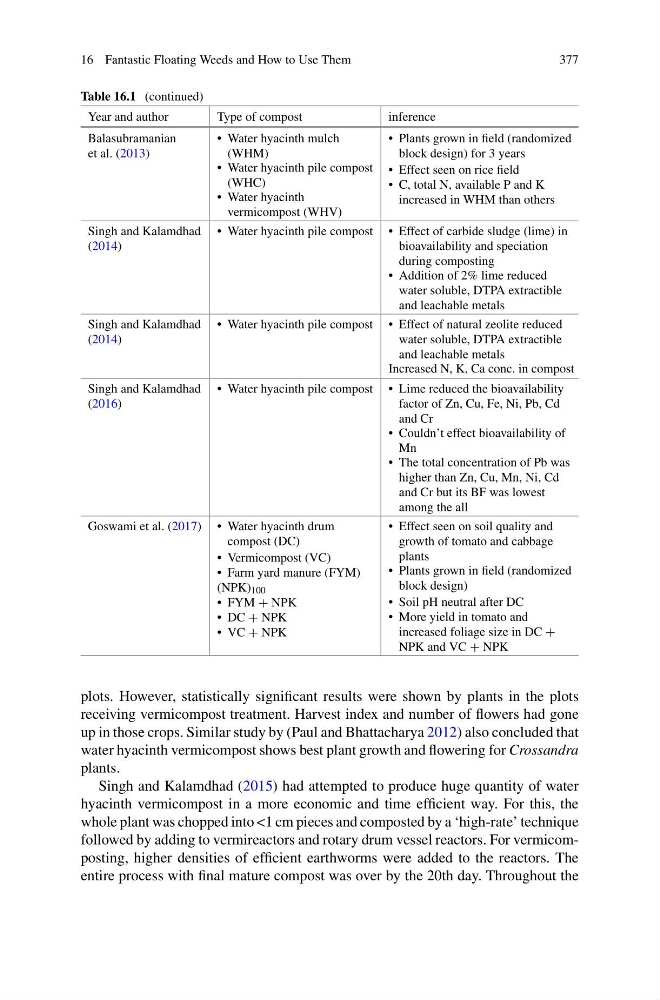
Table 16.1 (continued)
Year and author
Type of compost
inference
Balasubramanian
et al. (2013)
• Water hyacinth mulch
(WHM)
• Water hyacinth pile compost
(WHC)
• Water hyacinth
vermicompost (WHV)
• Plants grown in field (randomized
block design) for 3 years
• Effect seen on rice field
• C, total N, available P and K
increased in WHM than others
Singh and Kalamdhad
(2014)
• Water hyacinth pile compost • Effect of carbide sludge (lime) in
bioavailability and speciation
during composting
• Addition of 2% lime reduced
water soluble, DTPA extractible
and leachable metals
Singh and Kalamdhad
(2014)
• Water hyacinth pile compost • Effect of natural zeolite reduced
water soluble, DTPA extractible
and leachable metals
Increased N, K, Ca conc. in compost
Singh and Kalamdhad
(2016)
• Water hyacinth pile compost • Lime reduced the bioavailability
factor of Zn, Cu, Fe, Ni, Pb, Cd
and Cr
• Couldn’t effect bioavailability of
Mn
• The total concentration of Pb was
higher than Zn, Cu, Mn, Ni, Cd
and Cr but its BF was lowest
among the all
Goswami et al. (2017) • Water hyacinth drum
compost (DC)
• Vermicompost (VC)
• Farm yard manure (FYM)
(NPK) 100
• FYM + NPK
• DC + NPK
• VC + NPK
• Effect seen on soil quality and
growth of tomato and cabbage
plants
• Plants grown in field (randomized
block design)
• Soil pH neutral after DC
• More yield in tomato and
increased foliage size in DC +
NPK and VC + NPK
plots. However, statistically significant results were shown by plants in the plots
receiving vermicompost treatment. Harvest index and number of flowers had gone
up in those crops. Similar study by (Paul and Bhattacharya 2012) also concluded that
water hyacinth vermicompost shows best plant growth and flowering for Crossandra
plants.
Singh and Kalamdhad (2015) had attempted to produce huge quantity of water
hyacinth vermicompost in a more economic and time efficient way. For this, the
whole plant was chopped into <1 cm pieces and composted by a ‘high-rate’ technique
followed by adding to vermireactors and rotary drum vessel reactors. For vermicomposting, higher densities of efficient earthworms were added to the reactors. The
entire process with final mature compost was over by the 20th day. Throughout the
377
Table 16.1 (continued)
Year and author
Type of compost
inference
Balasubramanian
et al. (2013)
• Water hyacinth mulch
(WHM)
• Water hyacinth pile compost
(WHC)
• Water hyacinth
vermicompost (WHV)
• Plants grown in field (randomized
block design) for 3 years
• Effect seen on rice field
• C, total N, available P and K
increased in WHM than others
Singh and Kalamdhad
(2014)
• Water hyacinth pile compost • Effect of carbide sludge (lime) in
bioavailability and speciation
during composting
• Addition of 2% lime reduced
water soluble, DTPA extractible
and leachable metals
Singh and Kalamdhad
(2014)
• Water hyacinth pile compost • Effect of natural zeolite reduced
water soluble, DTPA extractible
and leachable metals
Increased N, K, Ca conc. in compost
Singh and Kalamdhad
(2016)
• Water hyacinth pile compost • Lime reduced the bioavailability
factor of Zn, Cu, Fe, Ni, Pb, Cd
and Cr
• Couldn’t effect bioavailability of
Mn
• The total concentration of Pb was
higher than Zn, Cu, Mn, Ni, Cd
and Cr but its BF was lowest
among the all
Goswami et al. (2017) • Water hyacinth drum
compost (DC)
• Vermicompost (VC)
• Farm yard manure (FYM)
(NPK) 100
• FYM + NPK
• DC + NPK
• VC + NPK
• Effect seen on soil quality and
growth of tomato and cabbage
plants
• Plants grown in field (randomized
block design)
• Soil pH neutral after DC
• More yield in tomato and
increased foliage size in DC +
NPK and VC + NPK
plots. However, statistically significant results were shown by plants in the plots
receiving vermicompost treatment. Harvest index and number of flowers had gone
up in those crops. Similar study by (Paul and Bhattacharya 2012) also concluded that
water hyacinth vermicompost shows best plant growth and flowering for Crossandra
plants.
Singh and Kalamdhad (2015) had attempted to produce huge quantity of water
hyacinth vermicompost in a more economic and time efficient way. For this, the
whole plant was chopped into <1 cm pieces and composted by a ‘high-rate’ technique
followed by adding to vermireactors and rotary drum vessel reactors. For vermicomposting, higher densities of efficient earthworms were added to the reactors. The
entire process with final mature compost was over by the 20th day. Throughout the