

376
P. Mazumder et al.
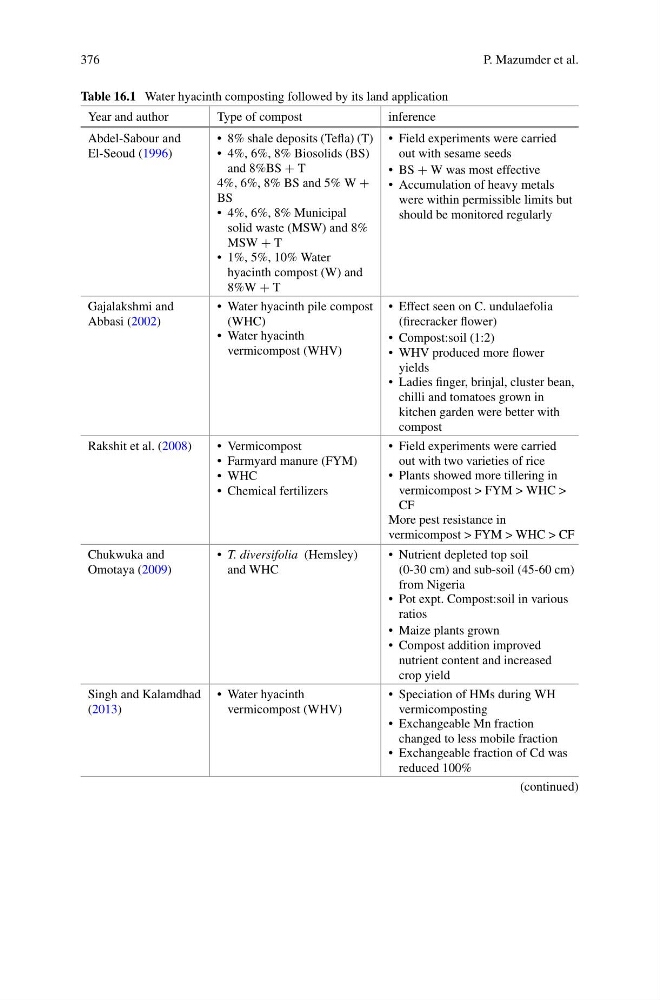
Table 16.1 Water hyacinth composting followed by its land application
Year and author
Type of compost
inference
Abdel-Sabour and
El-Seoud (1996)
• 8% shale deposits (Tefla) (T)
• 4%, 6%, 8% Biosolids (BS)
and 8%BS + T
4%, 6%, 8% BS and 5% W +
BS
• 4%, 6%, 8% Municipal
solid waste (MSW) and 8%
MSW + T
• 1%, 5%, 10% Water
hyacinth compost (W) and
8%W + T
• Field experiments were carried
out with sesame seeds
• BS + W was most effective
• Accumulation of heavy metals
were within permissible limits but
should be monitored regularly
Gajalakshmi and
Abbasi (2002)
• Water hyacinth pile compost
(WHC)
• Water hyacinth
vermicompost (WHV)
• Effect seen on C. undulaefolia
(firecracker flower)
• Compost:soil (1:2)
• WHV produced more flower
yields
• Ladies finger, brinjal, cluster bean,
chilli and tomatoes grown in
kitchen garden were better with
compost
Rakshit et al. (2008)
• Vermicompost
• Farmyard manure (FYM)
• WHC
• Chemical fertilizers
• Field experiments were carried
out with two varieties of rice
• Plants showed more tillering in
vermicompost > FYM > WHC >
CF
More pest resistance in
vermicompost > FYM > WHC > CF
Chukwuka and
Omotaya (2009)
• T. diversifolia (Hemsley)
and WHC
• Nutrient depleted top soil
(0-30 cm) and sub-soil (45-60 cm)
from Nigeria
• Pot expt. Compost:soil in various
ratios
• Maize plants grown
• Compost addition improved
nutrient content and increased
crop yield
Singh and Kalamdhad
(2013)
• Water hyacinth
vermicompost (WHV)
• Speciation of HMs during WH
vermicomposting
• Exchangeable Mn fraction
changed to less mobile fraction
• Exchangeable fraction of Cd was
reduced 100%
(continued)
P. Mazumder et al.
Table 16.1 Water hyacinth composting followed by its land application
Year and author
Type of compost
inference
Abdel-Sabour and
El-Seoud (1996)
• 8% shale deposits (Tefla) (T)
• 4%, 6%, 8% Biosolids (BS)
and 8%BS + T
4%, 6%, 8% BS and 5% W +
BS
• 4%, 6%, 8% Municipal
solid waste (MSW) and 8%
MSW + T
• 1%, 5%, 10% Water
hyacinth compost (W) and
8%W + T
• Field experiments were carried
out with sesame seeds
• BS + W was most effective
• Accumulation of heavy metals
were within permissible limits but
should be monitored regularly
Gajalakshmi and
Abbasi (2002)
• Water hyacinth pile compost
(WHC)
• Water hyacinth
vermicompost (WHV)
• Effect seen on C. undulaefolia
(firecracker flower)
• Compost:soil (1:2)
• WHV produced more flower
yields
• Ladies finger, brinjal, cluster bean,
chilli and tomatoes grown in
kitchen garden were better with
compost
Rakshit et al. (2008)
• Vermicompost
• Farmyard manure (FYM)
• WHC
• Chemical fertilizers
• Field experiments were carried
out with two varieties of rice
• Plants showed more tillering in
vermicompost > FYM > WHC >
CF
More pest resistance in
vermicompost > FYM > WHC > CF
Chukwuka and
Omotaya (2009)
• T. diversifolia (Hemsley)
and WHC
• Nutrient depleted top soil
(0-30 cm) and sub-soil (45-60 cm)
from Nigeria
• Pot expt. Compost:soil in various
ratios
• Maize plants grown
• Compost addition improved
nutrient content and increased
crop yield
Singh and Kalamdhad
(2013)
• Water hyacinth
vermicompost (WHV)
• Speciation of HMs during WH
vermicomposting
• Exchangeable Mn fraction
changed to less mobile fraction
• Exchangeable fraction of Cd was
reduced 100%
(continued)