

308
C. Bhagat et al.
Photocatalysis
Recently, photocatalysis techniques attracted researchers and scientific community
more because of their advantages over different techniques available, and the advantages like economical and eco-friendly are known to be sustainable technology having
negligible waste (Das 2014). Photocatalysis includes the elimination of contaminants
from WW which have resistance to degradation and chemically stable. In SP, to carry
out the degradation (Chen et al. 2016a) using oxidative mechanism requires three
components, catalyst with photo-sensitive (e.g., TiO 2 or inorganic semiconductors),
source of photon energy, and an efficient oxidizing agent (Ben et al. 2009; Belhouchet
et al. 2019). The fundamental principle of this process includes the stimulating of
semiconductor (generally used TiO 2 because of its immense stability, efficient performance, and cost-effectiveness easily available) by artificially means. Characterization of semiconductor is done by their valence and bandgap, and conduction bands,
etc. The mechanism involves in this process are as follows; either TiO 2 (semiconductor oxide) get a chance to adsorbed contaminants causing quick oxidation or firstly
change to adsorbed H 2 O molecules producing OH. (Hydroxyl radicals).
Photocatalyst (e.g. TiO 2 ) → TiO 2
e
−
+ h
+
(13.8)
h
+
+ contaminaents → contaminaents
(13.9)
h
+
+ OH → OH
(13.10)
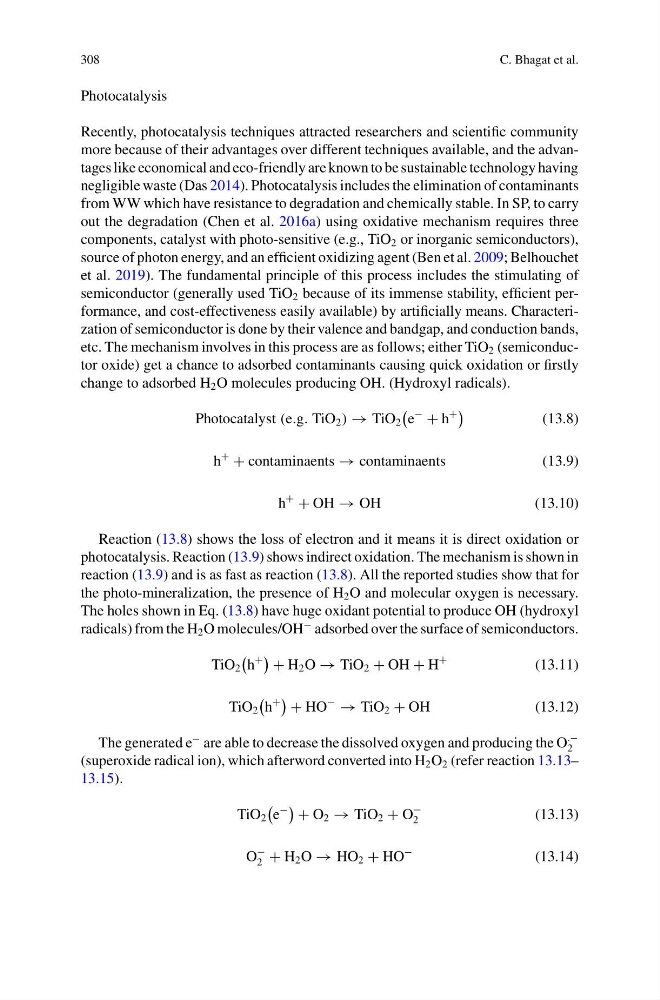
Reaction (13.8) shows the loss of electron and it means it is direct oxidation or
photocatalysis. Reaction (13.9) shows indirect oxidation. The mechanism is shown in
reaction (13.9) and is as fast as reaction (13.8). All the reported studies show that for
the photo-mineralization, the presence of H 2 O and molecular oxygen is necessary.
The holes shown in Eq. (13.8) have huge oxidant potential to produce OH (hydroxyl
radicals) from the H 2 O molecules/OH
− adsorbed over the surface of semiconductors.
TiO 2
h
+
+ H 2 O → TiO 2 + OH + H
+
(13.11)
TiO 2
h
+
+ HO
−
→ TiO 2 + OH
(13.12)
The generated e
− are able to decrease the dissolved oxygen and producing the O
.−
2
(superoxide radical ion), which afterword converted into H 2 O 2 (refer reaction 13.13–
13.15).
TiO 2
e
−
+ O 2 → TiO 2 + O
−
2
(13.13)
O
−
2 + H 2 O → HO 2 + HO
−
(13.14)
C. Bhagat et al.
Photocatalysis
Recently, photocatalysis techniques attracted researchers and scientific community
more because of their advantages over different techniques available, and the advantages like economical and eco-friendly are known to be sustainable technology having
negligible waste (Das 2014). Photocatalysis includes the elimination of contaminants
from WW which have resistance to degradation and chemically stable. In SP, to carry
out the degradation (Chen et al. 2016a) using oxidative mechanism requires three
components, catalyst with photo-sensitive (e.g., TiO 2 or inorganic semiconductors),
source of photon energy, and an efficient oxidizing agent (Ben et al. 2009; Belhouchet
et al. 2019). The fundamental principle of this process includes the stimulating of
semiconductor (generally used TiO 2 because of its immense stability, efficient performance, and cost-effectiveness easily available) by artificially means. Characterization of semiconductor is done by their valence and bandgap, and conduction bands,
etc. The mechanism involves in this process are as follows; either TiO 2 (semiconductor oxide) get a chance to adsorbed contaminants causing quick oxidation or firstly
change to adsorbed H 2 O molecules producing OH. (Hydroxyl radicals).
Photocatalyst (e.g. TiO 2 ) → TiO 2
e
−
+ h
+
(13.8)
h
+
+ contaminaents → contaminaents
(13.9)
h
+
+ OH → OH
(13.10)
Reaction (13.8) shows the loss of electron and it means it is direct oxidation or
photocatalysis. Reaction (13.9) shows indirect oxidation. The mechanism is shown in
reaction (13.9) and is as fast as reaction (13.8). All the reported studies show that for
the photo-mineralization, the presence of H 2 O and molecular oxygen is necessary.
The holes shown in Eq. (13.8) have huge oxidant potential to produce OH (hydroxyl
radicals) from the H 2 O molecules/OH
− adsorbed over the surface of semiconductors.
TiO 2
h
+
+ H 2 O → TiO 2 + OH + H
+
(13.11)
TiO 2
h
+
+ HO
−
→ TiO 2 + OH
(13.12)
The generated e
− are able to decrease the dissolved oxygen and producing the O
.−
2
(superoxide radical ion), which afterword converted into H 2 O 2 (refer reaction 13.13–
13.15).
TiO 2
e
−
+ O 2 → TiO 2 + O
−
2
(13.13)
O
−
2 + H 2 O → HO 2 + HO
−
(13.14)