

13 Reigning Technologies and Their Challenges for Antibiotics …
309
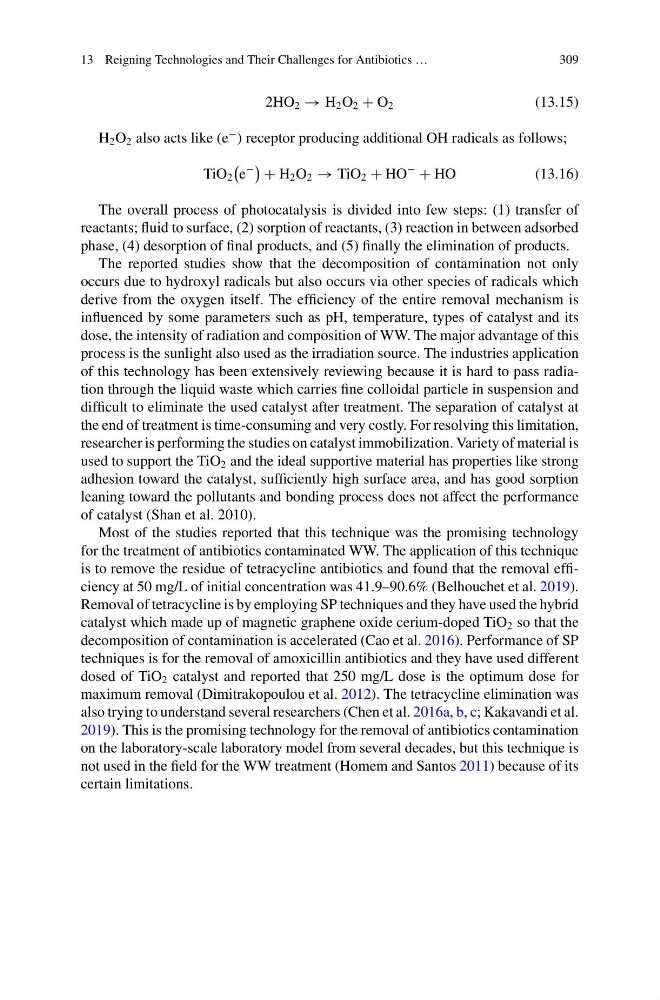
2HO 2 → H 2 O 2 + O 2
(13.15)
H 2 O 2 also acts like (e
− ) receptor producing additional OH radicals as follows;
TiO 2
e
−
+ H 2 O 2 → TiO 2 + HO
−
+ HO
(13.16)
The overall process of photocatalysis is divided into few steps: (1) transfer of
reactants; fluid to surface, (2) sorption of reactants, (3) reaction in between adsorbed
phase, (4) desorption of final products, and (5) finally the elimination of products.
The reported studies show that the decomposition of contamination not only
occurs due to hydroxyl radicals but also occurs via other species of radicals which
derive from the oxygen itself. The efficiency of the entire removal mechanism is
influenced by some parameters such as pH, temperature, types of catalyst and its
dose, the intensity of radiation and composition of WW. The major advantage of this
process is the sunlight also used as the irradiation source. The industries application
of this technology has been extensively reviewing because it is hard to pass radiation through the liquid waste which carries fine colloidal particle in suspension and
difficult to eliminate the used catalyst after treatment. The separation of catalyst at
the end of treatment is time-consuming and very costly. For resolving this limitation,
researcher is performing the studies on catalyst immobilization. Variety of material is
used to support the TiO 2 and the ideal supportive material has properties like strong
adhesion toward the catalyst, sufficiently high surface area, and has good sorption
leaning toward the pollutants and bonding process does not affect the performance
of catalyst (Shan et al. 2010).
Most of the studies reported that this technique was the promising technology
for the treatment of antibiotics contaminated WW. The application of this technique
is to remove the residue of tetracycline antibiotics and found that the removal efficiency at 50 mg/L of initial concentration was 41.9–90.6% (Belhouchet et al. 2019).
Removal of tetracycline is by employing SP techniques and they have used the hybrid
catalyst which made up of magnetic graphene oxide cerium-doped TiO 2 so that the
decomposition of contamination is accelerated (Cao et al. 2016). Performance of SP
techniques is for the removal of amoxicillin antibiotics and they have used different
dosed of TiO 2 catalyst and reported that 250 mg/L dose is the optimum dose for
maximum removal (Dimitrakopoulou et al. 2012). The tetracycline elimination was
also trying to understand several researchers (Chen et al. 2016a, b, c; Kakavandi et al.
2019). This is the promising technology for the removal of antibiotics contamination
on the laboratory-scale laboratory model from several decades, but this technique is
not used in the field for the WW treatment (Homem and Santos 2011) because of its
certain limitations.
309
2HO 2 → H 2 O 2 + O 2
(13.15)
H 2 O 2 also acts like (e
− ) receptor producing additional OH radicals as follows;
TiO 2
e
−
+ H 2 O 2 → TiO 2 + HO
−
+ HO
(13.16)
The overall process of photocatalysis is divided into few steps: (1) transfer of
reactants; fluid to surface, (2) sorption of reactants, (3) reaction in between adsorbed
phase, (4) desorption of final products, and (5) finally the elimination of products.
The reported studies show that the decomposition of contamination not only
occurs due to hydroxyl radicals but also occurs via other species of radicals which
derive from the oxygen itself. The efficiency of the entire removal mechanism is
influenced by some parameters such as pH, temperature, types of catalyst and its
dose, the intensity of radiation and composition of WW. The major advantage of this
process is the sunlight also used as the irradiation source. The industries application
of this technology has been extensively reviewing because it is hard to pass radiation through the liquid waste which carries fine colloidal particle in suspension and
difficult to eliminate the used catalyst after treatment. The separation of catalyst at
the end of treatment is time-consuming and very costly. For resolving this limitation,
researcher is performing the studies on catalyst immobilization. Variety of material is
used to support the TiO 2 and the ideal supportive material has properties like strong
adhesion toward the catalyst, sufficiently high surface area, and has good sorption
leaning toward the pollutants and bonding process does not affect the performance
of catalyst (Shan et al. 2010).
Most of the studies reported that this technique was the promising technology
for the treatment of antibiotics contaminated WW. The application of this technique
is to remove the residue of tetracycline antibiotics and found that the removal efficiency at 50 mg/L of initial concentration was 41.9–90.6% (Belhouchet et al. 2019).
Removal of tetracycline is by employing SP techniques and they have used the hybrid
catalyst which made up of magnetic graphene oxide cerium-doped TiO 2 so that the
decomposition of contamination is accelerated (Cao et al. 2016). Performance of SP
techniques is for the removal of amoxicillin antibiotics and they have used different
dosed of TiO 2 catalyst and reported that 250 mg/L dose is the optimum dose for
maximum removal (Dimitrakopoulou et al. 2012). The tetracycline elimination was
also trying to understand several researchers (Chen et al. 2016a, b, c; Kakavandi et al.
2019). This is the promising technology for the removal of antibiotics contamination
on the laboratory-scale laboratory model from several decades, but this technique is
not used in the field for the WW treatment (Homem and Santos 2011) because of its
certain limitations.