

306
C. Bhagat et al.
the producing of free hydroxyl radicals (OH
− ), these radicals are highly reactive and
having the potential of oxidants is 2.8 V, which is greater than ordinary or classical
oxidants, made them highly effective and efficient to carry out the treatment of highly
contaminated WW through an oxidation process (Hernandez et al. 2002). There are
some oxidizing agents often used to produce hydroxyl radicals like ozone (O 3 ),
hydrogen peroxide (H 2 O 2 ) combined with semiconductor catalysts or UV radiation
or metal catalysts. In this process, it is expected that pollutants get oxidized and
reduced into less harmful products or converted into carbon dioxide (CO 2 ) and water
(H 2 O). It is also possible that sometimes, by-products produced after the oxidation
is harmful than the parental compounds. Different AOTPs are as follows.
Ozonation
Ozone is known as effective or efficient oxidant because it has high oxidant potential
(E
0
= 2.07 V) (Iakovides et al. 2019). Ozone has high redox potential than classical
oxidants like hydrogen peroxides (H 2 O 2 ), chlorine dioxides (ClO 2 ), Cl 2 gas, and
hypochlorites. It has the ability to react directly or indirectly with contaminants. The
degradation mechanism primarily has direct oxidation rather than indirect oxidation
via OH (Ben et al. 2011, 2012). To carry out the direct oxidation using O 3 , it is
necessary to have a C = C (carbon–carbon) or aromatic bonds with the N (nitrogen),
O (oxygen), or S (molecules of sulfurs) because it reacts only and only with the
nucleophilic molecules. If this condition is not fulfilled then the degradation of O 3
in WW to generate an OH
− (Hydroxyl radicals) takes place through the bellow
mechanism (Alsager et al. 2018).
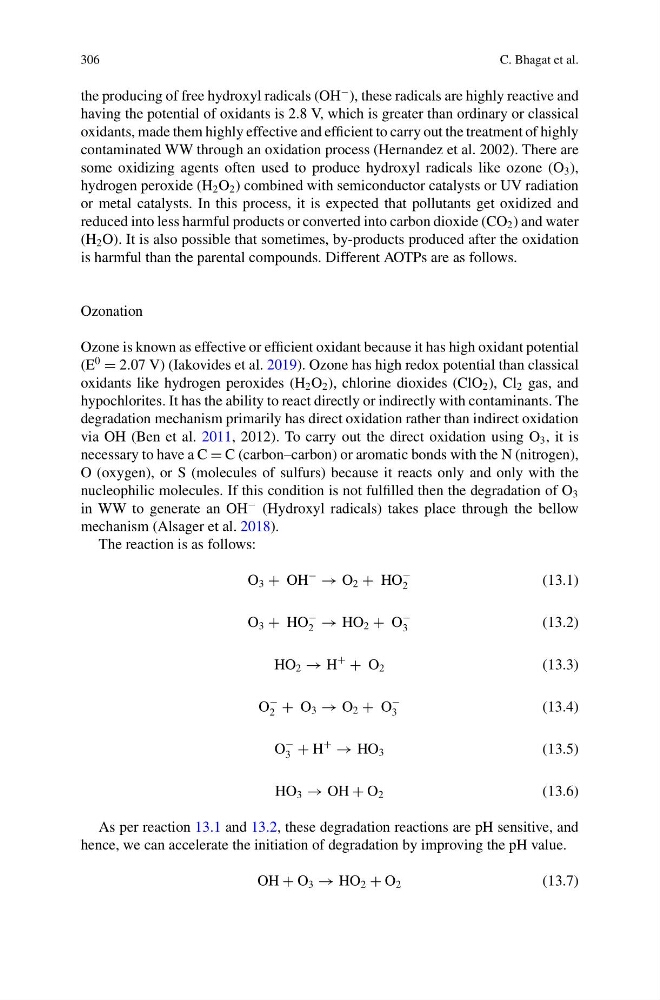
The reaction is as follows:
O 3 + OH
−
→ O 2 + HO
−
2
(13.1)
O 3 + HO
−
2 → HO 2 + O
−
3
(13.2)
HO 2 → H
+
+ O 2
(13.3)
O
−
2 + O 3 → O 2 + O
−
3
(13.4)
O
−
3 + H
+
→ HO 3
(13.5)
HO 3 → OH + O 2
(13.6)
As per reaction 13.1 and 13.2, these degradation reactions are pH sensitive, and
hence, we can accelerate the initiation of degradation by improving the pH value.
OH + O 3 → HO 2 + O 2
(13.7)
C. Bhagat et al.
the producing of free hydroxyl radicals (OH
− ), these radicals are highly reactive and
having the potential of oxidants is 2.8 V, which is greater than ordinary or classical
oxidants, made them highly effective and efficient to carry out the treatment of highly
contaminated WW through an oxidation process (Hernandez et al. 2002). There are
some oxidizing agents often used to produce hydroxyl radicals like ozone (O 3 ),
hydrogen peroxide (H 2 O 2 ) combined with semiconductor catalysts or UV radiation
or metal catalysts. In this process, it is expected that pollutants get oxidized and
reduced into less harmful products or converted into carbon dioxide (CO 2 ) and water
(H 2 O). It is also possible that sometimes, by-products produced after the oxidation
is harmful than the parental compounds. Different AOTPs are as follows.
Ozonation
Ozone is known as effective or efficient oxidant because it has high oxidant potential
(E
0
= 2.07 V) (Iakovides et al. 2019). Ozone has high redox potential than classical
oxidants like hydrogen peroxides (H 2 O 2 ), chlorine dioxides (ClO 2 ), Cl 2 gas, and
hypochlorites. It has the ability to react directly or indirectly with contaminants. The
degradation mechanism primarily has direct oxidation rather than indirect oxidation
via OH (Ben et al. 2011, 2012). To carry out the direct oxidation using O 3 , it is
necessary to have a C = C (carbon–carbon) or aromatic bonds with the N (nitrogen),
O (oxygen), or S (molecules of sulfurs) because it reacts only and only with the
nucleophilic molecules. If this condition is not fulfilled then the degradation of O 3
in WW to generate an OH
− (Hydroxyl radicals) takes place through the bellow
mechanism (Alsager et al. 2018).
The reaction is as follows:
O 3 + OH
−
→ O 2 + HO
−
2
(13.1)
O 3 + HO
−
2 → HO 2 + O
−
3
(13.2)
HO 2 → H
+
+ O 2
(13.3)
O
−
2 + O 3 → O 2 + O
−
3
(13.4)
O
−
3 + H
+
→ HO 3
(13.5)
HO 3 → OH + O 2
(13.6)
As per reaction 13.1 and 13.2, these degradation reactions are pH sensitive, and
hence, we can accelerate the initiation of degradation by improving the pH value.
OH + O 3 → HO 2 + O 2
(13.7)