

304
C. Bhagat et al.
Table 13.1
(continued)
Removal
techniques
Types of antibiotic
Removal
(concentration)
(%)
Remarks
References
In situ
removal
techniques
Azithromycin
Ciprofloxacin
Clarithromycin
Clindamycin
Doxycycline
Erythromycin
Norfloxacin
Oxytetracycline
Sulfamethoxazole
Tetracycline
Trimethoprim
Vancomycin
100
100
59
74
100
96
100
97
77
99
61
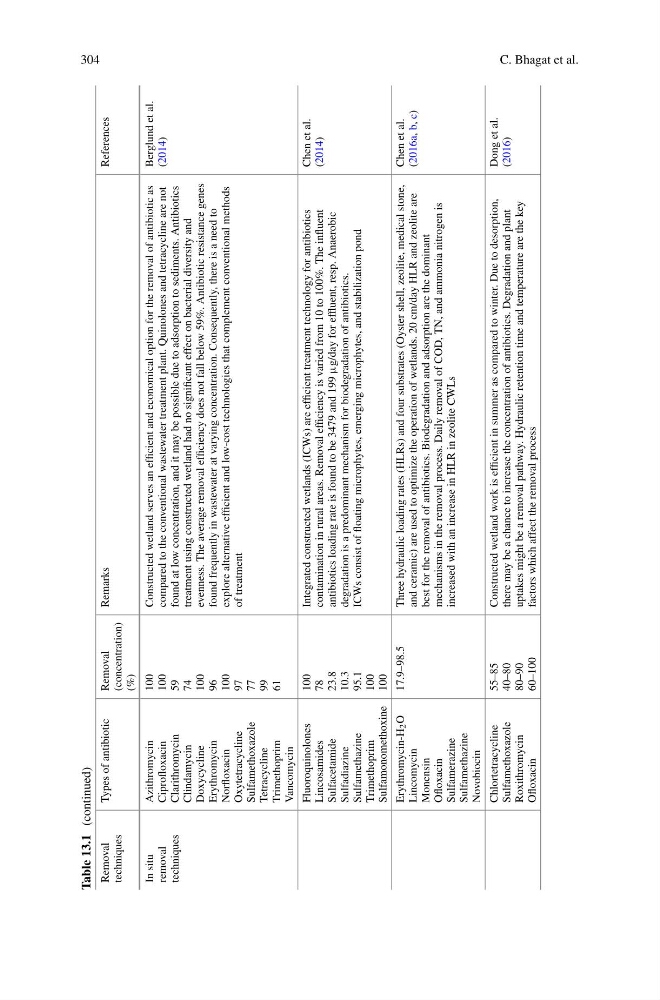
Constructed wetland serves an efficient and economical option for the removal of antibiotic as
compared to the conventional wastewater treatment plant. Quinolones and tetracycline are not
found at low concentration, and it may be possible due to adsorption to sediments. Antibiotics
treatment using constructed wetland had no significant effect on bacterial diversity and
evenness. The average removal efficiency does not fall below 59%. Antibiotic resistance genes
found frequently in wastewater at varying concentration. Consequently, there is a need to
explore alternative efficient and low-cost technologies that complement conventional methods
of treatment
Berglund et al.
(2014)
Fluoroquinolones
Lincosamides
Sulfacetamide
Sulfadiazine
Sulfamethazine
Trimethoprim
Sulfamonomethoxine
100
78
23.8
10.3
95.1
100
100
Integrated constructed wetlands (ICWs) are efficient treatment technology for antibiotics
contamination in rural areas. Removal efficiency is varied from 10 to 100%. The influent
antibiotics loading rate is found to be 3479 and 199
μg/day for effluent, resp. Anaerobic
degradation is a predominant mechanism for biodegradation of antibiotics.
ICWs consist of floating microphytes, emerging microphytes, and stabilization pond
Chen et al.
(2014)
Erythromycin-H
2 O
Lincomycin
Monensin
Ofloxacin
Sulfamerazine
Sulfamethazine
Novobiocin
17.9–98.5
Three hydraulic loading rates (HLRs) and four substrates (Oyster shell, zeolite, medical stone,
and ceramic) are used to optimize the operation of wetlands. 20 cm/day HLR and zeolite are
best for the removal of antibiotics. Biodegradation and adsorption are the dominant
mechanisms in the removal process. Daily removal of COD, TN, and ammonia nitrogen is
increased with an increase in HLR in zeolite CWLs
Chen et al.
(2016a, b, c)
Chlortetracycline
Sulfamethoxazole
Roxithromycin
Ofloxacin
55–85
40–80
80–90
60–100
Constructed wetland work is efficient in summer as compared to winter. Due to desorption,
there may be a chance to increase the concentration of antibiotics. Degradation and plant
uptakes might be a removal pathway. Hydraulic retention time and temperature are the key
factors which affect the removal process
Dong et al.
(2016)
C. Bhagat et al.
Table 13.1
(continued)
Removal
techniques
Types of antibiotic
Removal
(concentration)
(%)
Remarks
References
In situ
removal
techniques
Azithromycin
Ciprofloxacin
Clarithromycin
Clindamycin
Doxycycline
Erythromycin
Norfloxacin
Oxytetracycline
Sulfamethoxazole
Tetracycline
Trimethoprim
Vancomycin
100
100
59
74
100
96
100
97
77
99
61
Constructed wetland serves an efficient and economical option for the removal of antibiotic as
compared to the conventional wastewater treatment plant. Quinolones and tetracycline are not
found at low concentration, and it may be possible due to adsorption to sediments. Antibiotics
treatment using constructed wetland had no significant effect on bacterial diversity and
evenness. The average removal efficiency does not fall below 59%. Antibiotic resistance genes
found frequently in wastewater at varying concentration. Consequently, there is a need to
explore alternative efficient and low-cost technologies that complement conventional methods
of treatment
Berglund et al.
(2014)
Fluoroquinolones
Lincosamides
Sulfacetamide
Sulfadiazine
Sulfamethazine
Trimethoprim
Sulfamonomethoxine
100
78
23.8
10.3
95.1
100
100
Integrated constructed wetlands (ICWs) are efficient treatment technology for antibiotics
contamination in rural areas. Removal efficiency is varied from 10 to 100%. The influent
antibiotics loading rate is found to be 3479 and 199
μg/day for effluent, resp. Anaerobic
degradation is a predominant mechanism for biodegradation of antibiotics.
ICWs consist of floating microphytes, emerging microphytes, and stabilization pond
Chen et al.
(2014)
Erythromycin-H
2 O
Lincomycin
Monensin
Ofloxacin
Sulfamerazine
Sulfamethazine
Novobiocin
17.9–98.5
Three hydraulic loading rates (HLRs) and four substrates (Oyster shell, zeolite, medical stone,
and ceramic) are used to optimize the operation of wetlands. 20 cm/day HLR and zeolite are
best for the removal of antibiotics. Biodegradation and adsorption are the dominant
mechanisms in the removal process. Daily removal of COD, TN, and ammonia nitrogen is
increased with an increase in HLR in zeolite CWLs
Chen et al.
(2016a, b, c)
Chlortetracycline
Sulfamethoxazole
Roxithromycin
Ofloxacin
55–85
40–80
80–90
60–100
Constructed wetland work is efficient in summer as compared to winter. Due to desorption,
there may be a chance to increase the concentration of antibiotics. Degradation and plant
uptakes might be a removal pathway. Hydraulic retention time and temperature are the key
factors which affect the removal process
Dong et al.
(2016)