

13 Reigning Technologies and Their Challenges for Antibiotics …
303
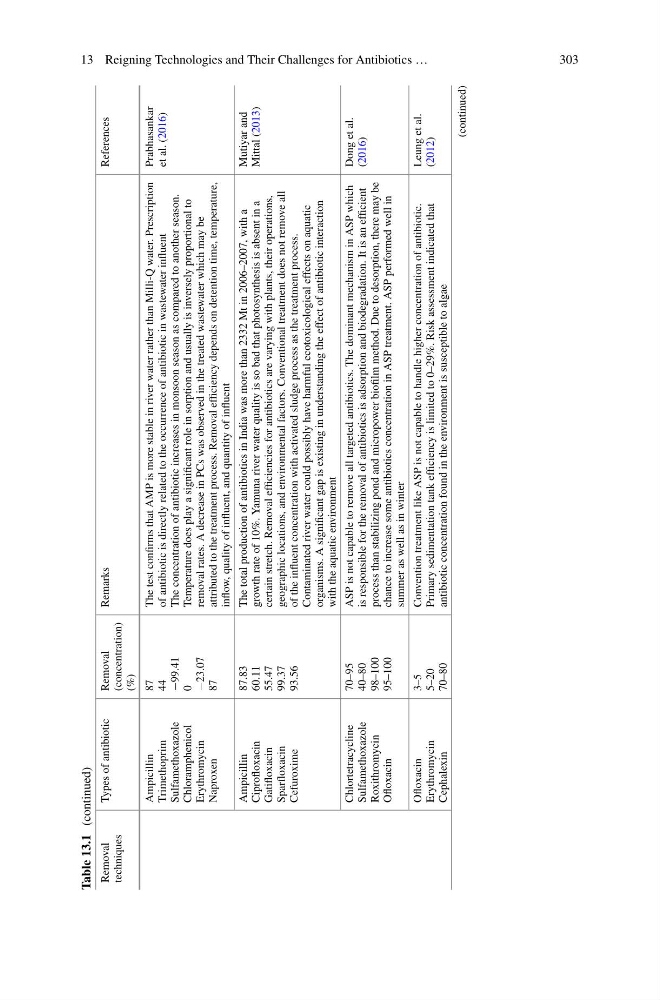
Table 13.1
(continued)
Removal
techniques
Types of antibiotic
Removal
(concentration)
(%)
Remarks
References
Ampicillin
Trimethoprim
Sulfamethoxazole
Chloramphenicol
Erythromycin
Naproxen
87
44
−99.41
0
−23.07
87
The test confirms that AMP is more stable in river water rather than Milli-Q water. Prescription
of antibiotic is directly related to the occurrence of antibiotic in wastewater influent
The concentration of antibiotic increases in monsoon season as compared to another season.
Temperature does play a significant role in sorption and usually is inversely proportional to
removal rates. A decrease in PCs was observed in the treated wastewater which may be
attributed to the treatment process. Removal efficiency depends on detention time, temperature,
inflow, quality of influent, and quantity of influent
Prabhasankar
et al. (2016)
Ampicillin
Ciprofloxacin
Gatifloxacin
Sparfloxacin
Cefuroxime
87.83
60.11
55.47
99.37
93.56
The total production of antibiotics in India was more than 2332 Mt in 2006–2007, with a
growth rate of 10%. Yamuna river water quality is so bad that photosynthesis is absent in a
certain stretch. Removal efficiencies for antibiotics are varying with plants, their operations,
geographic locations, and environmental factors. Conventional treatment does not remove all
of the influent concentration with activated sludge process as the treatment process.
Contaminated river water could possibly have harmful ecotoxicological effects on aquatic
organisms. A significant gap is existing in understanding the effect of antibiotic interaction
with the aquatic environment
Mutiyar and
Mittal (2013)
Chlortetracycline
Sulfamethoxazole
Roxithromycin
Ofloxacin
70–95
40–80
98–100
95–100
ASP is not capable to remove all targeted antibiotics. The dominant mechanism in ASP which
is responsible for the removal of antibiotics is adsorption and biodegradation. It is an efficient
process than stabilizing pond and micropower biofilm method. Due to desorption, there may be
chance to increase some antibiotics concentration in ASP treatment. ASP performed well in
summer as well as in winter
Dong et al.
(2016)
Ofloxacin
Erythromycin
Cephalexin
3–5
5–20
70–80
Convention treatment like ASP is not capable to handle higher concentration of antibiotic.
Primary sedimentation tank efficiency is limited to 0–29%. Risk assessment indicated that
antibiotic concentration found in the environment is susceptible to algae
Leung et al.
(2012)
(continued)
303
Table 13.1
(continued)
Removal
techniques
Types of antibiotic
Removal
(concentration)
(%)
Remarks
References
Ampicillin
Trimethoprim
Sulfamethoxazole
Chloramphenicol
Erythromycin
Naproxen
87
44
−99.41
0
−23.07
87
The test confirms that AMP is more stable in river water rather than Milli-Q water. Prescription
of antibiotic is directly related to the occurrence of antibiotic in wastewater influent
The concentration of antibiotic increases in monsoon season as compared to another season.
Temperature does play a significant role in sorption and usually is inversely proportional to
removal rates. A decrease in PCs was observed in the treated wastewater which may be
attributed to the treatment process. Removal efficiency depends on detention time, temperature,
inflow, quality of influent, and quantity of influent
Prabhasankar
et al. (2016)
Ampicillin
Ciprofloxacin
Gatifloxacin
Sparfloxacin
Cefuroxime
87.83
60.11
55.47
99.37
93.56
The total production of antibiotics in India was more than 2332 Mt in 2006–2007, with a
growth rate of 10%. Yamuna river water quality is so bad that photosynthesis is absent in a
certain stretch. Removal efficiencies for antibiotics are varying with plants, their operations,
geographic locations, and environmental factors. Conventional treatment does not remove all
of the influent concentration with activated sludge process as the treatment process.
Contaminated river water could possibly have harmful ecotoxicological effects on aquatic
organisms. A significant gap is existing in understanding the effect of antibiotic interaction
with the aquatic environment
Mutiyar and
Mittal (2013)
Chlortetracycline
Sulfamethoxazole
Roxithromycin
Ofloxacin
70–95
40–80
98–100
95–100
ASP is not capable to remove all targeted antibiotics. The dominant mechanism in ASP which
is responsible for the removal of antibiotics is adsorption and biodegradation. It is an efficient
process than stabilizing pond and micropower biofilm method. Due to desorption, there may be
chance to increase some antibiotics concentration in ASP treatment. ASP performed well in
summer as well as in winter
Dong et al.
(2016)
Ofloxacin
Erythromycin
Cephalexin
3–5
5–20
70–80
Convention treatment like ASP is not capable to handle higher concentration of antibiotic.
Primary sedimentation tank efficiency is limited to 0–29%. Risk assessment indicated that
antibiotic concentration found in the environment is susceptible to algae
Leung et al.
(2012)
(continued)