

302
C. Bhagat et al.
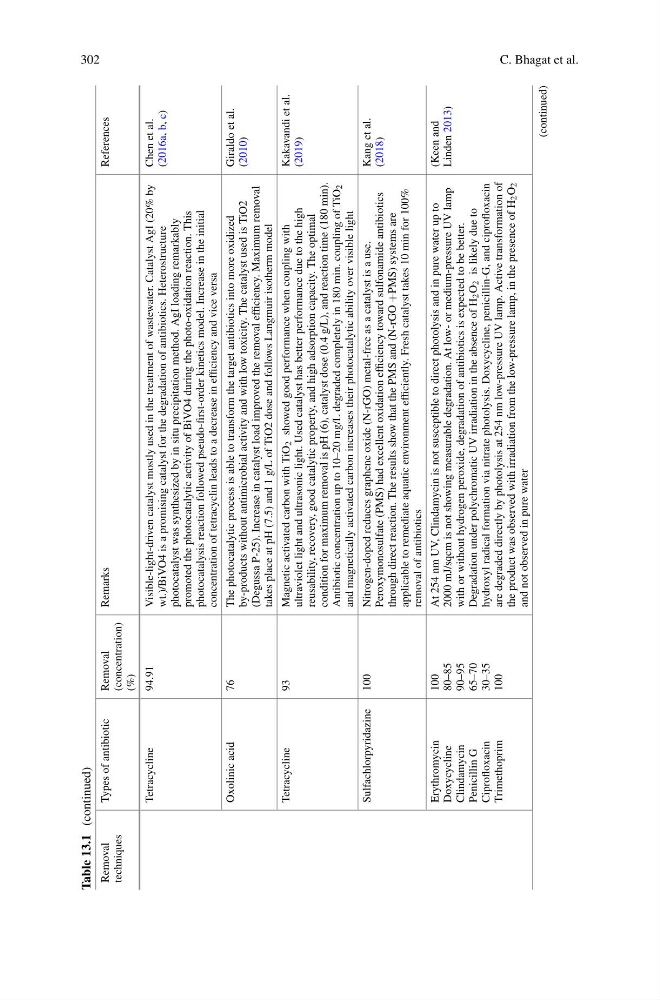
Table 13.1
(continued)
Removal
techniques
Types of antibiotic
Removal
(concentration)
(%)
Remarks
References
Tetracycline
94.91
Visible-light-driven catalyst mostly used in the treatment of wastewater. Catalyst AgI (20% by
wt.)/BiVO4 is a promising catalyst for the degradation of antibiotics. Heterostructure
photocatalyst was synthesized by in situ precipitation method. AgI loading remarkably
promoted the photocatalytic activity of BiVO4 during the photo-oxidation reaction. This
photocatalysis reaction followed pseudo-first-order kinetics model. Increase in the initial
concentration of tetracyclin leads to a decrease in efficiency and vice versa
Chen et al.
(2016a, b, c)
Oxolinic acid
76
The photocatalytic process is able to transform the target antibiotics into more oxidized
by-products without antimicrobial activity and with low toxicity. The catalyst used is TiO2
(Degussa P-25). Increase in catalyst load improved the removal efficiency. Maximum removal
takes place at pH (7.5) and 1 g/L of TiO2 dose and follows Langmuir isotherm model
Giraldo et al.
(2010)
Tetracycline
93
Magnetic activated carbon with TiO
2 showed good performance when coupling with
ultraviolet light and ultrasonic light. Used catalyst has better performance due to the high
reusability, recovery, good catalytic property, and high adsorption capacity. The optimal
condition for maximum removal is pH (6), catalyst dose (0.4 g/L), and reaction time (180 min).
Antibiotic concentration up to 10–20 mg/L degraded completely in 180 min. coupling of TiO
2
and magnetically activated carbon increases their photocatalytic ability over visible light
Kakavandi et al.
(2019)
Sulfachlorpyridazine
100
Nitrogen-doped reduces graphene oxide (N-rGO) metal-free as a catalyst is a use.
Peroxymonosulfate (PMS) had excellent oxidation efficiency toward sulfonamide antibiotics
through direct reaction. The results show that the PMS and (N-rGO
+PMS) systems are
applicable to remediate aquatic environment efficiently. Fresh catalyst takes 10 min for 100%
removal of antibiotics
Kang et al.
(2018)
Erythromycin
Doxycycline
Clindamycin
Penicillin G
Ciprofloxacin
Trimethoprim
100
80–85
90–95
65–70
30–35
100
At 254 nm UV, Clindamycin is not susceptible to direct photolysis and in pure water up to
2000 mJ/sqcm is not showing measurable degradation. At low- or medium-pressure UV lamp
with or without hydrogen peroxide, degradation of antibiotics is expected to be better.
Degradation under polychromatic UV irradiation in the absence of H
2 O
2 is likely due to
hydroxyl radical formation via nitrate photolysis. Doxycycline, penicillin-G, and ciprofloxacin
are degraded directly by photolysis at 254 nm low-pressure UV lamp. Active transformation of
the product was observed with irradiation from the low-pressure lamp, in the presence of H
2 O
2
and not observed in pure water
(Keen and
Linden 2013)
(continued)
C. Bhagat et al.
Table 13.1
(continued)
Removal
techniques
Types of antibiotic
Removal
(concentration)
(%)
Remarks
References
Tetracycline
94.91
Visible-light-driven catalyst mostly used in the treatment of wastewater. Catalyst AgI (20% by
wt.)/BiVO4 is a promising catalyst for the degradation of antibiotics. Heterostructure
photocatalyst was synthesized by in situ precipitation method. AgI loading remarkably
promoted the photocatalytic activity of BiVO4 during the photo-oxidation reaction. This
photocatalysis reaction followed pseudo-first-order kinetics model. Increase in the initial
concentration of tetracyclin leads to a decrease in efficiency and vice versa
Chen et al.
(2016a, b, c)
Oxolinic acid
76
The photocatalytic process is able to transform the target antibiotics into more oxidized
by-products without antimicrobial activity and with low toxicity. The catalyst used is TiO2
(Degussa P-25). Increase in catalyst load improved the removal efficiency. Maximum removal
takes place at pH (7.5) and 1 g/L of TiO2 dose and follows Langmuir isotherm model
Giraldo et al.
(2010)
Tetracycline
93
Magnetic activated carbon with TiO
2 showed good performance when coupling with
ultraviolet light and ultrasonic light. Used catalyst has better performance due to the high
reusability, recovery, good catalytic property, and high adsorption capacity. The optimal
condition for maximum removal is pH (6), catalyst dose (0.4 g/L), and reaction time (180 min).
Antibiotic concentration up to 10–20 mg/L degraded completely in 180 min. coupling of TiO
2
and magnetically activated carbon increases their photocatalytic ability over visible light
Kakavandi et al.
(2019)
Sulfachlorpyridazine
100
Nitrogen-doped reduces graphene oxide (N-rGO) metal-free as a catalyst is a use.
Peroxymonosulfate (PMS) had excellent oxidation efficiency toward sulfonamide antibiotics
through direct reaction. The results show that the PMS and (N-rGO
+PMS) systems are
applicable to remediate aquatic environment efficiently. Fresh catalyst takes 10 min for 100%
removal of antibiotics
Kang et al.
(2018)
Erythromycin
Doxycycline
Clindamycin
Penicillin G
Ciprofloxacin
Trimethoprim
100
80–85
90–95
65–70
30–35
100
At 254 nm UV, Clindamycin is not susceptible to direct photolysis and in pure water up to
2000 mJ/sqcm is not showing measurable degradation. At low- or medium-pressure UV lamp
with or without hydrogen peroxide, degradation of antibiotics is expected to be better.
Degradation under polychromatic UV irradiation in the absence of H
2 O
2 is likely due to
hydroxyl radical formation via nitrate photolysis. Doxycycline, penicillin-G, and ciprofloxacin
are degraded directly by photolysis at 254 nm low-pressure UV lamp. Active transformation of
the product was observed with irradiation from the low-pressure lamp, in the presence of H
2 O
2
and not observed in pure water
(Keen and
Linden 2013)
(continued)