

13 Reigning Technologies and Their Challenges for Antibiotics …
301
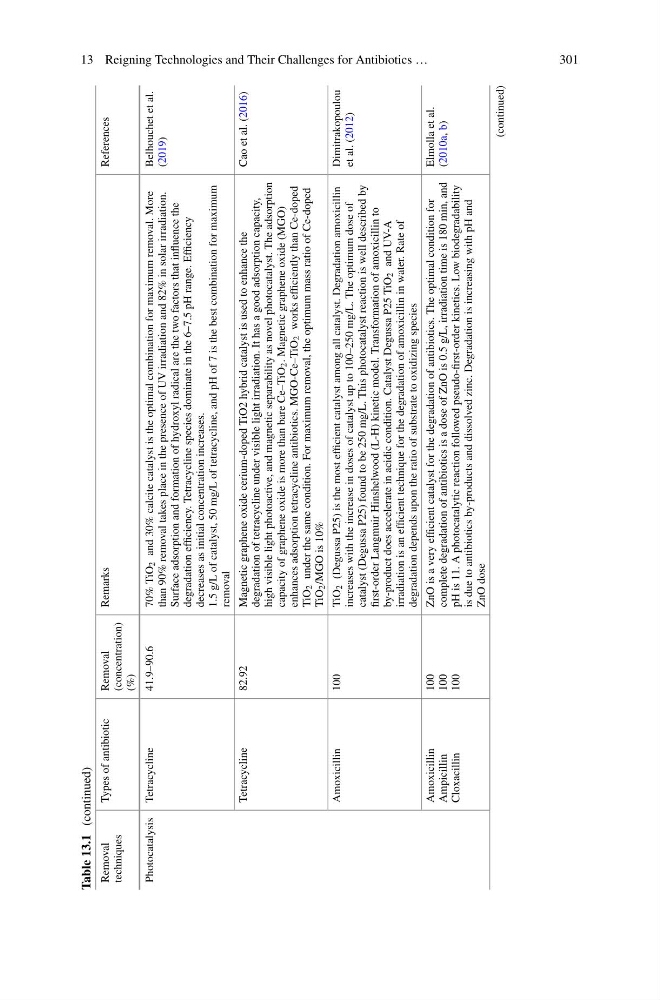
Table 13.1
(continued)
Removal
techniques
Types of antibiotic
Removal
(concentration)
(%)
Remarks
References
Photocatalysis Tetracycline
41.9–90.6
70% TiO
2 and 30% calcite catalyst is the optimal combination for maximum removal. More
than 90% removal takes place in the presence of UV irradiation and 82% in solar irradiation.
Surface adsorption and formation of hydroxyl radical are the two factors that influence the
degradation efficiency. Tetracycline species dominate in the 6–7.5 pH range. Efficiency
decreases as initial concentration increases.
1.5 g/L of catalyst, 50 mg/L of tetracycline, and pH of 7 is the best combination for maximum
removal
Belhouchet et al.
(2019)
Tetracycline
82.92
Magnetic graphene oxide cerium-doped TiO2 hybrid catalyst is used to enhance the
degradation of tetracycline under visible light irradiation. It has a good adsorption capacity,
high visible light photoactive, and magnetic separability as novel photocatalyst. The adsorption
capacity of graphene oxide is more than bare Ce–TiO
2 . Magnetic graphene oxide (MGO)
enhances adsorption tetracycline antibiotics. MGO-Ce–TiO
2 works efficiently than Ce-doped
TiO
2 under the same condition. For maximum removal, the optimum mass ratio of Ce-doped
TiO
2 /MGO is 10%
Cao et al. (2016)
Amoxicillin
100
TiO
2 (Degussa P25) is the most efficient catalyst among all catalyst. Degradation amoxicillin
increases with the increase in doses of catalyst up to 100–250 mg/L. The optimum dose of
catalyst (Degussa P25) found to be 250 mg/L. This photocatalyst reaction is well described by
first-order Langmuir Hinshelwood (L-H) kinetic model. Transformation of amoxicillin to
by-product does accelerate in acidic condition. Catalyst Degussa P25 TiO
2 and UV-A
irradiation is an efficient technique for the degradation of amoxicillin in water. Rate of
degradation depends upon the ratio of substrate to oxidizing species
Dimitrakopoulou
et al. (2012)
Amoxicillin
Ampicillin
Cloxacillin
100
100
100
ZnO is a very efficient catalyst for the degradation of antibiotics. The optimal condition for
complete degradation of antibiotics is a dose of ZnO is 0.5 g/L, irradiation time is 180 min, and
pH is 11. A photocatalytic reaction followed pseudo-first-order kinetics. Low biodegradability
is due to antibiotics by-products and dissolved zinc. Degradation is increasing with pH and
ZnO dose
Elmolla et al.
(2010a, b)
(continued)
301
Table 13.1
(continued)
Removal
techniques
Types of antibiotic
Removal
(concentration)
(%)
Remarks
References
Photocatalysis Tetracycline
41.9–90.6
70% TiO
2 and 30% calcite catalyst is the optimal combination for maximum removal. More
than 90% removal takes place in the presence of UV irradiation and 82% in solar irradiation.
Surface adsorption and formation of hydroxyl radical are the two factors that influence the
degradation efficiency. Tetracycline species dominate in the 6–7.5 pH range. Efficiency
decreases as initial concentration increases.
1.5 g/L of catalyst, 50 mg/L of tetracycline, and pH of 7 is the best combination for maximum
removal
Belhouchet et al.
(2019)
Tetracycline
82.92
Magnetic graphene oxide cerium-doped TiO2 hybrid catalyst is used to enhance the
degradation of tetracycline under visible light irradiation. It has a good adsorption capacity,
high visible light photoactive, and magnetic separability as novel photocatalyst. The adsorption
capacity of graphene oxide is more than bare Ce–TiO
2 . Magnetic graphene oxide (MGO)
enhances adsorption tetracycline antibiotics. MGO-Ce–TiO
2 works efficiently than Ce-doped
TiO
2 under the same condition. For maximum removal, the optimum mass ratio of Ce-doped
TiO
2 /MGO is 10%
Cao et al. (2016)
Amoxicillin
100
TiO
2 (Degussa P25) is the most efficient catalyst among all catalyst. Degradation amoxicillin
increases with the increase in doses of catalyst up to 100–250 mg/L. The optimum dose of
catalyst (Degussa P25) found to be 250 mg/L. This photocatalyst reaction is well described by
first-order Langmuir Hinshelwood (L-H) kinetic model. Transformation of amoxicillin to
by-product does accelerate in acidic condition. Catalyst Degussa P25 TiO
2 and UV-A
irradiation is an efficient technique for the degradation of amoxicillin in water. Rate of
degradation depends upon the ratio of substrate to oxidizing species
Dimitrakopoulou
et al. (2012)
Amoxicillin
Ampicillin
Cloxacillin
100
100
100
ZnO is a very efficient catalyst for the degradation of antibiotics. The optimal condition for
complete degradation of antibiotics is a dose of ZnO is 0.5 g/L, irradiation time is 180 min, and
pH is 11. A photocatalytic reaction followed pseudo-first-order kinetics. Low biodegradability
is due to antibiotics by-products and dissolved zinc. Degradation is increasing with pH and
ZnO dose
Elmolla et al.
(2010a, b)
(continued)