

300
C. Bhagat et al.
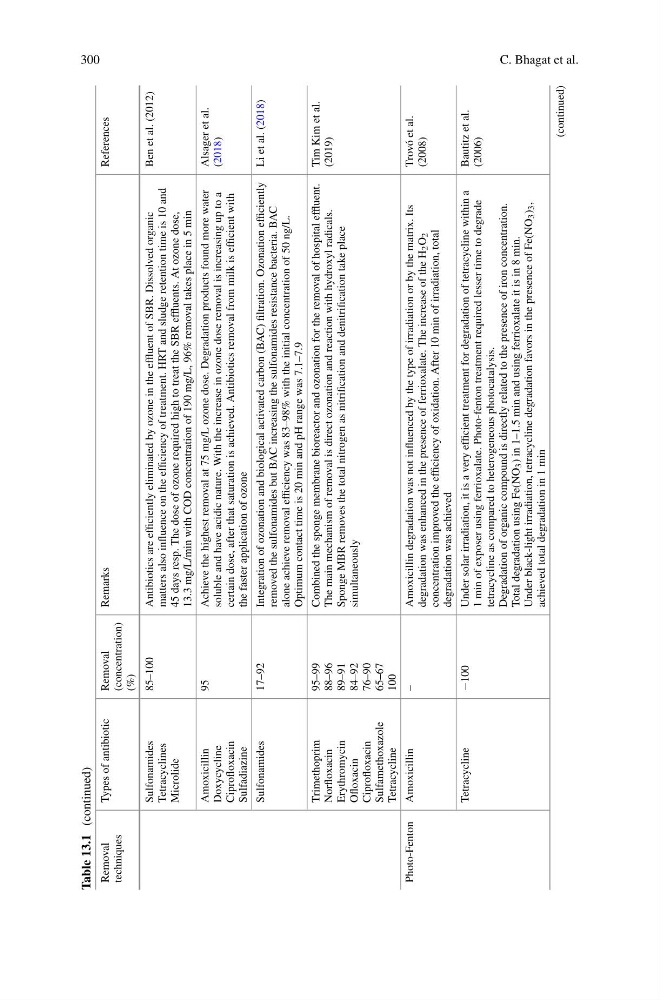
Table 13.1
(continued)
Removal
techniques
Types of antibiotic
Removal
(concentration)
(%)
Remarks
References
Sulfonamides
Tetracyclines
Microlide
85–100
Antibiotics are efficiently eliminated by ozone in the effluent of SBR. Dissolved organic
matters also influence on the efficiency of treatment. HRT and sludge retention time is 10 and
45 days resp. The dose of ozone required high to treat the SBR effluents. At ozone dose,
13.3 mg/L/min with COD concentration of 190 mg/L, 96% removal takes place in 5 min
Ben et al. (2012)
Amoxicillin
Doxycycline
Ciprofloxacin
Sulfadiazine
95
Achieve the highest removal at 75 mg/L ozone dose. Degradation products found more water
soluble and have acidic nature. With the increase in ozone dose removal is increasing up to a
certain dose, after that saturation is achieved. Antibiotics removal from milk is efficient with
the faster application of ozone
Alsager et al.
(2018)
Sulfonamides
17–92
Integration of ozonation and biological activated carbon (BAC) filtration. Ozonation efficiently
removed the sulfonamides but BAC increasing the sulfonamides resistance bacteria. BAC
alone achieve removal efficiency was 83–98% with the initial concentration of 50 ng/L.
Optimum contact time is 20 min and pH range was 7.1–7.9
Li et al. (2018)
Trimethoprim
Norfloxacin
Erythromycin
Ofloxacin
Ciprofloxacin
Sulfamethoxazole
Tetracycline
95–99
88–96
89–91
84–92
76–90
65–67
100
Combined the sponge membrane bioreactor and ozonation for the removal of hospital effluent.
The main mechanism of removal is direct ozonation and reaction with hydroxyl radicals.
Sponge MBR removes the total nitrogen as nitrification and denitrification take place
simultaneously
Tim Kim et al.
(2019)
Photo-Fenton
Amoxicillin
–
Amoxicillin degradation was not influenced by the type of irradiation or by the matrix. Its
degradation was enhanced in the presence of ferrioxalate. The increase of the H
2 O
2
concentration improved the efficiency of oxidation. After 10 min of irradiation, total
degradation was achieved
Trovó et al.
(2008)
Tetracycline
−100
Under solar irradiation, it is a very efficient treatment for degradation of tetracycline within a
1 min of exposer using ferrioxalate. Photo-fenton treatment required lesser time to degrade
tetracycline as compared to heterogeneous photocatalysis.
Degradation of organic compound is directly related to the presence of iron concentration.
Total degradation using Fe(NO
3 ) in 1–1.5 min and using ferrioxalate it is in 8 min.
Under black-light irradiation, tetracycline degradation favors in the presence of Fe(NO
3 )
3 ,
achieved total degradation in 1 min
Bautitz et al.
(2006)
(continued)
C. Bhagat et al.
Table 13.1
(continued)
Removal
techniques
Types of antibiotic
Removal
(concentration)
(%)
Remarks
References
Sulfonamides
Tetracyclines
Microlide
85–100
Antibiotics are efficiently eliminated by ozone in the effluent of SBR. Dissolved organic
matters also influence on the efficiency of treatment. HRT and sludge retention time is 10 and
45 days resp. The dose of ozone required high to treat the SBR effluents. At ozone dose,
13.3 mg/L/min with COD concentration of 190 mg/L, 96% removal takes place in 5 min
Ben et al. (2012)
Amoxicillin
Doxycycline
Ciprofloxacin
Sulfadiazine
95
Achieve the highest removal at 75 mg/L ozone dose. Degradation products found more water
soluble and have acidic nature. With the increase in ozone dose removal is increasing up to a
certain dose, after that saturation is achieved. Antibiotics removal from milk is efficient with
the faster application of ozone
Alsager et al.
(2018)
Sulfonamides
17–92
Integration of ozonation and biological activated carbon (BAC) filtration. Ozonation efficiently
removed the sulfonamides but BAC increasing the sulfonamides resistance bacteria. BAC
alone achieve removal efficiency was 83–98% with the initial concentration of 50 ng/L.
Optimum contact time is 20 min and pH range was 7.1–7.9
Li et al. (2018)
Trimethoprim
Norfloxacin
Erythromycin
Ofloxacin
Ciprofloxacin
Sulfamethoxazole
Tetracycline
95–99
88–96
89–91
84–92
76–90
65–67
100
Combined the sponge membrane bioreactor and ozonation for the removal of hospital effluent.
The main mechanism of removal is direct ozonation and reaction with hydroxyl radicals.
Sponge MBR removes the total nitrogen as nitrification and denitrification take place
simultaneously
Tim Kim et al.
(2019)
Photo-Fenton
Amoxicillin
–
Amoxicillin degradation was not influenced by the type of irradiation or by the matrix. Its
degradation was enhanced in the presence of ferrioxalate. The increase of the H
2 O
2
concentration improved the efficiency of oxidation. After 10 min of irradiation, total
degradation was achieved
Trovó et al.
(2008)
Tetracycline
−100
Under solar irradiation, it is a very efficient treatment for degradation of tetracycline within a
1 min of exposer using ferrioxalate. Photo-fenton treatment required lesser time to degrade
tetracycline as compared to heterogeneous photocatalysis.
Degradation of organic compound is directly related to the presence of iron concentration.
Total degradation using Fe(NO
3 ) in 1–1.5 min and using ferrioxalate it is in 8 min.
Under black-light irradiation, tetracycline degradation favors in the presence of Fe(NO
3 )
3 ,
achieved total degradation in 1 min
Bautitz et al.
(2006)
(continued)