

13 Reigning Technologies and Their Challenges for Antibiotics …
299
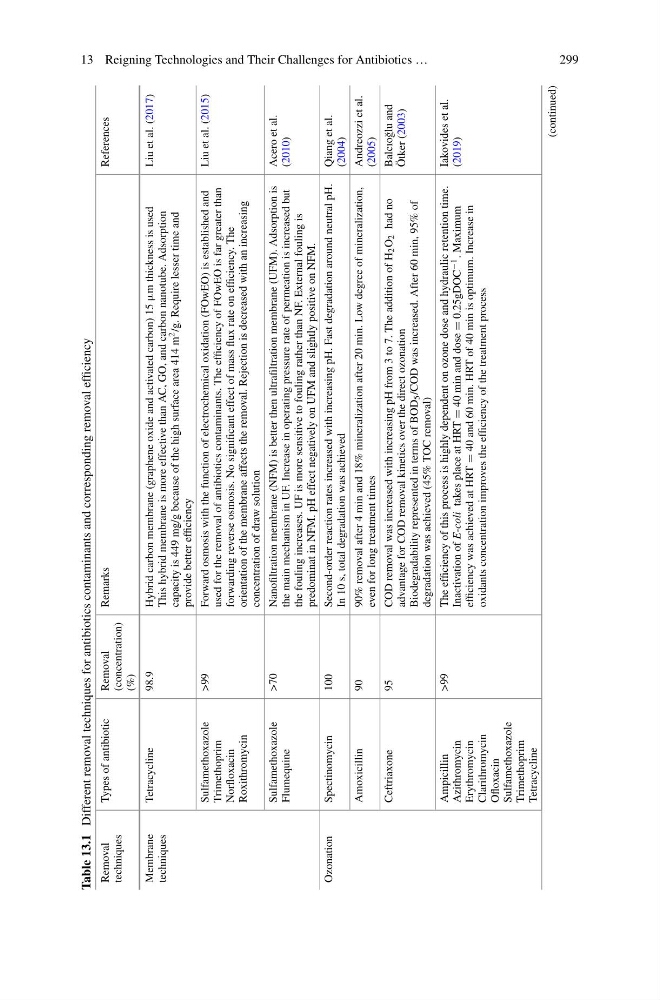
Table 13.1
Different removal techniques for antibiotics contaminants and corresponding removal efficiency
Removal
techniques
Types of antibiotic
Removal
(concentration)
(%)
Remarks
References
Membrane
techniques
Tetracycline
98.9
Hybrid carbon membrane (graphene oxide and activated carbon) 15
μm thickness is used
This hybrid membrane is more effective than AC, GO, and carbon nanotube. Adsorption
capacity is 449 mg/g because of the high surface area 414 m 2
/g. Require lesser time and
provide better efficiency
Liu et al. (2017)
Sulfamethoxazole
Trimethoprim
Norfloxacin
Roxithromycin
>99
Forward osmosis with the function of electrochemical oxidation (FOwEO) is established and
used for the removal of antibiotics contaminants. The efficiency of FOwEO is far greater than
forwarding reverse osmosis. No significant effect of mass flux rate on efficiency. The
orientation of the membrane affects the removal. Rejection is decreased with an increasing
concentration of draw solution
Liu et al. (2015)
Sulfamethoxazole
Flumequine
>70
Nanofiltration membrane (NFM) is better then ultrafiltration membrane (UFM). Adsorption is
the main mechanism in UF. Increase in operating pressure rate of permeation is increased but
the fouling increases. UF is more sensitive to fouling rather than NF. External fouling is
predominat in NFM. pH effect negatively on UFM and slightly positive on NFM.
Acero et al.
(2010)
Ozonation
Spectinomycin
100
Second-order reaction rates increased with increasing pH. Fast degradation around neutral pH.
In 10 s, total degradation was achieved
Qiang et al.
(2004)
Amoxicillin
90
90% removal after 4 min and 18% mineralization after 20 min. Low degree of mineralization,
even for long treatment times
Andreozzi et al.
(2005)
Ceftriaxone
95
COD removal was increased with increasing pH from 3 to 7. The addition of H
2 O
2 had no
advantage for COD removal kinetics over the direct ozonation
Biodegradability represented in terms of BOD
5 /COD was increased. After 60 min, 95% of
degradation was achieved (45% TOC removal)
Balcıo˘ glu and
Ötker (2003)
Ampicillin
Azithromycin
Erythromycin
Clarithromycin
Ofloxacin
Sulfamethoxazole
Trimethoprim
Tetracycline
>99
The efficiency of this process is highly dependent on ozone dose and hydraulic retention time.
Inactivation of E-coli
takes place at HRT
= 40 min and dose
= 0.25gDOC −1
. Maximum
efficiency was achieved at HRT
= 40 and 60 min. HRT of 40 min is optimum. Increase in
oxidants concentration improves the efficiency of the treatment process
Iakovides et al.
(2019)
(continued)
299
Table 13.1
Different removal techniques for antibiotics contaminants and corresponding removal efficiency
Removal
techniques
Types of antibiotic
Removal
(concentration)
(%)
Remarks
References
Membrane
techniques
Tetracycline
98.9
Hybrid carbon membrane (graphene oxide and activated carbon) 15
μm thickness is used
This hybrid membrane is more effective than AC, GO, and carbon nanotube. Adsorption
capacity is 449 mg/g because of the high surface area 414 m 2
/g. Require lesser time and
provide better efficiency
Liu et al. (2017)
Sulfamethoxazole
Trimethoprim
Norfloxacin
Roxithromycin
>99
Forward osmosis with the function of electrochemical oxidation (FOwEO) is established and
used for the removal of antibiotics contaminants. The efficiency of FOwEO is far greater than
forwarding reverse osmosis. No significant effect of mass flux rate on efficiency. The
orientation of the membrane affects the removal. Rejection is decreased with an increasing
concentration of draw solution
Liu et al. (2015)
Sulfamethoxazole
Flumequine
>70
Nanofiltration membrane (NFM) is better then ultrafiltration membrane (UFM). Adsorption is
the main mechanism in UF. Increase in operating pressure rate of permeation is increased but
the fouling increases. UF is more sensitive to fouling rather than NF. External fouling is
predominat in NFM. pH effect negatively on UFM and slightly positive on NFM.
Acero et al.
(2010)
Ozonation
Spectinomycin
100
Second-order reaction rates increased with increasing pH. Fast degradation around neutral pH.
In 10 s, total degradation was achieved
Qiang et al.
(2004)
Amoxicillin
90
90% removal after 4 min and 18% mineralization after 20 min. Low degree of mineralization,
even for long treatment times
Andreozzi et al.
(2005)
Ceftriaxone
95
COD removal was increased with increasing pH from 3 to 7. The addition of H
2 O
2 had no
advantage for COD removal kinetics over the direct ozonation
Biodegradability represented in terms of BOD
5 /COD was increased. After 60 min, 95% of
degradation was achieved (45% TOC removal)
Balcıo˘ glu and
Ötker (2003)
Ampicillin
Azithromycin
Erythromycin
Clarithromycin
Ofloxacin
Sulfamethoxazole
Trimethoprim
Tetracycline
>99
The efficiency of this process is highly dependent on ozone dose and hydraulic retention time.
Inactivation of E-coli
takes place at HRT
= 40 min and dose
= 0.25gDOC −1
. Maximum
efficiency was achieved at HRT
= 40 and 60 min. HRT of 40 min is optimum. Increase in
oxidants concentration improves the efficiency of the treatment process
Iakovides et al.
(2019)
(continued)