

264
T. Sahoo et al.
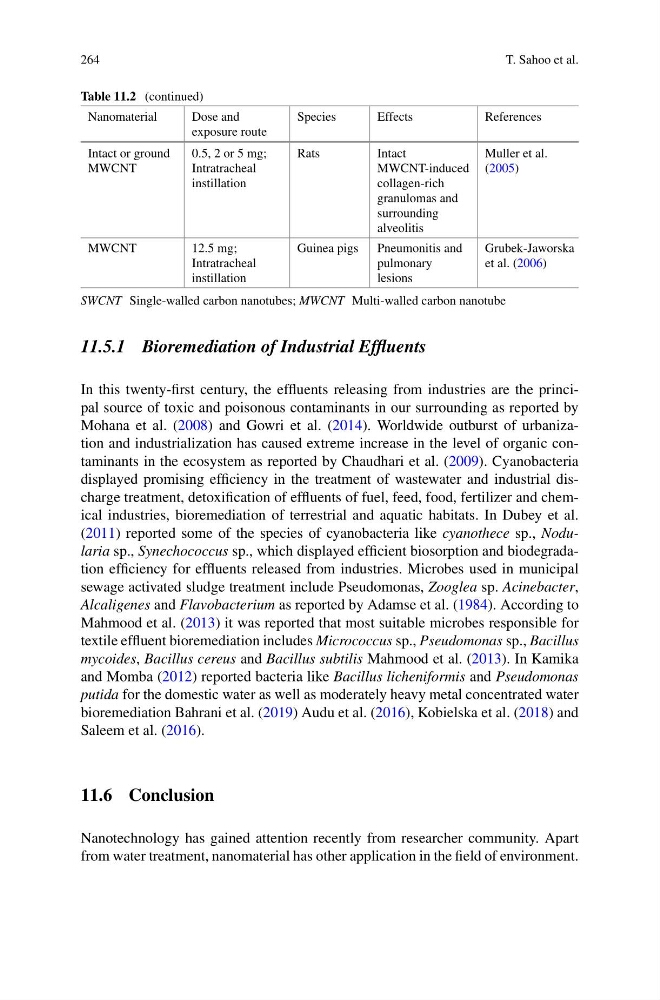
Table 11.2 (continued)
Nanomaterial
Dose and
exposure route
Species
Effects
References
Intact or ground
MWCNT
0.5, 2 or 5 mg;
Intratracheal
instillation
Rats
Intact
MWCNT-induced
collagen-rich
granulomas and
surrounding
alveolitis
Muller et al.
(2005)
MWCNT
12.5 mg;
Intratracheal
instillation
Guinea pigs Pneumonitis and
pulmonary
lesions
Grubek-Jaworska
et al. (2006)
SWCNT Single-walled carbon nanotubes; MWCNT Multi-walled carbon nanotube
11.5.1 Bioremediation of Industrial Effluents
In this twenty-first century, the effluents releasing from industries are the principal source of toxic and poisonous contaminants in our surrounding as reported by
Mohana et al. (2008) and Gowri et al. (2014). Worldwide outburst of urbanization and industrialization has caused extreme increase in the level of organic contaminants in the ecosystem as reported by Chaudhari et al. (2009). Cyanobacteria
displayed promising efficiency in the treatment of wastewater and industrial discharge treatment, detoxification of effluents of fuel, feed, food, fertilizer and chemical industries, bioremediation of terrestrial and aquatic habitats. In Dubey et al.
(2011) reported some of the species of cyanobacteria like cyanothece sp., Nodularia sp., Synechococcus sp., which displayed efficient biosorption and biodegradation efficiency for effluents released from industries. Microbes used in municipal
sewage activated sludge treatment include Pseudomonas, Zooglea sp. Acinebacter,
Alcaligenes and Flavobacterium as reported by Adamse et al. (1984). According to
Mahmood et al. (2013) it was reported that most suitable microbes responsible for
textile effluent bioremediation includes Micrococcus sp., Pseudomonas sp., Bacillus
mycoides, Bacillus cereus and Bacillus subtilis Mahmood et al. (2013). In Kamika
and Momba (2012) reported bacteria like Bacillus licheniformis and Pseudomonas
putida for the domestic water as well as moderately heavy metal concentrated water
bioremediation Bahrani et al. (2019) Audu et al. (2016), Kobielska et al. (2018) and
Saleem et al. (2016).
11.6 Conclusion
Nanotechnology has gained attention recently from researcher community. Apart
from water treatment, nanomaterial has other application in the field of environment.
T. Sahoo et al.
Table 11.2 (continued)
Nanomaterial
Dose and
exposure route
Species
Effects
References
Intact or ground
MWCNT
0.5, 2 or 5 mg;
Intratracheal
instillation
Rats
Intact
MWCNT-induced
collagen-rich
granulomas and
surrounding
alveolitis
Muller et al.
(2005)
MWCNT
12.5 mg;
Intratracheal
instillation
Guinea pigs Pneumonitis and
pulmonary
lesions
Grubek-Jaworska
et al. (2006)
SWCNT Single-walled carbon nanotubes; MWCNT Multi-walled carbon nanotube
11.5.1 Bioremediation of Industrial Effluents
In this twenty-first century, the effluents releasing from industries are the principal source of toxic and poisonous contaminants in our surrounding as reported by
Mohana et al. (2008) and Gowri et al. (2014). Worldwide outburst of urbanization and industrialization has caused extreme increase in the level of organic contaminants in the ecosystem as reported by Chaudhari et al. (2009). Cyanobacteria
displayed promising efficiency in the treatment of wastewater and industrial discharge treatment, detoxification of effluents of fuel, feed, food, fertilizer and chemical industries, bioremediation of terrestrial and aquatic habitats. In Dubey et al.
(2011) reported some of the species of cyanobacteria like cyanothece sp., Nodularia sp., Synechococcus sp., which displayed efficient biosorption and biodegradation efficiency for effluents released from industries. Microbes used in municipal
sewage activated sludge treatment include Pseudomonas, Zooglea sp. Acinebacter,
Alcaligenes and Flavobacterium as reported by Adamse et al. (1984). According to
Mahmood et al. (2013) it was reported that most suitable microbes responsible for
textile effluent bioremediation includes Micrococcus sp., Pseudomonas sp., Bacillus
mycoides, Bacillus cereus and Bacillus subtilis Mahmood et al. (2013). In Kamika
and Momba (2012) reported bacteria like Bacillus licheniformis and Pseudomonas
putida for the domestic water as well as moderately heavy metal concentrated water
bioremediation Bahrani et al. (2019) Audu et al. (2016), Kobielska et al. (2018) and
Saleem et al. (2016).
11.6 Conclusion
Nanotechnology has gained attention recently from researcher community. Apart
from water treatment, nanomaterial has other application in the field of environment.