

11 Nanotechnology: An Efficient Technique of Contaminated …
263
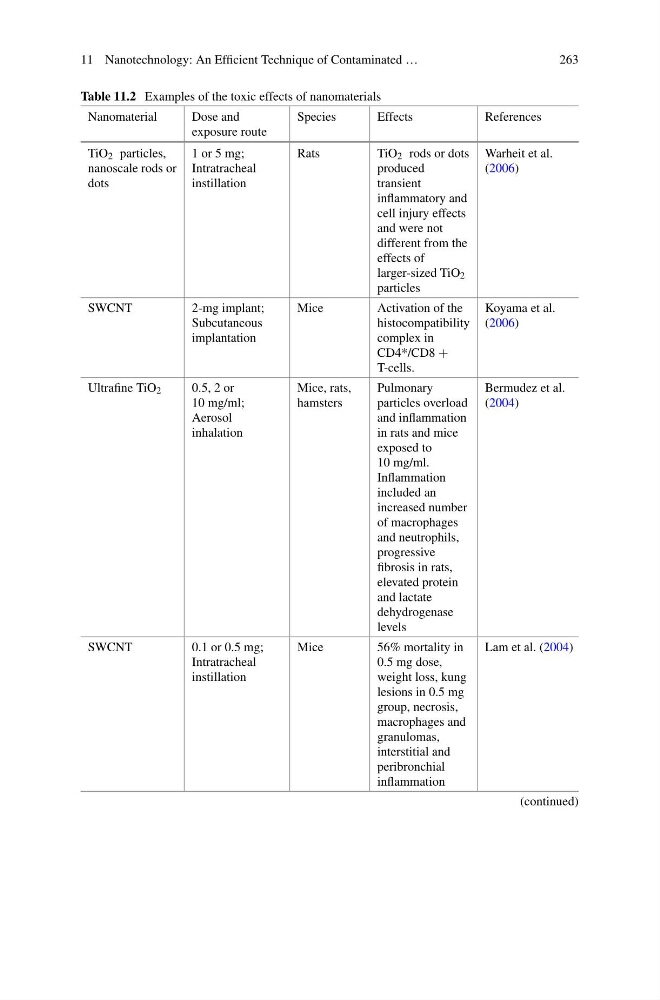
Table 11.2 Examples of the toxic effects of nanomaterials
Nanomaterial
Dose and
exposure route
Species
Effects
References
TiO 2 particles,
nanoscale rods or
dots
1 or 5 mg;
Intratracheal
instillation
Rats
TiO 2 rods or dots
produced
transient
inflammatory and
cell injury effects
and were not
different from the
effects of
larger-sized TiO 2
particles
Warheit et al.
(2006)
SWCNT
2-mg implant;
Subcutaneous
implantation
Mice
Activation of the
histocompatibility
complex in
CD4*/CD8 +
T-cells.
Koyama et al.
(2006)
Ultrafine TiO 2
0.5, 2 or
10 mg/ml;
Aerosol
inhalation
Mice, rats,
hamsters
Pulmonary
particles overload
and inflammation
in rats and mice
exposed to
10 mg/ml.
Inflammation
included an
increased number
of macrophages
and neutrophils,
progressive
fibrosis in rats,
elevated protein
and lactate
dehydrogenase
levels
Bermudez et al.
(2004)
SWCNT
0.1 or 0.5 mg;
Intratracheal
instillation
Mice
56% mortality in
0.5 mg dose,
weight loss, kung
lesions in 0.5 mg
group, necrosis,
macrophages and
granulomas,
interstitial and
peribronchial
inflammation
Lam et al. (2004)
(continued)
263
Table 11.2 Examples of the toxic effects of nanomaterials
Nanomaterial
Dose and
exposure route
Species
Effects
References
TiO 2 particles,
nanoscale rods or
dots
1 or 5 mg;
Intratracheal
instillation
Rats
TiO 2 rods or dots
produced
transient
inflammatory and
cell injury effects
and were not
different from the
effects of
larger-sized TiO 2
particles
Warheit et al.
(2006)
SWCNT
2-mg implant;
Subcutaneous
implantation
Mice
Activation of the
histocompatibility
complex in
CD4*/CD8 +
T-cells.
Koyama et al.
(2006)
Ultrafine TiO 2
0.5, 2 or
10 mg/ml;
Aerosol
inhalation
Mice, rats,
hamsters
Pulmonary
particles overload
and inflammation
in rats and mice
exposed to
10 mg/ml.
Inflammation
included an
increased number
of macrophages
and neutrophils,
progressive
fibrosis in rats,
elevated protein
and lactate
dehydrogenase
levels
Bermudez et al.
(2004)
SWCNT
0.1 or 0.5 mg;
Intratracheal
instillation
Mice
56% mortality in
0.5 mg dose,
weight loss, kung
lesions in 0.5 mg
group, necrosis,
macrophages and
granulomas,
interstitial and
peribronchial
inflammation
Lam et al. (2004)
(continued)