

4 Impact and Fate of Microplastics in the Riverine …
101
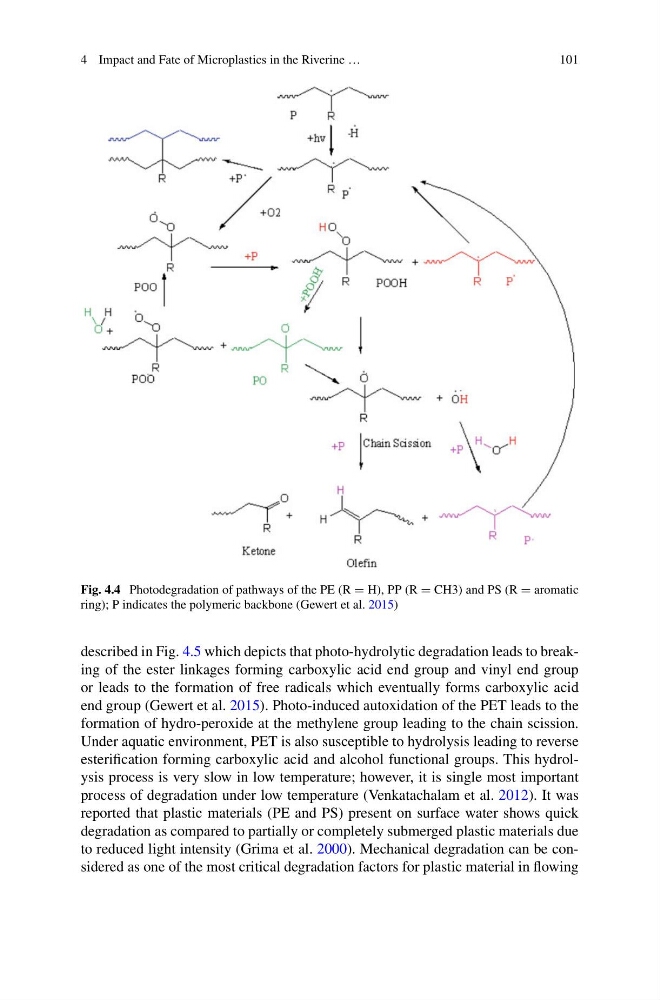
Fig. 4.4 Photodegradation of pathways of the PE (R = H), PP (R = CH3) and PS (R = aromatic
ring); P indicates the polymeric backbone (Gewert et al. 2015)
described in Fig. 4.5 which depicts that photo-hydrolytic degradation leads to breaking of the ester linkages forming carboxylic acid end group and vinyl end group
or leads to the formation of free radicals which eventually forms carboxylic acid
end group (Gewert et al. 2015). Photo-induced autoxidation of the PET leads to the
formation of hydro-peroxide at the methylene group leading to the chain scission.
Under aquatic environment, PET is also susceptible to hydrolysis leading to reverse
esterification forming carboxylic acid and alcohol functional groups. This hydrolysis process is very slow in low temperature; however, it is single most important
process of degradation under low temperature (Venkatachalam et al. 2012). It was
reported that plastic materials (PE and PS) present on surface water shows quick
degradation as compared to partially or completely submerged plastic materials due
to reduced light intensity (Grima et al. 2000). Mechanical degradation can be considered as one of the most critical degradation factors for plastic material in flowing
101
Fig. 4.4 Photodegradation of pathways of the PE (R = H), PP (R = CH3) and PS (R = aromatic
ring); P indicates the polymeric backbone (Gewert et al. 2015)
described in Fig. 4.5 which depicts that photo-hydrolytic degradation leads to breaking of the ester linkages forming carboxylic acid end group and vinyl end group
or leads to the formation of free radicals which eventually forms carboxylic acid
end group (Gewert et al. 2015). Photo-induced autoxidation of the PET leads to the
formation of hydro-peroxide at the methylene group leading to the chain scission.
Under aquatic environment, PET is also susceptible to hydrolysis leading to reverse
esterification forming carboxylic acid and alcohol functional groups. This hydrolysis process is very slow in low temperature; however, it is single most important
process of degradation under low temperature (Venkatachalam et al. 2012). It was
reported that plastic materials (PE and PS) present on surface water shows quick
degradation as compared to partially or completely submerged plastic materials due
to reduced light intensity (Grima et al. 2000). Mechanical degradation can be considered as one of the most critical degradation factors for plastic material in flowing