

102
D. J. Sarkar et al.
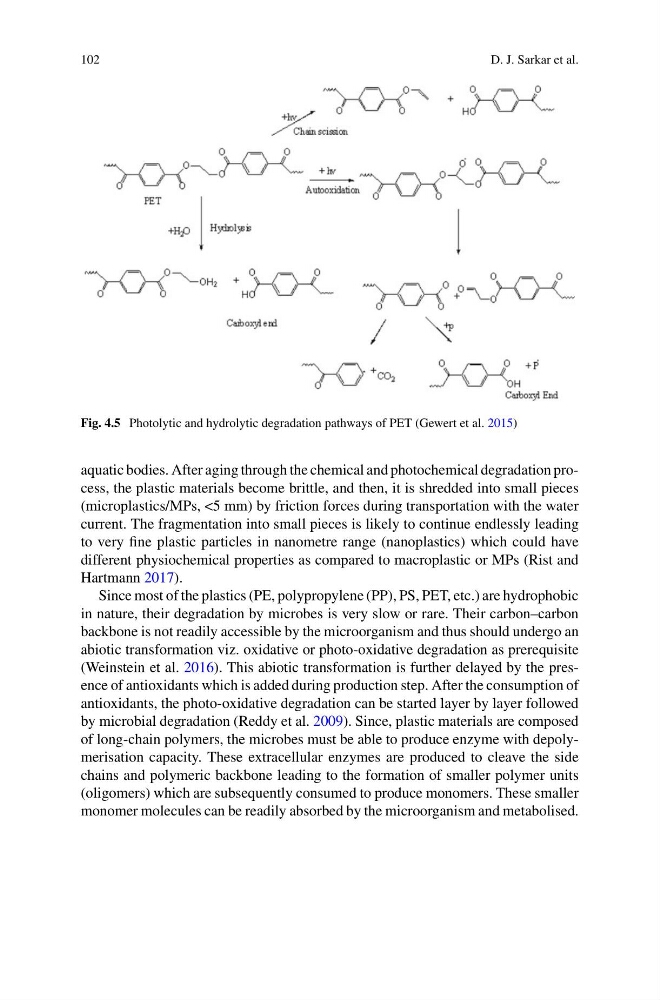
Fig. 4.5 Photolytic and hydrolytic degradation pathways of PET (Gewert et al. 2015)
aquatic bodies. After aging through the chemical and photochemical degradation process, the plastic materials become brittle, and then, it is shredded into small pieces
(microplastics/MPs, <5 mm) by friction forces during transportation with the water
current. The fragmentation into small pieces is likely to continue endlessly leading
to very fine plastic particles in nanometre range (nanoplastics) which could have
different physiochemical properties as compared to macroplastic or MPs (Rist and
Hartmann 2017).
Since most of the plastics (PE, polypropylene (PP), PS, PET, etc.) are hydrophobic
in nature, their degradation by microbes is very slow or rare. Their carbon–carbon
backbone is not readily accessible by the microorganism and thus should undergo an
abiotic transformation viz. oxidative or photo-oxidative degradation as prerequisite
(Weinstein et al. 2016). This abiotic transformation is further delayed by the presence of antioxidants which is added during production step. After the consumption of
antioxidants, the photo-oxidative degradation can be started layer by layer followed
by microbial degradation (Reddy et al. 2009). Since, plastic materials are composed
of long-chain polymers, the microbes must be able to produce enzyme with depolymerisation capacity. These extracellular enzymes are produced to cleave the side
chains and polymeric backbone leading to the formation of smaller polymer units
(oligomers) which are subsequently consumed to produce monomers. These smaller
monomer molecules can be readily absorbed by the microorganism and metabolised.
D. J. Sarkar et al.
Fig. 4.5 Photolytic and hydrolytic degradation pathways of PET (Gewert et al. 2015)
aquatic bodies. After aging through the chemical and photochemical degradation process, the plastic materials become brittle, and then, it is shredded into small pieces
(microplastics/MPs, <5 mm) by friction forces during transportation with the water
current. The fragmentation into small pieces is likely to continue endlessly leading
to very fine plastic particles in nanometre range (nanoplastics) which could have
different physiochemical properties as compared to macroplastic or MPs (Rist and
Hartmann 2017).
Since most of the plastics (PE, polypropylene (PP), PS, PET, etc.) are hydrophobic
in nature, their degradation by microbes is very slow or rare. Their carbon–carbon
backbone is not readily accessible by the microorganism and thus should undergo an
abiotic transformation viz. oxidative or photo-oxidative degradation as prerequisite
(Weinstein et al. 2016). This abiotic transformation is further delayed by the presence of antioxidants which is added during production step. After the consumption of
antioxidants, the photo-oxidative degradation can be started layer by layer followed
by microbial degradation (Reddy et al. 2009). Since, plastic materials are composed
of long-chain polymers, the microbes must be able to produce enzyme with depolymerisation capacity. These extracellular enzymes are produced to cleave the side
chains and polymeric backbone leading to the formation of smaller polymer units
(oligomers) which are subsequently consumed to produce monomers. These smaller
monomer molecules can be readily absorbed by the microorganism and metabolised.